Loading...
Listen To The Bible! | Psalms | King James Audio Bible KJV | Love Of Jesus Christ Revealed

Listen To The Bible! | Psalm 14 | King James Audio Bible KJV | Denunciation Of Godlessness | The Fool Hath Said In His Heart There Is No God | Prayer With Jesus | Revolution In Christian Prayer | True Faith In God | Arise, Lord

Psalm 14 | King James Audio Bible | KJV | Oliver Peers | Word Aloud | King James Version

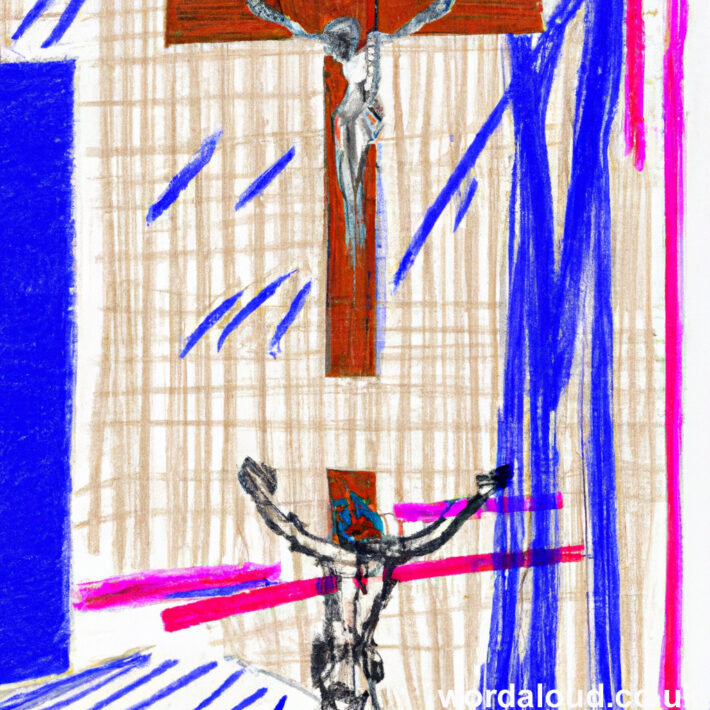
Christian Art | Prayer With Jesus | Psalms | The Fool Hath Said In His Heart There Is No God

Psalm 14 | King James Audio Bible

YouTube: Psalm 14 | KJV | King James Audio Bible | Word Aloud

Psalm 14 explores the clash between faith and disbelief, wisdom and folly.

At the start, the psalmist introduces the fool, one who denies God’s existence. This stance shapes the fool’s actions, leading to corruption.

The psalm shifts as the Lord observes humanity from the heavens, seeking those who understand and seek God.

The psalmist reveals that everyone goes astray, becoming tarnished by actions. No one is righteous.

The psalmist questions the lack of knowledge among those who harm God’s people but don’t seek the Lord.

Fear spreads among the wicked as they realize God stands with the righteous.

The psalmist highlights the shame inflicted on the counsel of the poor, emphasizing the Lord’s role as their refuge.

The psalm yearns for Israel’s salvation from the current plight in absence of Zion, envisioning rejoicing when God restores His people.

Psalm 14 contrasts denial of God’s existence with seeking divine understanding. It is an invitation to ponder the interplay between beliefs and quest for spiritual connection.

Psalm 14 | King James Audio Bible | KJV | Oliver Peers | Word Aloud | King James Version

Jesus Is Lord | Psalms | King James Audio Bible

Psalm 13 | King James Audio Bible | Love Revealed By Jesus

The fool hath said in his heart, There is no God. They are corrupt, they have done abominable works, there is none that doeth good.

The Lord looked down from heaven upon the children of men, to see if there were any that did understand, and seek God.

They are all gone aside, they are all together become filthy: there is none that doeth good, no, not one.

Have all the workers of iniquity no knowledge? who eat up my people as they eat bread, and call not upon the Lord.

There were they in great fear: for God is in the generation of the righteous.

Ye have shamed the counsel of the poor, because the Lord is his refuge.

Oh that the salvation of Israel were come out of Zion! When the Lord bringeth back the captivity of his people, Jacob shall rejoice, and Israel shall be glad.

Psalm 14 | King James Audio Bible | KJV | Oliver Peers | Word Aloud | King James Version

Jesus Is Lord | Psalms | King James Audio Bible

Key Themes Of The Psalm For Reflection | Love Revealed By Jesus Christ

  • Foolish Denial: The psalm examines the foolish denial of God’s existence by some, leading to corrupt actions.
  • Search for Understanding: The Lord’s observation of humanity from above highlights the search for understanding and connection with God.
  • Universal Straying: The psalm reveals the universal inclination of people to stray from righteous paths.
  • Lack of Knowledge: The lack of knowledge among those who harm others and disregard seeking the Lord is questioned.
  • Fear of Divine Presence: Fear among the wicked arises as they realize God stands with the righteous.
  • Shame and Refuge: The psalm underscores shame inflicted upon the poor and the Lord’s role as their refuge.
  • Yearning for Salvation: The psalm expresses a yearning for Israel’s salvation and a vision of rejoicing upon restoration.
  • Belief and Connection: Psalm 14 contrasts disbelief with seeking understanding and spiritual connection. It’s an exploration of human beliefs and their impact on behaviour and faith.

Psalm 14 | King James Audio Bible | KJV | Oliver Peers | Word Aloud | King James Version

Jesus Is Lord | Psalms | King James Audio Bible

Meditations On The Love Of Jesus Christ | Word Aloud | Prayer And Reflection
  • Ash Wednesday | T.S. Eliot | Christian Poetry | Faith In Jesus Christ | Transformation | Healing | Redemption | Audio | Word Aloud

     YouTube: Ash Wednesday | T.S. Eliot | Audio Christian Poetry | Word Aloud Ash Wednesday, one of T.S. Eliot’s most profound and enigmatic poems, marks a significant transition in his life and work. Written in 1930, it is the first long poem Eliot composed after his conversion to Anglicanism in 1927. The poem, often considered one of Eliot’s masterpieces, delves into themes of faith, redemption, and spiritual struggle. It reflects the poet’s personal journey towards spiritual enlightenment and serves as a testament to his newfound religious beliefs. A reading of Ash Wednesday is an exploration of the poem’s religious, literary, and personal contexts, as of the poem’s complex structure and themes. Religious Context And Symbolism Ash Wednesday is deeply embedded in Christian symbolism and tradition. The title refers to the first day of Lent in the Christian liturgical calendar, a day marked by penance, fasting, and prayer. Ash Wednesday is a time for reflection on mortality and repentance, themes that are intricately woven throughout the poem. Eliot’s conversion to Anglicanism profoundly influenced his writing; ‘Ash Wednesday’ is an expression of spiritual awakening and quest for redemption. The poem is replete with religious imagery and references, drawing on Christian doctrine and scripture. The use of liturgical language, biblical allusions, and references to saints and spiritual figures creates a tapestry of faith that invites readers to contemplate deep spiritual truths with which Eliot is grappling. The repetitive and prayer-like quality of the verses echoes meditative practices of the faithful, in part enabling the contemplative nature of the poem. Literary Influences And Techniques T.S. Eliot was a master of literary allusion and technique, and Ash Wednesday expresses Eliot’s ability to blend various influences into a cohesive whole. The poem reflects the influence of Dante, particularly The Divine Comedy, which Eliot admired for its exploration of spiritual ascent and redemption. Dante’s journey through Hell, Purgatory and Heaven parallels Eliot’s own spiritual journey, and the structure of Ash Wednesday can be seen as a reflection of this pilgrimage. Eliot’s use of fragmented narrative, a hallmark of his earlier work such as The Waste Land, is also present in Ash Wednesday. However, in this poem, the fragmentation serves a different purpose. Instead of depicting the disintegration of modern society, it mirrors the fragmented and often painful process of spiritual rebirth. The disjointed structure reflects the internal struggle of the speaker, who is torn between the pull of worldly desires and the aspiration for divine grace. The poem’s language is rich and varied, combining the lyrical and the obscure, the personal and the universal. Eliot employs a range of poetic forms and devices, including free verse, rhyme and meter, to convey the tumultuous journey of faith. The shifting tone and style reflect the complexities and contradictions inherent in the spiritual quest, capturing moments of doubt, despair, hope, and transcendence. Personal Significance Ash Wednesday is a deeply personal work. Eliot’s conversion to Anglicanism marked a profound shift in his life, providing a sense of purpose and direction that had been missing. The poem can be read as a reflection of Eliot’s own struggles with faith and his efforts to reconcile his intellectual skepticism with his desire for spiritual certainty. Eliot’s personal experiences, including his troubled marriage and professional pressures, also inform the poem. Themes of renunciation and acceptance, sin and redemption, are not merely abstract concepts but lived realities for the poet. This personal dimension adds a layer of intimacy and urgency to the poem, which thereby resonates with readers who have faced their own spiritual crises. Thematic Exploration At its core, Ash Wednesday is a meditation on the possibility of spiritual renewal in a world that often seems devoid of meaning. The poem grapples with the tension between faith and doubt, reflecting the existential struggles of modernity. The poem acknowledges the difficulties of maintaining belief in an age of skepticism but ultimately affirms the possibility of redemption and grace. The central theme of renunciation is explored through imagery of ascension and purification. The speaker’s journey is marked by a series of renunciations, symbolizing the shedding of earthly attachments in pursuit of spiritual truth. This process is neither straightforward nor easy; it involves moments of intense struggle and introspection. Yet, through this arduous journey, the speaker moves closer to a state of spiritual clarity and acceptance. Ash Wednesday | T. S. Eliot Because I do not hope to turn again Because I do not hope Because I do not hope to turn Desiring this man’s gift and that man’s scope I no longer strive to strive towards such things (Why should the agèd eagle stretch its wings?) Why should I mourn The vanished power of the usual reign? Because I do not hope to know The infirm glory of the positive hour Because I do not think Because I know I shall not know The one veritable transitory power Because I cannot drink There, where trees flower, and springs flow, for there is nothing again Because I know that time is always time And place is always and only place And what is actual is actual only for one time And only for one place I rejoice that things are as they are and I renounce the blessèd face And renounce the voice Because I cannot hope to turn again Consequently I rejoice, having to construct something Upon which to rejoice And pray to God to have mercy upon us And pray that I may forget These matters that with myself I too much discuss Too much explain Because I do not hope to turn again Let these words answer For what is done, not to be done again May the judgement not be too heavy upon us Because these wings are no longer wings to fly But merely vans to beat the air The air which is now thoroughly small and dry Smaller and dryer than the will Teach us to care and not to care Teach us to sit still. Pray for us sinners now […]

  • George Herbert | The Temple | The Church | Sighs And Grones | Christian Poems

    The poem offers Herbert’s desperate plea for divine mercy, structured as a series of direct appeals to God. The repeated cries of ‘O do not’ introduce a layered exploration of sin, justice, and grace, where Herbert acknowledges personal failure while seeking deliverance [ … ]

  • Psalm 112 KJV King James Audio Bible | Word Aloud | Oliver Peers | King David

    Psalm 112 centralizes the concept of the righteous life. The psalm praises those who fear the Lord and delight in his commandments. This fear is not about being afraid, but about respecting and revering God, and finding joy in following his teachings. This respect for divine commandments sets the stage for a life guided by ethical and moral values [ … ]

Search Google Here | A Holy Land Jerusalem Pilgrimage? | A Safari? | An Escape..