
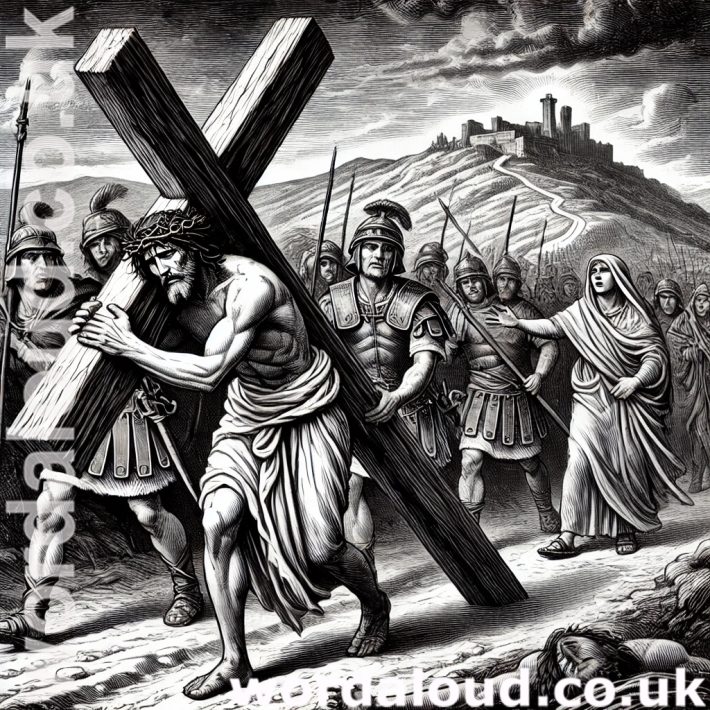
Christian Art | Jesus Carries His Cross | Via Dolorosa
Office Of Readings | Week 20, Wednesday, Ordinary Time | A Reading From The Sermons Of Saint Augustine | He Who Perseveres To The End Will Be Saved
‘He who perseveres to the end will be saved.’
Saint Augustine’s sermon addresses a recurring human tendency: the belief that former times were better than the present. His reflection places suffering within the broader theological framework of punishment for sin and correction for salvation. Affliction is not simply random misfortune but part of the divine pedagogy by which believers are purified and trained in perseverance.
The bishop begins by emphasising the realism of Scripture. The Gospel does not promise peace or ease but explicitly prepares believers for trials, culminating in the assurance that ‘he who perseveres to the end will be saved’ (Mt 24:13). Augustine contrasts this with misplaced nostalgia, the lament that past generations had easier lives. Against this, he offers a stark reminder: from Adam onwards, human life has been marked by toil, suffering, and death.
By invoking Genesis 3:17–19, Augustine roots present afflictions in the primordial curse pronounced upon humanity after the Fall: labour, hardship, and mortality. He then recalls biblical history—the Flood, famine, and wars—to demonstrate that earlier generations endured calamities no less, and often far greater, than those of his own day. Complaints about the present, therefore, betray both forgetfulness of Scripture and ingratitude for God’s mercy.
Augustine’s perspective is shaped by his doctrine of providence. The Christian, freed by Christ from the eternal consequences of Adam’s sin, must interpret temporal trials as occasions for growth in patience and faith. Affliction becomes a form of correction—a training in endurance—rather than merely punitive. Complaining against God, he warns, risks repeating the error of Israel in the wilderness, where murmuring led to destruction (cf. 1 Cor 10:10).
The sermon underscores the virtue of gratitude. By contrasting the hardships of earlier ages with those of the present, Augustine aims not to deny the reality of suffering but to reframe it. Each generation must see its trials in continuity with the long history of human struggle, but also in the light of Christ’s redemption. What distinguishes the Christian’s lot from that of Adam is not the absence of toil, but the presence of hope. Affliction no longer has the final word, for perseverance in faith leads to salvation.

A Reading From The Sermons Of Saint Augustine | He Who Perseveres To The End Will Be Saved
Whenever we suffer some affliction, we should regard it both as a punishment and as a correction. Our holy Scriptures themselves do not promise us peace, security and rest. On the contrary, the Gospel makes no secret of the troubles and temptations that await us, but it also says that he who perseveres to the end will be saved. What good has there ever been in this life since the time when the first man received the just sentence of death and the curse from which Christ our Lord has delivered us?
So we must not grumble, my brothers, for as the Apostle says: Some of them murmured and were destroyed by serpents. Is there any affliction now endured by mankind that was not endured by our fathers before us? What sufferings of ours even bear comparison with what we know of their sufferings? And yet you hear people complaining about this present day and age because things were so much better in former times. I wonder what would happen if they could be taken back to the days of their ancestors – would we not still hear them complaining? You may think past ages were good, but it is only because you are not living in them.
It amazes me that you who have now been freed from the curse, who have believed in the Son of God, who have been instructed in the holy Scriptures – that you can think the days of Adam were good. And your ancestors bore the curse of Adam, of that Adam to whom the words were addressed: With sweat on your brow you shall eat your bread; you shall till the earth from which you were taken, and it will yield you thorns and thistles. This is what he deserved and what he had to suffer; this is the punishment meted out to him by the just judgment of God. How then can you think that the past ages were better than your own? From the time of that first Adam to the time of his descendants today, man’s lot has been labor and sweat, thorns and thistles. Have we forgotten the flood and the calamitous times of famine and war whose history has been recorded precisely in order to keep us from complaining to God on account of our own times? Just think what those past ages were like! Is there one of us who does not shudder to hear or read of them? Far from the justifying complaints about our own time, they teach us how much we have to be thankful for.
Christian Prayer With Jesus
Lord of all ages,
you guide your people through trial and affliction
and call us to persevere in faith until the end.
Forgive us when we murmur against your providence
and strengthen us with the hope of salvation in Christ.
Grant that, mindful of those who have gone before us,
we may face our own time with courage,
endure hardship with patience,
and give thanks always for your mercy.
Through Christ our Lord.
Amen.
Glossary Of Christian Terms
Affliction: Hardship, suffering, or trial; in Augustine’s teaching, both a punishment for sin and a means of correction.
Correction: Divine discipline by which God trains believers in patience, virtue, and perseverance.
Perseverance: Remaining steadfast in faith and obedience to God despite trials; a central Christian virtue.
Murmuring: Complaining against God, often referring to Israel’s grumbling during the Exodus (cf. Ex 16–17; Num 14).
The Curse of Adam: The consequences of the Fall (Gen 3:17–19), including toil, suffering, and death, which mark human existence.
Providence: God’s wise governance of creation, ensuring that even suffering serves his purpose for salvation.
Nostalgia for past ages: The belief that earlier times were better; Augustine challenges this as forgetfulness of Scripture and history.
Persevere to the end: A phrase from Matthew 24:13, meaning to remain faithful to Christ until death, which leads to salvation.




Jesus teaches us to know the effectiveness of prayer through what might seem an unusual comparison, or parable. The suggestion is that a person asking his friend for bread will be given that bread not because of friendship, but because of his insistence and persistency in knocking and asking for the bread. This might seem to us an unusual way of considering God’s response to our prayers [ … ]

In this homily, Saint John Chrysostom reflects on the Apostle Paul’s words to the Corinthian church: ‘Our mouth is open to you, Corinthians; our heart is enlarged.’ (2 Corinthians 6:11) Chrysostom, known for his deep pastoral insight and command of Scripture, explores how love works to expand the heart, just as heat causes material things to expand. He sees in Paul not only a preacher of doctrine but a man whose heart was capacious—so full of love that it embraced both the faithful and the unbelieving [ … ]

The Jewish authorities have begun to take note of Jesus. While Jesus has attracted the people, now ‘the Jews’, a term which in John’s Gospel is often used to refer to the Jewish authorities, are beginning to murmur against him. Jesus’ relationship with the Jews is to become increasingly tense [ … ]