
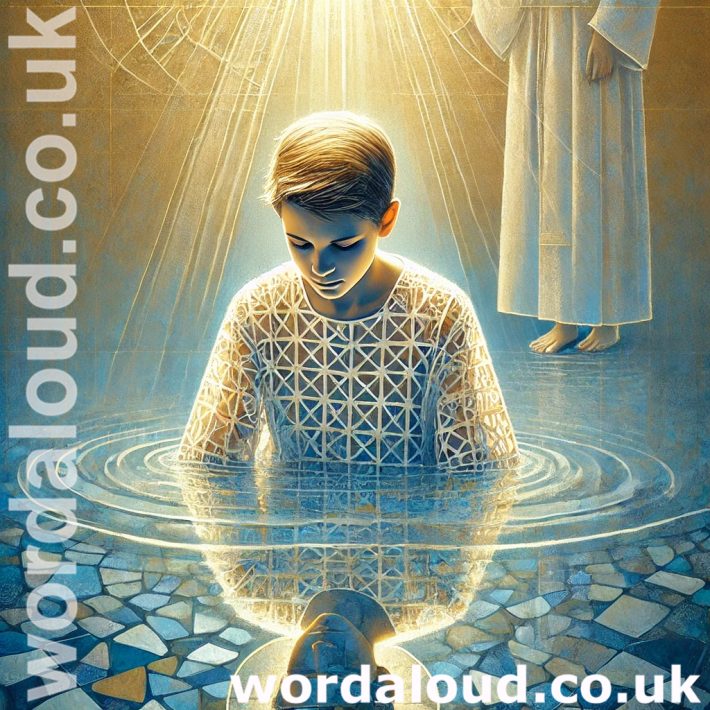
Christian Art | Mystery Of Baptism | The Newly Baptized
Office Of Readings | Week 15, Wednesday, Ordinary Time | A Reading From The Treatise Of Saint Ambrose On The Mysteries | Water Does Not Sanctify Without The Holy Spirit
‘Everything that happened to them was a figure.’
‘Water Does Not Sanctify Without The Holy Spirit’ | Patristic And Theological Reflection
Saint Ambrose writes at a time when the Church was still catechising adults over a prolonged period before admitting them to baptism, typically at the Easter Vigil. These catechumens underwent a spiritual and moral formation, echoing Israel’s long preparation for the Promised Land. In Milan, the Lenten season was filled with scriptural instruction, exorcisms, and the rites of scrutiny to prepare them for rebirth through water and the Spirit.
Ambrose addresses his newly baptized flock during the octave of Easter, guiding them through what the early Church called ‘mystagogical catechesis’ — a post-baptismal reflection on what they had undergone. His insistence that the mystery cannot be fully grasped through outward appearances alone reflects the early Church’s reverence for the sacramental mysteries, which were kept from the uninitiated and revealed only once one had entered into the life of grace.
Scriptural Foundations | The Word, The Water, And The Spirit
Saint Ambrose frequently reminds his audience that what appears ordinary to the senses becomes extraordinary through divine presence. He draws on 1 John 5:8, which speaks of the three witnesses — the Spirit, the water, and the blood — to argue that each is essential to baptism. If any one element is removed, the sacrament is not whole. The water without the Spirit is merely natural; the Spirit without Christ’s blood — poured out on the cross — is not Christian baptism.
His reference to John 3:5 (‘Unless a man be born of water and the Spirit… ‘) is crucial. Jesus Christ’s own words establish the dual agency of baptism: it is not merely symbolic washing, but a supernatural rebirth. Ambrose’s catechetical teaching firmly opposes any reductionist or merely moral interpretation of the sacrament.
Patristic Consensus | Ambrose In Dialogue With The Fathers
Ambrose’s view is echoed in other early Church Fathers. Tertullian, writing in the 2nd century, described baptism as ‘the seal of faith’, in which the Spirit was truly imparted. Cyprian of Carthage (3rd century) insisted on the unity of the Spirit with the Church and the sacraments. Saint Cyril of Jerusalem, roughly contemporary with Ambrose, likewise employed mystagogical catechesis to unveil the mysteries post-baptism, emphasising how the visible signs point to invisible realities.
Saint Augustine, who was baptized by Ambrose, would later develop these themes with philosophical rigour, arguing that the sacraments derive their power not from the minister but from Christ himself, who acts invisibly. This understanding would be codified centuries later as ex opere operato — the idea that the sacrament works by the power of the rite itself, through Jesus Christ, not the worthiness of the celebrant.
Symbolism Of Fire, Water, And The Spirit
Saint Ambrose’s imagery is particularly rich when he speaks of the fire of the Spirit. He recalls how, in the Old Testament, fire came from heaven in response to the prayers of Gideon and Elijah, consuming their offerings as a sign of divine acceptance. So too, he says, in baptism, the fire of the Spirit invisibly purifies and consecrates the soul. He contrasts this invisible fire with the visible flames of Pentecost that rested upon the apostles’ heads — signs which symbolised the internal transformation wrought by the Spirit.
Saint Ambrose also draws a powerful connection between the dove sent by Noah, the dove that descended on Christ at his baptism, and the Holy Spirit who now descends upon the baptized. These scriptural typologies weave the entire narrative of salvation history into the sacramental experience, revealing that baptism is not an isolated rite but the culmination of God’s saving plan.
The Holy Spirit And The Cross | Unity In The Trinity
One of the most profound theological insights in Ambrose’s passage is the insistence that the Spirit does not act independently of Christ or the Father. Baptism is not the work of the Spirit alone, but of the whole Trinity. The candidate is baptized ‘in the name of the Father, and of the Son, and of the Holy Spirit’, not into a hierarchy, but into the unity of the divine persons.
This Trinitarian formula, commanded by Jesus Christ himself in Matthew 28:19, affirms the equality and communion of the divine persons. Ambrose reinforces this when he reminds the newly baptized that they did not say, ‘I believe in a greater, a lesser, and a least,’ but professed a full and equal belief in Father, Son, and Holy Spirit. The only distinction is that the cross is proper to the Son, for he alone died for us. Yet the grace of that cross flows through the Spirit, and it is by the Father’s will that we are reborn.
A Reading From The Treatise Of Saint Ambrose On The Mysteries | Water Does Not Sanctify Without The Holy Spirit
You were told before not to believe only what you saw. This was to prevent you from saying: Is this the great mystery that eye has not seen nor ear heard nor man’s heart conceived? I see the water I used to see every day; does this water in which I have often bathed without being sanctified really have the power to sanctify me? Learn from this that water does not sanctify without the Holy Spirit.
You have read that the three witnesses in baptism – the water, the blood and the Spirit – are one. This means that if you take away one of these the sacrament is not conferred. What is water without the cross of Christ? Only an ordinary element without sacramental effect. Again, without water there is no sacrament of rebirth: Unless a man is born again of water and the Spirit he cannot enter into the kingdom of God. The catechumen believes in the cross of the Lord with which he too is signed, but unless he is baptized in the name of the Father, and of the Son and of the Holy Spirit he cannot receive the forgiveness of sins or the gift of spiritual grace.
The Syrian Naaman bathed seven times under the old law, but you were baptized in the name of the Trinity. You proclaimed your faith in the Father – recall what you did – and the Son and the Spirit. Mark the sequence of events. In proclaiming this faith you died to the world, you rose again to God, and, as though buried to sin, you were reborn to eternal life. Believe, then, that the water is not without effect.
The paralytic at the pool was waiting for someone. Who was this if not the Lord Jesus, born of a virgin? At his coming it is not a question of a shadow healing an individual, but Truth himself healing the universe. He is the one whose coming was expected, the one of whom God the Father spoke when he said to John the Baptist: He on whom you see the Spirit coming down from heaven and resting, this is the one who baptizes in the Holy Spirit. He is the one witnessed to by John: I saw the Spirit coming down from heaven as a dove and resting on him. Why did the Spirit come down as a dove if not to let you see and understand that the dove sent out by holy Noah from the ark was a figure of this dove? In this way you were to recognise a type of this sacrament.
Is there any room left for doubt? The Father speaks clearly in the Gospel: This is my beloved Son, in whom I am well pleased; the Son too, above whom the Holy Spirit showed himself in the form of a dove; and also the Holy Spirit, who came down as a dove. David too speaks clearly: The voice of the Lord is above the waters; the God of glory has thundered; the Lord is above the many waters. Again, Scripture bears witness for you that fire came down from heaven in answer to Gideon’s prayers, and that when Elijah prayed, God sent fire which consumed the sacrifice.
Do not consider the merits of individuals but the office of the priests. If you do look at merits, consider the merits of Peter and also of Paul in the same way you consider the merits of Elijah; they have handed on to us this sacrament which they received from the Lord Jesus. Visible fire was sent upon them to give them faith; in us who believe an invisible fire is at work. That visible fire was a sign, our invisible fire is for our instruction. Believe then that the Lord Jesus is present when he is invoked by the prayers of the priests. He said: Where two or three are gathered, there I am also. How much more does he give his loving presence where the Church is, where the sacraments are!
You went down into the water. Remember what you said: I believe in the Father and the Son and the Holy Spirit. Not: I believe in a greater, a lesser and a least. You are committed by this spoken understanding of yours to believe the same of the Son as of the Father, and the same of the Holy Spirit as of the Son, with this one exception: you proclaim that you must believe in the cross of the Lord Jesus alone.
Prayer With Jesus
Heavenly Father,
You have called us from darkness into light,
from death into life,
and from the shadow of sin into the grace of baptism.
We thank You for the water that cleanses,
for the Spirit who sanctifies,
and for Your Son, Jesus Christ,
whose cross makes all things new.
Send again Your Holy Spirit,
as fire upon our hearts and peace upon our minds.
Let not our eyes be fixed only on what is seen,
but grant us to perceive the unseen —
Your presence in the sacraments,
Your power in weakness,
Your glory in humility.
Renew in us the grace of baptism:
that we may reject all that is false,
walk as children of light,
and grow into the likeness of Christ,
through whom we are born again.
We ask this through Christ our Lord,
who lives and reigns with You
in the unity of the Holy Spirit,
God for ever and ever.
Amen.
Glossary Of Christian Terms
Baptism – A sacrament of initiation in Christianity through which a person is reborn by water and the Holy Spirit, becoming a member of the Church.
Sanctify – To make holy; in baptism, this refers to the action of the Holy Spirit cleansing the soul from sin and dedicating it to God.
Sacrament – A visible sign of an invisible grace, instituted by Christ. Baptism is one of the seven sacraments in the Catholic Church.
Mystagogical Catechesis – Teaching that occurs after baptism to deepen understanding of the sacraments and Christian mysteries.
Typology – A method of interpretation where events or people in the Old Testament prefigure or symbolise events or persons in the New Testament.
Trinity – The Christian belief in one God in three Persons: Father, Son, and Holy Spirit – equal, united, and eternal.
Ex opere operato – Latin for ‘from the work worked’; a theological principle meaning that sacraments confer grace by the act itself, not through the personal merit of the minister.
The Dove – A biblical symbol of the Holy Spirit, especially evident at Christ’s baptism and linked to the dove released by Noah.
Catechumen – A person undergoing instruction and formation in preparation for receiving baptism.
Invisible fire – A spiritual metaphor for the inner working of the Holy Spirit who transforms and sanctifies the believer.
Sacrament of Rebirth – A phrase describing baptism as the moment of dying to sin and rising to new life in Christ.
Cross of Christ – Central to Christian faith; through baptism, believers are united with the death and resurrection of Jesus.



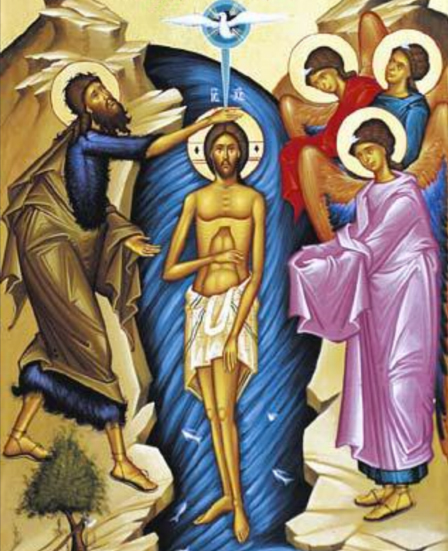
Today’s Bible reading celebrates two complementary affirmations of Jesus’ true identity, of Jesus’ divinity. The first is of John the Baptist, who came to prepare the way toward Jesus, teaching people an initial baptism of repentance, with water, such that they might be initially prepared to receive the Lord. The second is of God the Father and the Holy Spirit, the divine affirmation, that of heaven, the Father’s voice visiting Earth and the Spirit descending, as heaven bows to Earth, the Father to acknowledge His beloved Son as His Own [ … ]
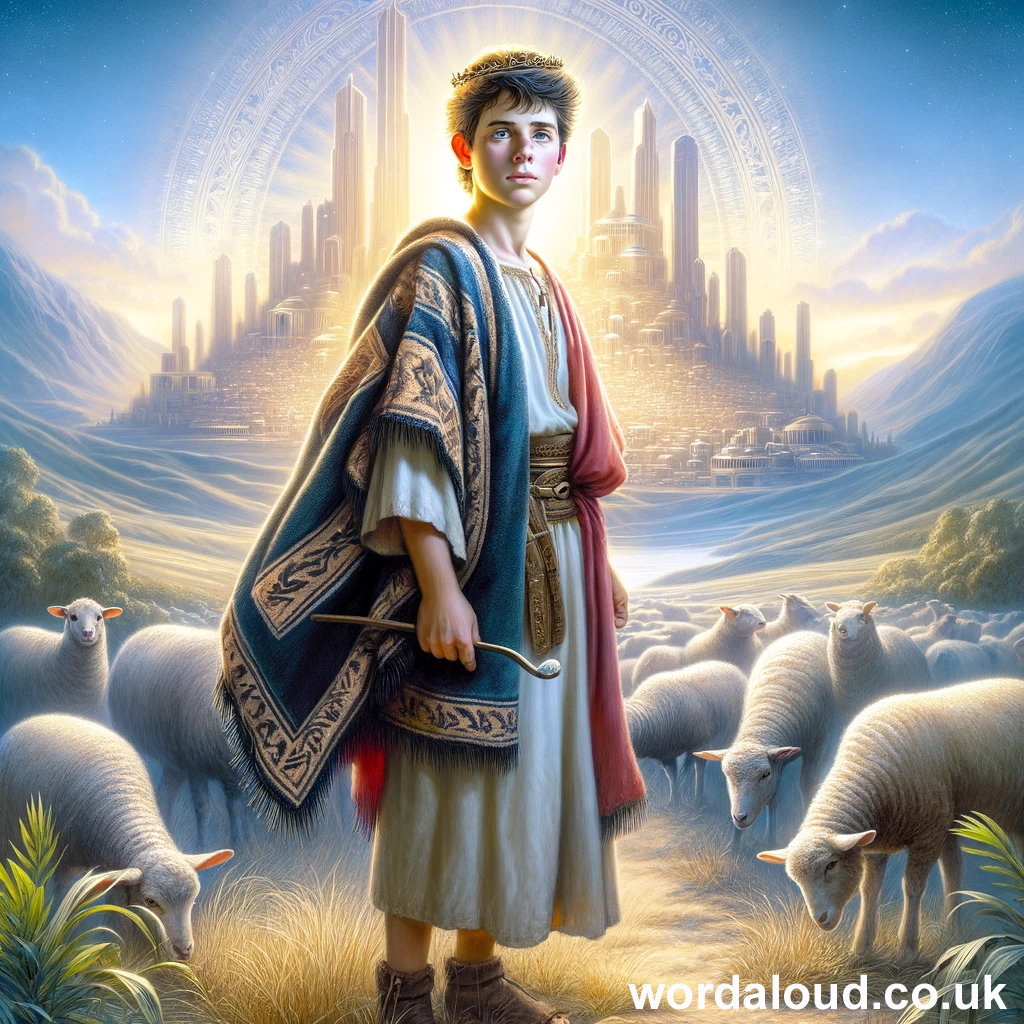
Psalm 121 is of the series of Psalms known as the ‘Songs of Ascents’ (Psalms 120-134). Traditionally, these psalms were sung by pilgrims ascending to Jerusalem for religious festivals. Psalm 121, in particular, has been a source of comfort, revered for its focus on God’s protection and providence [ … ]
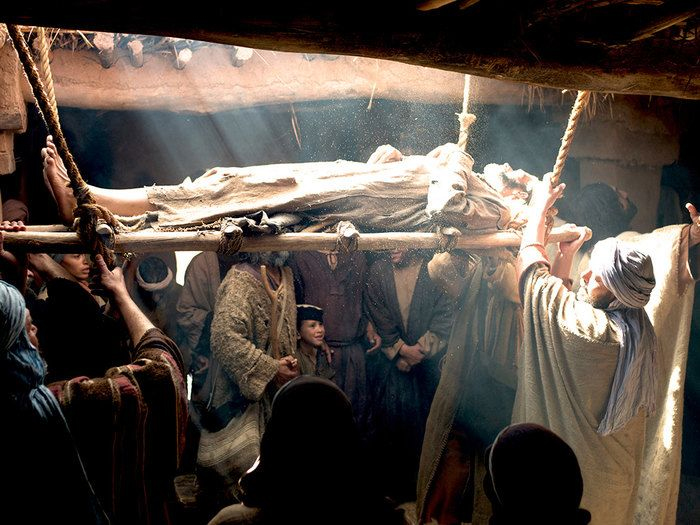
The words of Jesus to the paralytic man on his bed might have seemed strange and even, at first, insensitive: the paralytic has been brought to Jesus seeking to be healed, and Jesus says to him: ‘Son, thy sins be forgiven thee.’ This could hardly be what the paralysed man might have been expecting [ … ]
