
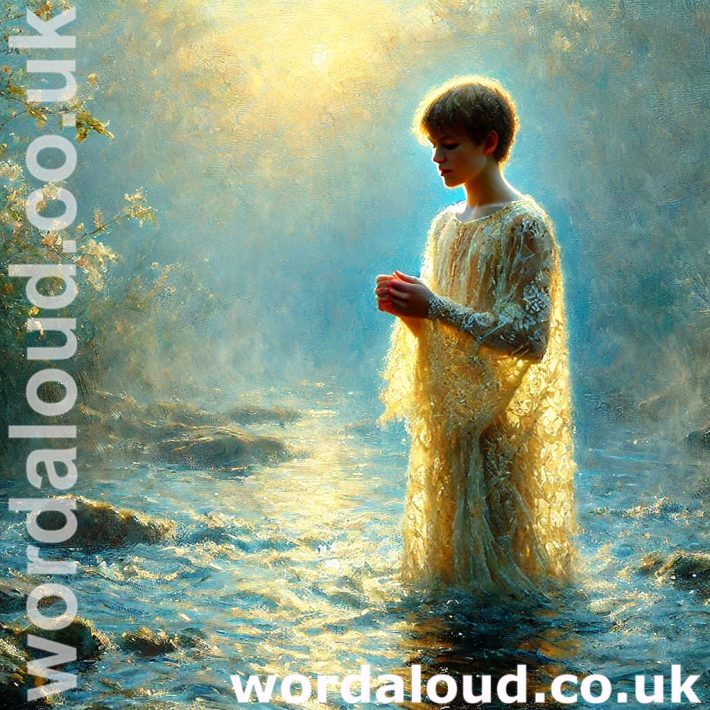
Christian Art | Baptism | We Are Born Again Of Water And The Holy Spirit | The Newly Baptized
Office Of Readings | Week 15, Monday, Ordinary Time | A Reading From The Treatise Of Saint Ambrose On The Mysteries | We Are Born Again Of Water And The Holy Spirit
‘We are born again through water and the Holy Spirit.’
Saint Ambrose’s catechesis on baptism, drawn from his treatise On the Mysteries, offers a rich theological and scriptural reflection on the rite of Christian initiation, weaving together typology, sacramental theology, and pastoral instruction. Addressed to the newly baptized in fourth-century Milan, this passage exemplifies the mystagogical tradition — the Church’s practice of interpreting the mysteries of the sacraments only after the faithful had experienced them.
The Sacramental Event | Visible Signs And Invisible Grace
Saint Ambrose begins by urging his catechumens not to limit their perception to what they see — water, deacons, and the bishop — but to discern the invisible realities conveyed through these visible signs. This principle, echoing Saint Paul’s teaching (2 Corinthians 4:18), underscores a central sacramental axiom: the material elements of baptism convey divine grace because God Himself is present and acting through them. This is no mere symbolic ritual; it is an encounter with the living God, whose Spirit both initiates and perfects the work of salvation.
Ambrose anchors this sacramental realism in Scripture: ‘Since the creation of the world, the invisible attributes of God… are understood through the things that he has done.’ (Romans 1:20) The invocation of this Pauline text signals Ambrose’s conviction that the whole created order speaks sacramentally of God’s action, culminating in baptism.
Biblical Typology | Creation, Flood, And New Birth
Ambrose’s exposition turns to typology — a hallmark of patristic exegesis. He sees the origins of baptism prefigured in the Spirit hovering over the waters at creation (Genesis 1:2): this primordial image suggests that the Spirit’s creative power has been present since the beginning and now brings about a new creation in the baptized.
Next, Ambrose draws on the story of Noah’s flood (Genesis 6–8), an image widely used in early Christian literature to symbolise both judgment and renewal. The ark becomes an image of salvation, the floodwaters prefigure the waters of baptism that wash away sin, and the dove bearing the olive branch anticipates the descent of the Holy Spirit at Christ’s baptism in the Jordan. Here Ambrose underscores that what the flood prefigured, Christ has fulfilled.
This typological method situates baptism within a continuum of salvation history. Ambrose’s catechumens are invited to see themselves as inheritors of this divine narrative: like Noah and his family, they have been delivered from the corrupt world; like Christ in the Jordan, they have passed through water and received the Spirit.
Trinitarian Theology And Ecclesial Context
Ambrose’s emphasis on the Trinity, ‘the Father, the Son and the Holy Spirit’, reflects the deepening Trinitarian consciousness of the fourth-century Church, shaped by the Arian controversies of the time. His clear articulation that the same Spirit present at creation and the flood is the Spirit at work in baptism reinforces the continuity of God’s saving action throughout history.
Moreover, his comparison of deacons and bishop to the Levites and high priest situates the liturgical action within a sacred order and draws an implicit parallel between the Old Testament Temple cult and Christian worship. Yet, as Ambrose’s exegesis shows, the Christian mystery surpasses the old: whereas the Temple sacrifices prefigured God’s saving work, baptism actually confers divine life.
Moral Exhortation | Purification And Peace
Ambrose also integrates moral exhortation into his exposition. He reminds his hearers that ‘carnal impurity and the pollution of grave sin turn away the grace of the Spirit’. Baptism, then, is not merely an outward washing but demands interior conversion — a purification of heart and mind that enables the soul to be receptive to the indwelling Spirit.
This ethical dimension is further expressed in his closing reflection on the dove as symbol of peace and calm. The Spirit who descended on Christ in the Jordan and who comes upon the baptized brings not only forgiveness but also peace — a peace that reorients the soul towards God.
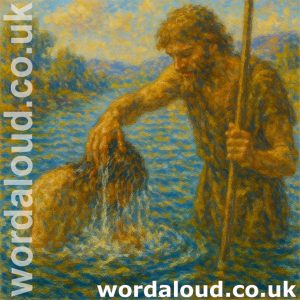
A Reading From The Treatise Of Saint Ambrose On The Mysteries | We Are Born Again Of Water And The Holy Spirit
What did you see at the baptism? Water, certainly, but not water alone; you saw the deacons (like the Levites of old) exercising their ministry and the bishop (like the chief priest of old) asking questions and bestowing sanctification.
The Apostle Paul taught you to look not at what is visible but at what is invisible; for visible things will pass away but the invisible things are eternal. As you read elsewhere: Since the creation of the world, the invisible attributes of God, his eternal power and his divinity are understood through the things that he has done. The Lord himself says: If you do not believe in me, believe in my works. So here, at baptism, believe that the Godhead is present. Can you believe that God is at work and yet deny that he is present? How can any work happen unless the one who performs it is already there?
Consider how ancient this mystery is; for it is prefigured even in the origin of the world itself. In the very beginning, when God made the heaven and the earth, it is said: The Spirit moved upon the waters. He who was moving over the waters, was he not acting on them as well? You can recognise that he was working in that moment of creation, when you see how the prophet says: By the word of the Lord were the heavens made, and all their strength by the spirit of his mouth. There is as much support from the prophets for one thing as for the other. Moses says that the spirit of God was moving and David the psalmist testifies that he was working.
Here is another piece of evidence. By its own iniquities all flesh was corrupted. And God says: My Spirit shall not remain among men, because they are flesh. This goes to show that carnal impurity and the pollution of grave sin turn away the grace of the Spirit. Since that had happened, God sought to repair his disfigured creation. He sent the flood and commanded Noah, the just man, to go up into the ark. As the waters of the flood were receding Noah sent first a raven (which did not return) and then a dove, which came back with an olive branch, as we read in the scriptures. And now you see the water, you see the wood, you see the dove, and you still doubt the mystery?
The water is the water into which the flesh is dipped, to wash away all the sins of the flesh. And so is all sin buried.
The wood is the wood on which the Lord Jesus was fastened when he suffered for us.
The dove symbolizes the Holy Spirit’s taking on the form of a dove, as you have learnt from the New Testament: the Spirit who brings peace to your soul and calm to your troubled mind.
Prayer With Jesus
Heavenly Father,
we praise You for the gift of baptism,
through which You make us a new creation in Christ
and breathe into us Your Holy Spirit.
Grant that we may never take for granted this grace,
but live lives worthy of the calling we have received.
As You hovered over the waters at creation,
so hover over our hearts,
cleansing us from sin, calming our restless minds,
and filling us with the peace of Your Spirit.
May we, who have passed through the waters of new birth,
walk always as children of light,
and bear witness to Your saving power,
until we come at last to the fullness of life with You.
Through Jesus Christ our Lord,
who lives and reigns with You and the Holy Spirit,
God forever and ever.
Amen.
Glossary Of Christian Terms
Catechesis: Religious instruction given to those preparing for baptism or recently baptized.
Mystagogy: The period of post-baptismal teaching explaining the sacraments and deepening the understanding of faith.
Typology: A method of biblical interpretation where Old Testament events, persons, or symbols are seen as prefigurations of Christ and the sacraments.
Levites: Members of the tribe of Levi, assigned liturgical duties in the Temple in the Old Testament.
Prefigure: To foreshadow or symbolically anticipate a future reality.
Theophany: A visible manifestation of God to humans.
Effetha: An Aramaic word meaning ‘be opened’, used by Jesus when healing the deaf man (Mark 7:34) and used symbolically in baptismal rites.
Dove (symbol): A symbol of the Holy Spirit, peace, and purity.
Trinitarian: Relating to the doctrine of the Trinity — Father, Son, and Holy Spirit.
Ark: In this context, Noah’s ark — a biblical image of salvation and refuge.



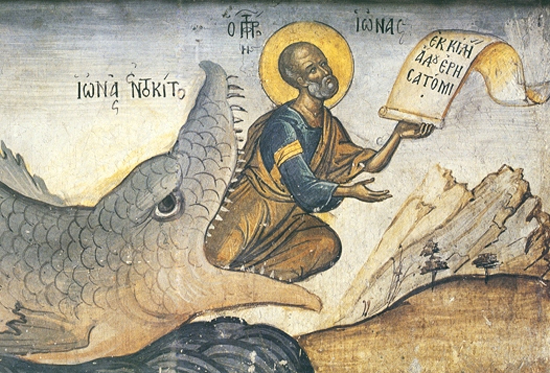
The crowds gather to see and to hear Jesus. Among them, as Matthew relates in his Gospel (Matthew 12: 38-42), are the scribes and Pharisees, who ask for a sign from Jesus to prove his divinity. Jesus refuses to confirm his preaching with dramatic signs. It is his teaching Jesus wishes the people to hear. Through seeking to taunt Jesus, and through their unbelief, the scribes and the Pharisees express the hardness of their hearts. Christ is present to them and they refuse to see. Christ is speaking to them and they refuse to hear. Through the Gospel, we have witnessed Christ’s miracles. And we are called to hear his word. ‘An evil and adulterous generation seeketh after a sign.’ [ … ]
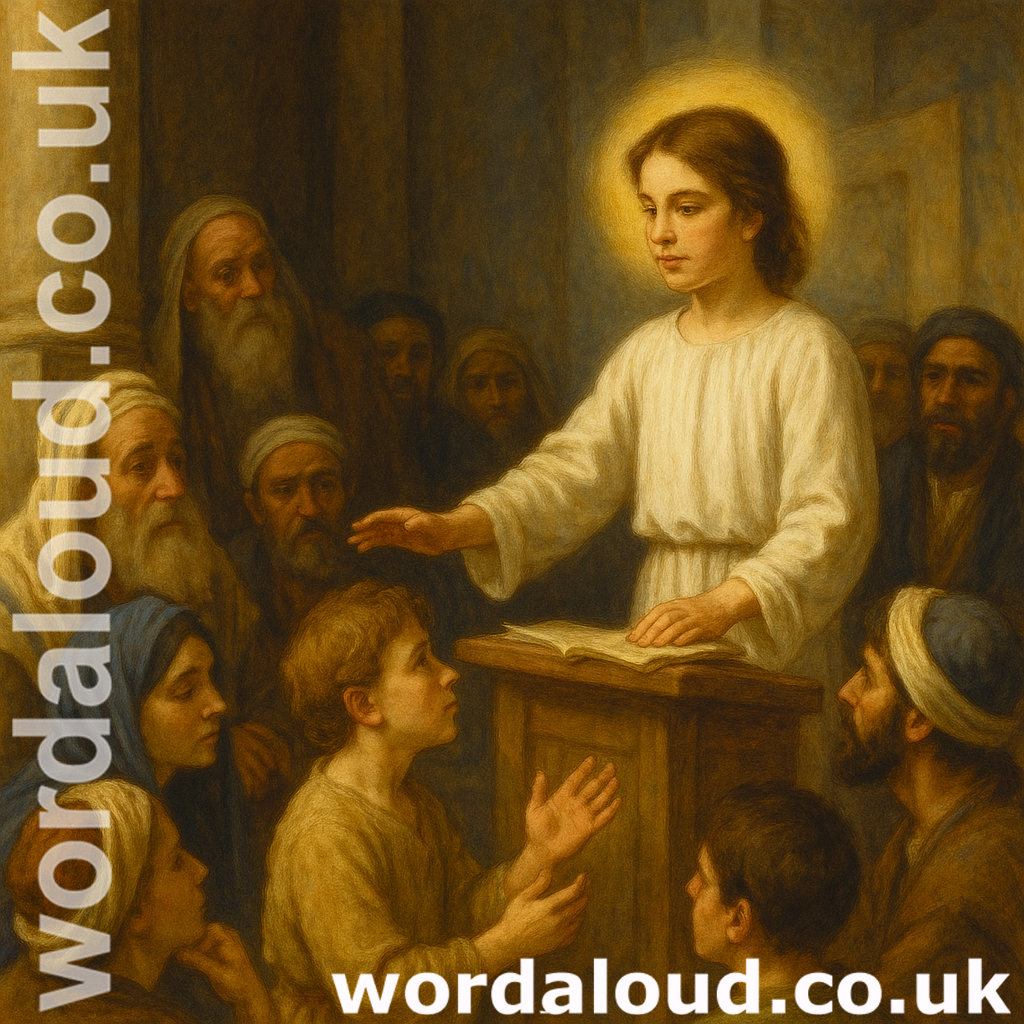
The homily draws on the Christological hymn of Colossians 1:15-20, describing Christ as ‘the firstborn of all creation’, the head of the Church, and the one in whom the fullness of God was pleased to dwell. In emphasising that Christ is both ‘the beginning and the end’, Paul VI presents Jesus as the key to understanding human history and the destiny of each person. This is a deeply Pauline theology, with references not only to Colossians but also to Romans 5 and Philippians 2 [ … ]
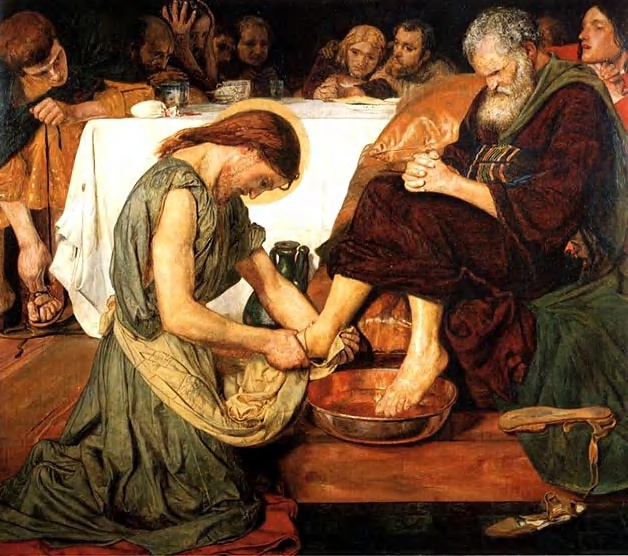
John speaks of the Last Supper in a different way from the Synoptic Gospels. He omits, for example, the institution of the Eucharist, because the other Gospels and Paul have already spoken of this in their accounts of the Last Supper. Through chapters thirteen to seventeen, John gives an extensive account of Jesus’ teaching at the Last Supper, in which Jesus builds on his teachings so far and leads his disciples to a greater understanding of the love that they must share and of the way ahead [ … ]
