

Christian Art | Longing For Jesus | Resurrection Of The Lord
Office Of Readings | Advent Friday Week 1 | A Reading From The Proslogion Of Saint Anselm | A Rousing Of The Mind To The Contemplation Of God
‘A rousing of the mind to the contemplation of God.’
Saint Anselm expresses a very personal kind of prayer — not analysing God from a distance, but putting into words the restless desire of a believer who knows that God is real, yet not yet fully seen. For Anselm, faith naturally awakens longing, and longing draws the soul deeper into God.
Anselm begins by calling the reader to silence and interior stillness. He knows how easily the mind is occupied by responsibilities, anxieties, and distractions. For him, the search for God requires a deliberate turning inward, a quietness of heart in which everything unnecessary is set aside. This is not escapism but a way of recovering the most important truth: that God cannot be found amid noise unless the heart is first at rest.
Anselm then prays honestly. He acknowledges the paradox that God is everywhere, yet not perceived; that God is light, yet unapproachable; that God made him, yet remains unseen. For Anselm, this tension is not a failure of faith but part of the believer’s journey. The human heart was created to behold God, and that vision is the fulfilment of our nature. Until that moment, the soul feels like an exile — loving the One it has not yet fully met.
Much of his prayer expresses a kind of holy impatience. He asks ‘How long?’ echoing the Psalms. He names the ache of loving God while feeling God’s hiddenness. Yet this longing itself becomes a form of worship. The desire to see God is already the work of grace, already the beginning of union.
Finally, Anselm prays for the help he knows he cannot supply. We cannot even begin to seek God unless God first draws us; we cannot find him unless he reveals himself. Seeking, longing, finding, loving — all of it depends on grace, but grace that engages the whole heart. Anselm wants to seek God with desire, to desire God in the seeking, to find God through love, and then to love God more fully in the finding.
Anselm’s prayer becomes a simple expression of the Christian life, especially in Advent: waiting, longing, asking for light, and trusting that God will reveal himself fully in his own time.

A Reading From The Proslogion Of Saint Anselm | A Rousing Of The Mind To The Contemplation Of God
Little man, rise up! Flee your preoccupations for a little while. Hide yourself for a time from your turbulent thoughts. Cast aside, now, your heavy responsibilities and put off your burdensome business. Make a little space free for God; and rest for a little time in him.
Enter the inner chamber of your mind; shut out all thoughts. Keep only thought of God, and thoughts that can aid you in seeking him. Close your door and seek him. Speak now, my whole heart! Speak now to God, saying, I seek your face; your face, Lord, will I seek.
And come you now, O Lord my God, teach my heart where and how it may seek you, where and how it may find you.
Lord, if you are not here, where shall I seek you when you are absent? But if you are everywhere, why do I not see you present? Truly you dwell in unapproachable light. But where is unapproachable light, or how shall I come to it? Or who shall lead me to that light and into it, that I may see you in it? Again, by what signs, under what form, shall I seek you? I have never seen you, O Lord, my God; I do not know your face.
What, O most high Lord, shall this man do, an exile far from you? What shall your servant do, anxious in his love of you, and cast out far from your presence? He is breathless with desire to see you, and your face is too far from him. He longs to come to you, and your dwelling-place is inaccessible. He is eager to find you, but does not know where. He desires to seek you, and does not know your face.
Lord, you are my God, and you are my Lord, and never have I seen you. You have made me and renewed me, you have given me all the good things that I have, and I have not yet met you. I was created to see you, and I have not yet done the thing for which I was made.
And as for you, Lord, how long? How long, O Lord, do you forget us; how long do you turn your face from us? When will you look upon us, and hear us? When will you enlighten our eyes, and show us your face? When will you restore yourself to us?
Look upon us, Lord; hear us, enlighten us, reveal yourself to us. Restore yourself to us, that it may be well with us, yourself, without whom it is so ill with us. Pity our toilings and strivings towards you since we can do nothing without you.
Teach me to seek you, and reveal yourself to me when I seek you, for I cannot seek you unless you teach me, nor find you unless you reveal yourself. Let me seek you in longing, let me long for you in seeking; let me find you by loving you and love you in the act of finding you.
Christian Prayer With Jesus
Lord God,
you have made us for yourself,
and our hearts are restless until they rest in you.
Grant us moments of quiet in which we can turn aside
from our burdens and distractions.
Teach us to seek you with honesty and longing.
Show us your light, strengthen our desire,
and guide us into the fullness of your presence.
Let us seek you because you draw us;
let us find you because you reveal yourself;
and let us love you more deeply
as you bring us nearer to your face.
Amen.
Glossary Of Christian Terms
Proslogion – A short work of prayerful theology by Saint Anselm, written as a meditation addressed directly to God.
Contemplation – A quiet, attentive form of prayer in which the soul seeks to rest in God’s presence.
The divine vision (or beatific vision) – The final and perfect seeing of God ‘face to face’ in heaven.
Grace – God’s free gift of his life and help, enabling us to seek, know, and love him.
Exile – A spiritual image for the human condition before seeing God: created for him, yet not yet fully united.
Longing for God – A desire planted by grace, expressing the soul’s natural orientation toward its Creator.
Divine hiddenness – The experience of God being real yet not fully seen or felt; a common theme in Scripture and prayer.




The reading from the Jerusalem Catecheses offers a luminous and powerful reflection on the mystery of the Eucharist, the sacrament at the very heart of Christian life. Attributed traditionally to Saint Cyril of Jerusalem, these catecheses were designed to unfold the hidden mysteries of the faith to those who had newly received baptism and first communion at the Easter Vigil. The context is important: these were not casual theological musings, but careful, pastoral teachings meant to anchor the newly-initiated in the life-giving truths they had just entered into [ … ]
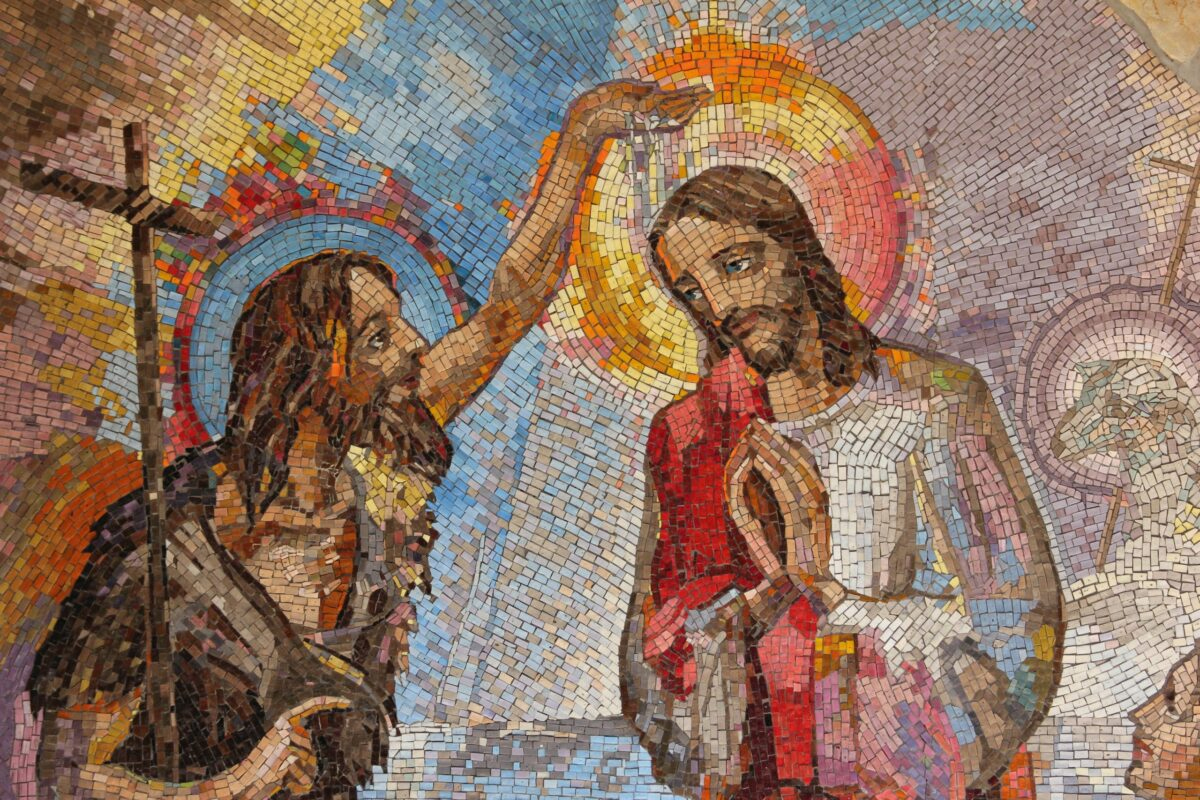
The impression clearly formed is that the Archbishop’s ideas are not mere bookish speculation but, as it were, bucket-and-spade, in the sense of his having visited the place where he thinks it was that Jesus was baptized. He tells us about the place, in the Holy Land, over the Jordan, where there is a confluence, troubled waters, and danger in entering into them. The picture he evokes of broiling surge, plunging deep, a GPS map-point, a trial in ways apart from our sacrament. Where waters churn and threaten to swallow you. And he is convinced it happened there. He is convinced. He relates it to our own baptism [ … ]

Some people are so simple that they do not know what uprightness is. Theirs is not the true simplicity of the innocent: they are as far from that as they are far from rising to the virtue of uprightness. As long as they do not know how to guard their steps by walking in uprightness, they can never remain innocent merely by walking in simplicity. This is why Saint Paul warns his disciples I hope that you are also wise in what is good, and innocent of what is bad but also Brothers, you are not to be childish in your outlook, though you can be babies as far as wickedness is concerned. Thus Christ our Truth enjoins his disciples with the words Be cunning as serpents and yet as harmless as doves. In giving them this admonition, he had to join the two together, so that both the simplicity of the dove might be instructed by the craftiness of the serpent, and the craftiness of the serpent might be attempered by the simplicity of the dove [ … ]
