
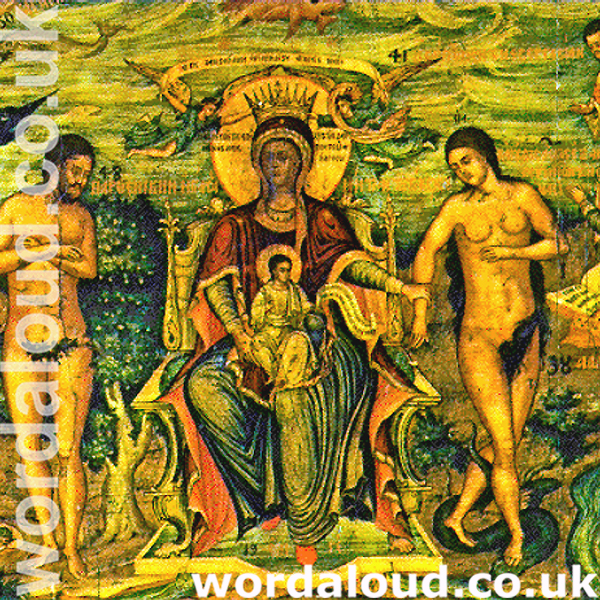
Christian Art | Eve And Mary | God’s Love Revealed In Jesus Christ
Office Of Readings | Advent Friday Week 2 | A Reading From The Treatise Of Saint Irenaeus Against The Heresies | On Eve And Mary
‘Eve and Mary.’
Saint Irenaeus sets before us one of the earliest and most important Christian ways of understanding salvation: God heals humanity by retracing its steps. What was damaged at the beginning is not abandoned but restored, and it is restored in a way that respects both human freedom and God’s justice.
Irenaeus begins with Christ’s obedience. Humanity’s fall began at a tree, when Adam disobeyed God in the garden of Eden. Christ reverses that act by his obedience on another tree, the cross. Salvation is not an escape from human history but a healing within it. Christ enters fully into creation, is sustained by it, and redeems it from within.
Irenaeus then places Eve and Mary side by side. Eve, still a virgin and promised in marriage, listened to a word that was false and turned away from God. Mary, also a virgin and promised in marriage, listened to a word that was true and turned toward God in obedience. Where Eve fled from God, Mary welcomed God into her life. The contrast is deliberate and careful: the same human situation becomes the place of reversal.
This does not mean that Mary replaces Eve, but that she becomes her advocate. Humanity is not condemned by its first disobedience forever. Through Mary’s obedience, the knot of disobedience is loosened. God’s plan works not by force but by persuasion, not by negating human freedom but by restoring it.
Irenaeus insists that this victory must be just. Since humanity was deceived through a woman, the defeat of the enemy comes through a woman as well. Since death entered through a human act, life must return through a human act. This is why Christ is truly born of a woman and truly human. Salvation is not imposed from outside but won fairly within the same human condition that had fallen.
By calling himself the Son of Man, Christ gathers all humanity into himself. Adam’s defeat had consequences for all; Christ’s victory does the same, but in the opposite direction. What was lost through disobedience is restored through obedience. What was bound by death is released into life.
For Irenaeus, this teaching safeguards the goodness of creation, the dignity of the human body, and the coherence of God’s saving plan. Redemption is not an afterthought. From the beginning, God intended to heal, restore, and raise humanity, leading it not back to Eden, but forward into life with him.
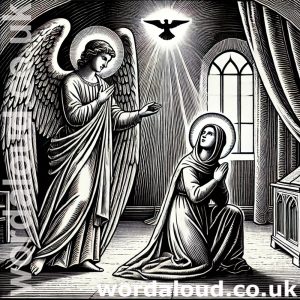
A Reading From The Treatise Of Saint Irenaeus Against The Heresies | On Eve And Mary
The Lord, coming into his own creation in visible form, was sustained by his own creation which he himself sustains in being. His obedience on the tree of the cross reversed the disobedience at the tree in Eden; the good news of the truth announced by an angel to Mary, a virgin subject to a husband, undid the evil lie that seduced Eve, a virgin espoused to a husband.
As Eve was seduced by the word of an angel and so fled from God after disobeying his word, Mary in her turn was given the good news by the word of an angel, and bore God in obedience to his word. As Eve was seduced into disobedience to God, so Mary was persuaded into obedience to God; thus the Virgin Mary became the advocate of the virgin Eve.
Christ gathered all things into one, by gathering them into himself. He declared war against our enemy, crushed him who at the beginning had taken us captive in Adam, and trampled on his head, in accordance with God’s words to the serpent in Genesis: I will put enmity between you and the woman, and between your seed and her seed; he shall lie in wait for your head, and you shall lie in wait for his heel.
The one lying in wait for the serpent’s head is the one who was born in the likeness of Adam from the woman, the Virgin. This is the seed spoken of by Paul in the letter to the Galatians: The law of works was in force until the seed should come to whom the promise was made.
He shows this even more clearly in the same letter when he says: When the fullness of time had come, God sent his Son, born of a woman. The enemy would not have been defeated fairly if his vanquisher had not been born of a woman, because it was through a woman that he had gained mastery over man in the beginning, and set himself up as man’s adversary.
That is why the Lord proclaims himself the Son of Man, the one who renews in himself that first man from whom the race born of woman was formed; as by a man’s defeat our race fell into the bondage of death, so by a man’s victory we were to rise again to life.
Christian Prayer With Jesus
God of faithfulness,
you did not abandon us when we fell,
but prepared our restoration with patience and love.
Grant us hearts like Mary’s,
ready to hear your word and obey it,
so that we may share in the victory of Christ,
who restores all things in himself.
Amen.
Glossary Of Christian Terms
Irenaeus of Lyons – Second-century bishop and theologian, defender of apostolic faith against early heresies.
Eve – The first woman, whose disobedience contributed to humanity’s fall (Genesis 3).
Mary – The mother of Jesus, whose obedience made possible the Incarnation (Luke 1).
Obedience / disobedience – Key themes in Irenaeus, describing humanity’s fall and restoration.
Recapitulation – Irenaeus’s teaching that Christ ‘sums up’ or re-lives human history in order to heal it.
Son of Man – Title used by Christ to express his full solidarity with humanity.



Saint Winifred, also known as Saint Winefride, was born in the 7th century in Wales. She was the daughter of a chieftain named Tyfid ap Eiludd. From a young age, Winifred was devoted to her faith, choosing a life of piety and religious dedication. She was greatly influenced by her uncle, Saint Beuno, a renowned Welsh saint and abbot, who played a significant role in her spiritual education [ … ]
Our verses begin with Jesus asking two questions. The first gives us a sense of the rumour and speculation surrounding Jesus as he preaches. The crowds see Jesus as a prophet, wondering if he might be one of the prophets returned. Jesus’ next question, ‘But whom say ye that I am?’ is a call to his disciples for faith and clarity, and Peter obliges, affirming that Jesus is the Messiah. Once more, Jesus charges his disciples to keep this knowledge secret. It is not yet time for our Lord to reveal himself, perhaps because the social situation is too dangerous, perhaps because the multitudes are not yet ready to receive such spiritual truth – we do not know [ … ]
Little Gidding, the fourth and final poem in T.S. Eliot’s Four Quartets, examines themes of time, redemption, and spiritual renewal. Written in 1942 during World War II, this poem brings together reflections from the previous three poems and culminates in a unified vision of human experience and transcendence [ … ]
