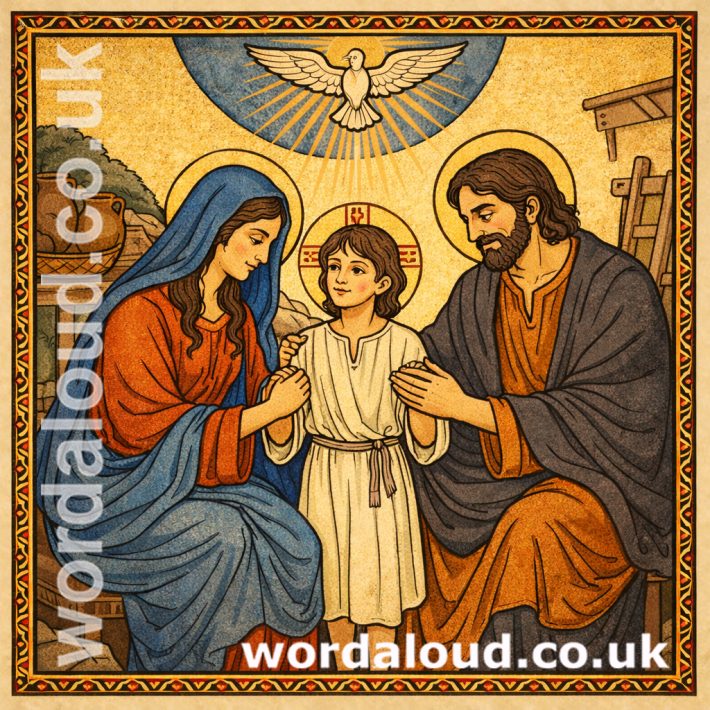
Christian Art | Jesus, Mary And Joseph | The Holy Family
Office Of Readings | Week 3, Monday, Ordinary Time | A Reading From The Constitution On The Church In The Modern World Of The Second Vatican Council | The Sanctity Of Marriage And The Family
‘The sanctity of marriage and the family.’
This reading from the Constitution on the Church in the Modern World presents marriage and family life as a central setting for Christian holiness. The reading describes marriage not simply as a social arrangement, but as a covenant rooted in personal union, fidelity, and participation in God’s own love.
The reading begins with the unity of husband and wife. Marriage is described as a communion of persons expressed through shared life and action. This unity is not static but deepens over time as spouses grow in mutual understanding and service. The Council emphasises that such intimacy requires full fidelity and an indissoluble bond, reflecting the total self-giving that marriage entails.
Christ’s role is then brought into focus. Married love is said to have its source in divine love and to be shaped by the model of Christ’s union with the Church. Just as God entered into a covenant of love with his people, Jesus Christ now meets spouses in the sacrament of matrimony. His presence is not momentary but enduring: he remains with them so that their love may be marked by constancy, sacrifice, and faithfulness.
The Council makes clear that marriage is sustained by grace. Married love is taken up into God’s saving work and strengthened by Christ’s redeeming power and by the life of the Church. This grace is directed not only to the couple themselves but also to the good of their children. Parenthood is presented as a serious and noble responsibility, one that requires spiritual support and divine assistance.
Marriage is therefore described as a vocation, supported by a specific sacrament. Through it, spouses are strengthened for their duties and share in the spirit of Christ. Their everyday life becomes a place where faith, hope, and love are lived out. In this way, spouses contribute both to their own sanctification and to one another’s, and their shared life becomes a witness to God’s glory.
The reading turns to the family as a whole. Parents are given a leading role through example and prayer, especially in the religious education of their children. The family is presented as a community in which virtue, faith, and holiness can grow naturally. Children, for their part, are not passive recipients but active participants, contributing to the holiness of family life through gratitude, respect, and care, particularly as parents grow older.
Marriage and family life are a privileged place of grace, responsibility, and mutual sanctification, woven into the wider mission of the Church.
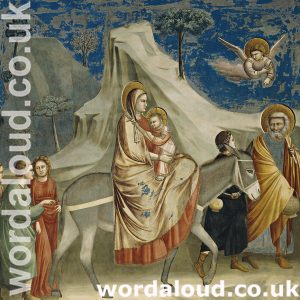
A Reading From The Constitution On The Church In The Modern World Of The Second Vatican Council | The Sanctity Of Marriage And The Family
Husband and wife, by the covenant of marriage, are no longer two, but one flesh. By their intimate union of persons and of actions they give mutual help and service to each other, experience the meaning of their unity, and gain an ever deeper understanding of it day by day.
This intimate union in the mutual self-giving of two persons, as well as the good of the children, demands full fidelity from both, and an indissoluble unity between them.
Christ the Lord has abundantly blessed this richly complex love which springs from the divine source of love and is founded on the model of his union with the Church.
In earlier times God met his people in a covenant of love and fidelity. So now the Savior of mankind, the Bridegroom of the Church, meets Christian husbands and wives in the sacrament of matrimony. Further, he remains with them in order that, as he loved the Church and gave himself up for her, so husband and wife may, in mutual self-giving, love each other with perpetual fidelity.
True married love is caught up into God’s love; it is guided and enriched by the redeeming power of Christ and the saving action of the Church, in order that the partners may be effectively led to God and receive help and strength in the sublime responsibility of parenthood.
Christian partners are therefore strengthened, and as it were consecrated, by a special sacrament for the duties and the dignity of their state. By the power of this sacrament they fulfil their obligations to each other and to their family and are filled with the spirit of Christ. This spirit pervades their whole lives with faith, hope and love. Thus they promote their own perfection and each other’s sanctification, and so contribute together to the greater glory of God.
Hence, with parents leading the way by example and family prayer, their children – indeed, all within the family circle – will find it easier to make progress in natural virtues, in salvation and in holiness. Husband and wife, raised to the dignity and the responsibility of parenthood, will be zealous in fulfilling their task as educators, especially in the sphere of religious education, a task that is primarily their own.
Children, as active members of the family, contribute in their own way to the holiness of their parents. With the love of grateful hearts, with loving respect and trust, they will return the generosity of their parents and will stand by them as true sons and daughters when they meet with hardship and the loneliness of old age.
Christian Prayer With Jesus Christ
God of love and faithfulness,
you created marriage as a covenant of unity and life.
Bless husbands and wives
as they give themselves to one another in fidelity and trust.
Remain with families,
that their homes may be places of faith, hope, and love.
Strengthen parents in their responsibility
to nurture life and to guide their children in your ways.
Grant children grateful hearts,
ready to respond with love and respect
to the care they receive.
Sustain families in times of joy and in times of trial,
and keep them united in your peace.
May every family grow in holiness
and bear witness to your love in the world.
Through Christ our Lord.
Amen
Glossary Of Christian Terms
Covenant of marriage | A lifelong bond of mutual self-giving between husband and wife
One flesh | The deep personal and bodily unity of spouses in marriage
Indissoluble | Not capable of being broken
Sacrament of matrimony | The sacramental sign through which Christ blesses and sustains marriage
Fidelity | Faithful and exclusive commitment to one’s spouse
Self-giving | The free and generous offering of oneself to another
Union of Christ and the Church | The relationship between Christ and believers, used as the model for marriage
Consecrated | Set apart and strengthened by God for a specific purpose
Sanctification | Growth in holiness through God’s grace
Parenthood | The responsibility of bringing up children and guiding them towards maturity and faith
Religious education | Formation in faith and moral life
Family prayer | Shared prayer within the household
Natural virtues | Human qualities such as patience, honesty, and responsibility



The presence of angels in the Gospels expressed incarnation of the divine in the person of Jesus Christ. Angels heralded Jesus’ coming, rejoicing in the birth of the Saviour. In the Gospel of Luke, an angel announced to the shepherds, ‘Fear not: for, behold, I bring you good tidings of great joy, which shall be to all people. For unto you is born this day in the city of David a Saviour, which is Christ the Lord’ (Luke 2:10-11, KJV) [ … ]
In this passage, Augustine of Hippo offers a sustained reflection on desire as the defining movement of the Christian life. The text is less concerned with doctrinal exposition than with the interior disposition required for the vision of God. Its central claim—that ‘the entire life of a good Christian is an exercise of holy desire’—provides the organising principle for what follows [ … ]

Saint Fulgentius sets the martyrdom of Stephen directly alongside the birth of Christ. The two events are linked, not by time, but by meaning. Christ enters the world in humility; Stephen leaves it in witness. What Christ gives in his incarnation is shown at work in Stephen’s death.