
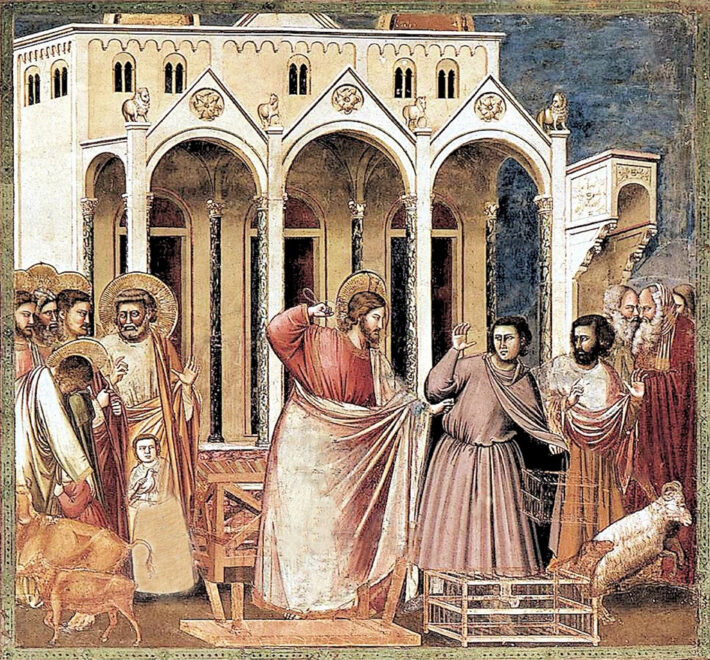
Christian Art | Jesus Cleanses The Temple
Mark 11: 11-26 – Week 8 Ordinary Time, Friday (King James Audio Bible | Spoken Word)
11 And Jesus entered into Jerusalem, and into the temple: and when he had looked round about upon all things, and now the eventide was come, he went out unto Bethany with the twelve.
12 ¶ And on the morrow, when they were come from Bethany, he was hungry:
13 And seeing a fig tree afar off having leaves, he came, if haply he might find any thing thereon: and when he came to it, he found nothing but leaves; for the time of figs was not yet.
14 And Jesus answered and said unto it, No man eat fruit of thee hereafter for ever. And his disciples heard it.
15 ¶ And they come to Jerusalem: and Jesus went into the temple, and began to cast out them that sold and bought in the temple, and overthrew the tables of the moneychangers, and the seats of them that sold doves;
16 And would not suffer that any man should carry any vessel through the temple.
17 And he taught, saying unto them, Is it not written, My house shall be called of all nations the house of prayer? but ye have made it a den of thieves.
18 And the scribes and chief priests heard it, and sought how they might destroy him: for they feared him, because all the people was astonished at his doctrine.
19 And when even was come, he went out of the city.
20 ¶ And in the morning, as they passed by, they saw the fig tree dried up from the roots.
21 And Peter calling to remembrance saith unto him, Master, behold, the fig tree which thou cursedst is withered away.
22 And Jesus answering saith unto them, Have faith in God.
23 For verily I say unto you, That whosoever shall say unto this mountain, Be thou removed, and be thou cast into the sea; and shall not doubt in his heart, but shall believe that those things which he saith shall come to pass; he shall have whatsoever he saith.
24 Therefore I say unto you, What things soever ye desire, when ye pray, believe that ye receive them, and ye shall have them.
25 And when ye stand praying, forgive, if ye have ought against any: that your Father also which is in heaven may forgive you your trespasses.
26 But if ye do not forgive, neither will your Father which is in heaven forgive your trespasses.
Mark’s account of the cleansing of the Temple is framed by the episode of Jesus’ encounter with the barren fig tree. In Matthew 21, the two are also proximate. The juxtaposition helps us more fully to understand both the cleansing of the Temple and the cursing of the fig tree.
Jesus is hungry, a touching sign of his true humanity, and knows, of course, that it is not the right time of the year for figs. Jesus’ words may startle and surprise us, seeming perhaps maverick, and perhaps in this way would have caught the attention of those accompanying Jesus. St Bede tells us that this miracle has a deeper, allegorical purpose: Jesus has hoped to find among his own people, especially the leaders of the Jewish groups, fruit of holiness and good works, but has found only hollow observances, external practices, and no real love of and faith in God; in the Temple, Jesus find that what should have been a house of prayer, the fruit of piety, there is commerce, exploitation, mere leaves. ‘So you,’ St Bede writes, ‘if you do not want to be condemned by Christ, should guard against being a barren tree, by offering to Jesus, who made himself poor, the fruit of piety which he expects of you.’
Jesus enters the Temple and what he finds there is blasphemy. The house of God has become a place of profiteering, and the chief priests and the scribes are complicit in this. They are using the laws concerning purity to force people both to exchange their money for temple money and then also to buy their sacrifices.
This isn’t what God wants. It is a perversion of justice, of God’s Law. Jesus sets about cleansing the Temple in a way which is messy, violent, and indeed outrageous. He strikes at the heart of the self-interest among the leaders of the Jewish community, which keeps the chief priests and the scribes well fed and the people removed from God. Those leaders, therefore, want to destroy him.
These Bible verses are relevant to the present day, not only insofar as we consider all of the ways in which our attachment to money and status obscures our relationship with God, but also in terms of what happens when we have sinned and then we re-admit Jesus into our lives.
It might not be an easy process. There might well be a lot to reckon with, a lot to cast out, a lot to cleanse. When we approach Jesus and ask him to enter again into the temple which is our body and our soul, we might experience all of that violence as he does indeed enter in and then proceeds to purge us of wrongdoing.
It is a healing process, and it can be mortifying and intense. What is happening now, though, is that we are making ourselves once more a fitting home for God. We are making ourselves a fit tabernacle for God to dwell within us as we in him.
‘We have to work a lot on this earth and we must do our work well, since it is our daily tasks that we have to sanctify. But let us never forget to do everything for God’s sake. If we were to do it for ourselves, out of pride, we would produce nothing but leaves, and no matter how luxuriant they were, neither God nor our fellow man would find any good in them.’ St Josemaria Escriva
Concluding Prayer
Lord God,
bestow a full measure of your grace on us
who gather in prayer.
As you work within us
to keep us in the path of your commandments,
may we receive consolation in this present life
and eternal joys in the next.
We make our prayer through our Lord.




In these Gospel verses, Jesus goes to the Mount of Olives with his disciples, and at a particular place, Jesus separates himself to pray. Jesus urges his disciples to pray against temptation. In his prayer, Jesus expresses his desire for the cup of suffering to be removed but ultimately submits to God’s will. An angel appears from heaven to strengthen Jesus, and Jesus prays with such intensity that his sweat becomes like drops of blood falling to the ground [ … read more and listen … ]

Psalm 131, attributed to David, begins with a declaration of humility: ‘Lord, my heart is not haughty, nor mine eyes lofty.’ Here, the psalmist asserts a conscious rejection of pride and arrogance, setting the tone for a meditation on humility and trust in God [ … ]

In this portion of his treatise, Saint Cyprian of Carthage underscores the profoundly communal nature of Christian prayer, especially as it is expressed in the Our Father. Writing in the mid-third century amidst persecution and internal divisions, Cyprian offers not only theological reflection but also pastoral guidance on the meaning and practice of unity in prayer [ … ]