Christian Art | George Herbert | The Temple | The Church | Avarice
George Herbert | The Temple | The Church | Avarice
Money, thou bane of blisse, and sourse of wo,
Whence com’st thou, that thou art so fresh and fine?
I know thy parentage is base and low:
Man found thee poore and dirtie in a mine.
Surely thou didst so little contribute
To this great kingdome, which thou now hast got,
That he was fain, when thou wert destitute,
To digge thee out of thy dark cave and grot:
Then forcing thee, by fire he made thee bright:
Nay, thou hast got the face of man; for we
Have with our stamp and seal transferr’d our right;
Thou art the man, and man but drosse to thee.
Man calleth thee his wealth, who made thee rich;
And while he digs out thee, falls in the ditch.

George Herbert | The Temple | The Church | Avarice
Herbert’s ‘Avarice’ critiques humanity’s obsession with wealth by tracing money’s journey from its origins to its corrupting influence on human values. The poem is structured as a meditation, moving from the origins of money to its transformation and eventual dominance over human life.
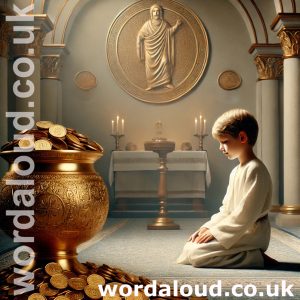
The opening lines establish money as a paradoxical force, both ‘bane of bliss’ and a ‘source of woe’ – ‘so fresh and fine’ and ‘base and low’. This ambivalence suggests that while money appears to offer benefits, its true nature is harmful. Herbert challenges the reader to consider money’s humble beginnings: it is ‘poor and dirty in a mine’. This image emphasizes a base materiality of money and origins in the earth, contrasting sharply with an elevated status humans later assign to it.
The refining process is described as an act of transformation by fire, where humans create value out of something that initially lacked it. The subsequent ‘stamp and seal’ is a crucial moment in the poem: humans impose their authority on money, projecting value onto it. Yet, in doing so, they unwittingly diminish themselves. The inversion of roles—money becomes ‘the man’, and man is reduced to ‘dross’—illustrates the corrupting effects of ‘Avarice’. The object gains power, while its creators lose their dignity and purpose.
Herbert concludes with a stark moral warning in the final couplet: that man, ‘While he digs out thee, falls in the ditch’. This image of falling into a ditch symbolizes spiritual ruin. It reflects futility and self-destruction inherent in humanity’s relentless pursuit of wealth. The poem suggests that by prioritizing money, humans neglect higher, spiritual concerns, effectively digging their own graves.
The poem employs clear, concrete imagery—mines, fire, stamps, and ditches—that grounds its critique in tangible processes. These physical actions highlight human effort behind money’s creation and the absurdity of its subsequent power over human lives. Herbert uses this imagery to draw attention to the artificiality of wealth’s value and the moral degradation it brings.
Theologically, ‘Avarice’ aligns with Herbert’s broader concern with idolatry. Money is treated as a false god, worshiped despite being a human creation. This misplaced reverence leads to a loss of spiritual priorities, with wealth supplanting God as the ultimate object of human devotion.
Herbert’s ‘Avarice’ offers a critique of greed, focusing on the self-inflicted harm caused by humanity’s elevation of wealth. It is not simply a condemnation of money but a reflection on the distortion of values that occurs when material gain takes precedence over spiritual and moral integrity.



Saint Augustine’s commentary on Psalm 141 presents the suffering of Christ as inseparable from the suffering of the Church. Saint Augustine interprets the Psalmist’s plea—“Lord, I have cried to you, hear me”—as the voice of Christ in his human nature, but also as the voice of his body, the Church. This identification between Christ and the Church is fundamental to Saint Augustine’s theology. The trials of the faithful are not isolated events; they are part of the ongoing participation in the passion of Christ. Just as Christ prayed in anguish in Gethsemane, sweating drops of blood, so too does the Church continue to suffer until the end of time. The martyrdom of believers, both literal and spiritual, is an extension of Christ’s own sacrifice [ … ]
In this reading from his letter to the Ephesians, Saint Ignatius of Antioch continues his instruction on the Christian life, concentrating on faith, love, and the power of common worship. Writing to a community he knows well, Ignatius encourages regular gathering for prayer and thanksgiving, seeing this as a central defence against spiritual danger [ … ]

William of Saint-Thierry reflects on salvation not as something we achieve, but as something we receive. From the beginning, he insists that God’s dominion is not oppressive power but saving love. To belong to God is already to be rescued, because serving God means being held within God’s care [ … ]