
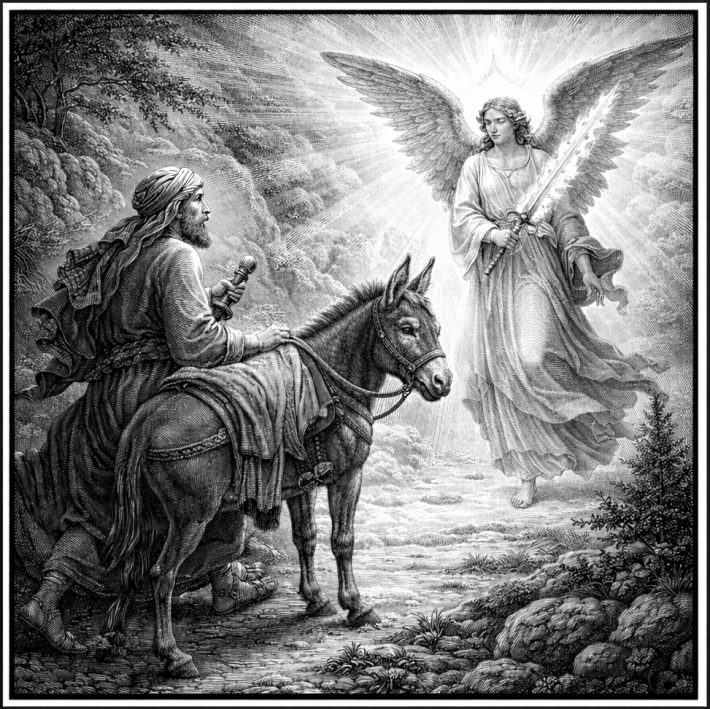
Christian Art | And The Ass Saw The Angel Standing In The Middle Of The Road
Office Of Readings | Sunday, Week 7, Ordinary Time | A Reading From The Four Centuries On Charity By Saint Maximus The Confessor | Without Charity All Is Vanity Of Vanities
‘Without love everything is in vain.’
This passage from Maximus the Confessor presents a rigorous and integrated account of charity as the decisive principle of the Christian life. Its argument is both ascetical and theological, insisting that love of God cannot coexist with disordered attachment to created things, and that authentic faith is inseparable from active love.
The opening definition of charity as a ‘right attitude of mind’ establishes its scope. Charity is not merely an emotion or isolated act, but a comprehensive orientation of the intellect and will. It directs the whole person towards the knowledge of God, understood not as abstract speculation but as lived participation. The contrast with attachment to earthly things is immediate and uncompromising. To prefer created goods over God is not a neutral choice; it is a misordering of value. Maximus frames this in stark terms: to turn from the Creator to creation is to invert the proper hierarchy of being.
This ontological framework underpins the ethical demands that follow. Love of God is not self-contained but necessarily extends to love of neighbour. Maximus draws directly on the teaching of Jesus Christ: the commandment to love God is inseparable from the commandment to love others. The logic is reciprocal and exacting. Failure to love one’s neighbour is not a secondary fault but a direct contradiction of love for God. Charity, therefore, is indivisible; it cannot be selectively applied.
A notable feature of the text is its insistence on universality. The ‘charitable man’ loves all equally, without distinction based on moral status. Yet this equality is not moral indifference. Maximus allows for a preferential inclination towards those who pursue virtue, but this does not diminish the obligation to love all. The model is explicitly divine: as God gives generously according to need, so the believer is to imitate this impartial generosity. Charity is thus shaped by both justice and mercy, responding to the concrete condition of each person.
The discussion then shifts from external acts to interior transformation. While material generosity is affirmed, it is not sufficient. Charity is more deeply expressed in personal service and in the sharing of divine truth. This marks a transition from almsgiving to self-giving. The renunciation of worldly concerns is not presented as withdrawal but as liberation. Freed from selfish desire, the person becomes capable of participating in God’s own knowledge and love. This participation is the goal of the ascetical life.
Maximus further emphasises the endurance required of charity. Drawing on the example of the prophet Jeremiah, he presents love as steadfast under reproach and hardship. The absence of resentment becomes a key criterion. Charity is not negated by suffering but revealed through it. The believer who truly loves does not harbour ill will, even when wronged. This introduces a demanding standard, aligning charity with patience and perseverance.
The final section addresses the relationship between faith and works. Maximus explicitly rejects any notion of faith as sufficient in isolation. The reference to belief shared even by demons underscores the inadequacy of mere assent. Faith must be ‘joined to an active love of God’, expressed concretely in action. This is not an addition to faith but its necessary expression. Without such expression, faith remains incomplete.
The concluding emphasis on ‘using things aright’ returns to the initial theme. Charity orders not only relationships but also the use of material goods. The world is not rejected, but it must be engaged without attachment. Proper use reflects proper love: created things are received and employed in a manner consistent with the primacy of God.
In sum, Maximus presents a demanding yet coherent vision in which charity governs thought, action, and desire. It is the criterion by which faith is tested, the means by which the soul is transformed, and the principle that orders all relations—to God, to others, and to the created world. Without it, all else is indeed in vain.
A Reading From The Four Centuries On Charity By Saint Maximus The Confessor | Without Charity All Is Vanity Of Vanities
Charity is a right attitude of mind which prefers nothing to the knowledge of God. If a man possesses any strong attachment to the things of this earth, he cannot possess true charity. For anyone who really loves God prefers to know and experience God rather than his creatures. The whole set and longing of his mind is ever directed toward him.
For God is far superior to all his creation, since everything which exists has been made by God and for him. And so, in deserting God, who is beyond compare, for the inferior works of creation, a man shows that he values God, the author of creation, less than creation itself.
The Lord himself reminds us: Whoever loves me will keep my commandments. And this is my commandments: that you love one another. So the man who does not love his neighbour does not obey God’s command. But one who does not obey his command cannot love God. A man is blessed if he can love all men equally. Moreover, if he truly loves God, he must love his neighbour absolutely. Such a man cannot hoard his wealth. Rather, like God himself, he generously gives from his own resources to each man according to his needs.
Since he imitates God’s generosity, the only distinction he draws is the person’s need. He does not distinguish between a good man and a bad one, a just man and one who is unjust. Yet his own goodness of will makes him prefer the man who strives after virtue to the one who is depraved.
A Charitable mind is not displayed simply in giving money; it is manifested still more by personal service as well as by the communication of God’s word to others. In fact, if a man’s service toward his brothers is genuine and if he really renounces worldly concerns, he is freed from selfish desires. For he now shares in God’s own knowledge and love. Since he does possess God’s love, he does not experience weariness as he follows the Lord his God. Rather, following the prophet Jeremiah, he withstands every type of reproach and hardship without even harbouring an evil thought toward any man.
For Jeremiah warns us: ’We are the Lord’s temple.’ Neither should you say: ’Faith alone in our Lord Jesus Christ can save me.’ By itself faith accomplishes nothing. For even the devils believe and shudder. No, faith must be joined to an active love of God which is expressed in good works. The charitable man is distinguished by sincere and long-suffering service to his fellow man: it also means using things aright.
Christian Prayer With Jesus Christ
O God,
who are the source and fulfilment of all love,
grant that we may prefer nothing to you.
Free our hearts from every disordered attachment,
that we may seek you above all things
and love you with an undivided mind.
Teach us to love our neighbour as ourselves,
without distinction or reserve,
and to serve others with patience and generosity.
Join our faith to living charity,
that our words and actions may be one,
and that we may follow Jesus Christ in all things.
Through the same Christ our Lord.
Amen
Glossary Of Christian Terms
Charity (Caritas)
The highest theological virtue, by which God is loved above all things and neighbour is loved for God’s sake.
Knowledge of God
A participatory understanding of God, involving both intellect and lived relationship.
Attachment (Disordered Attachment)
An excessive or misplaced love for created things that hinders love of God.
Creation
All that has been made by God, distinct from the Creator yet dependent on him.
Commandment of Love
The teaching of Jesus Christ to love God and neighbour as the foundation of all moral life.
Neighbour
Every human person, regarded as worthy of love without distinction.
Almsgiving
The giving of material assistance to those in need, as an expression of charity.
Asceticism
The practice of self-denial and discipline aimed at spiritual growth and freedom from selfish desire.
Renunciation
The deliberate turning away from worldly attachments in order to seek God more fully.
Faith and Works
The relationship between belief and action; in Christian teaching, true faith is expressed through loving deeds.
Perseverance
Steadfast endurance in love and faith, especially in the face of difficulty.
Imitation of God
The call to reflect God’s attributes, especially love and generosity, in one’s life.
Grace
The divine assistance that enables a person to live according to God’s will.
Use of Created Things
The proper ordering of material goods in accordance with their purpose and with the primacy of God.
Sanctification
The process of becoming holy through growth in charity and participation in divine life.




George Herbert’s Affliction (4) explores a personal and spiritual journey marked by expectation, suffering, and ultimate resignation to God’s will. The poem follows Herbert’s movement from early enthusiasm and joy in his relationship with God to a period of deep suffering and questioning, before finally arriving at a state of reluctant submission. The structure and language of the poem reflect the volatility of this experience, capturing shifts in mood and understanding as Herbert struggles with divine providence [ … ]

‘Behold the Lamb of God.’ Throughout the Bible, we are called to know and to develop our relationship with the Lamb. It is in Genesis the Lamb is first mentioned, provided by God as a sacrifice to take the place of Isaac. Through the history of Jewish ritual, a lamb is offered in sacrifice, for expiation, reparation, sanctification. The prophets speak of a meek, tame lamb, sheared without opening its mouth. In the Book of Revelation, or Apocalypse, the full meaning of the Lamb will be revealed, as the king, the Spouse, the lamp, the temple, the place of our eternal dwelling. The Lamb spans all history. And John the Baptist has already, in John’s Gospel, recognised and declared Christ as the Lamb of God who will take away the sins of the world [ … ]

The Didache—meaning ‘Teaching’—is one of the earliest extra-biblical Christian documents. Its section on the Eucharist provides evidence of a living liturgical tradition at a time when the Church was still young and not yet institutionally centralised. Scholars generally date it between 70 and 110 AD, situating it within living memory of the apostles [ … ]
