

Christian Art | The Eucharist | Jesus And A Boy | Thank You, Jesus
Office Of Readings | Week 14, Wednesday, Ordinary Time | A Reading From An Ancient Work Called The Teaching Of The Twelve Apostles | The Didache | The Eucharist
‘The eucharist.’
Historical Context | A Window Into Early Eucharistic Practice
The Didache—meaning ‘Teaching’—is one of the earliest extra-biblical Christian documents. Its section on the Eucharist provides evidence of a living liturgical tradition at a time when the Church was still young and not yet institutionally centralised. Scholars generally date it between 70 and 110 AD, situating it within living memory of the apostles.
The Eucharistic prayers in this document are shaped less by the Last Supper narrative (which features prominently in later texts such as the Apostolic Tradition of Hippolytus or Justin Martyr’s First Apology) and more by Jewish berakoth—prayers of thanksgiving over food and wine. This suggests that the earliest Christians, many of whom were Jewish converts, drew upon synagogue forms of worship and adapted them to the new covenant revealed in Jesus Christ.
Moreover, the prayer’s reference to the ‘holy vine of David’ and ‘life and knowledge’ through Jesus indicates that Christian liturgical language was already evolving to express Christ’s mediating role in divine revelation. The Eucharist, even at this early stage, was understood as both a meal and a mystery—nourishment for the body and the soul.
Theological Insights | Thanksgiving, Unity, And Eschatology
The Didache’s theology is understated yet significant. First and foremost, the Eucharist is presented as an act of thanksgiving (from the Greek eucharistia), highlighting its nature as a response to God’s gifts rather than a human-initiated ritual. The prayers repeatedly thank the Father ‘through Jesus your servant’, underscoring Christ’s role as mediator and theocentric worship.
Secondly, the prayer over the bread contains a remarkable ecclesiological metaphor:
‘As this broken bread, scattered on the mountains, was gathered and became one, so too may your Church be gathered together from the ends of the earth into your kingdom.’
This image reflects both the physical unity of the Church and its mystical union in Christ. Bread, once scattered grain, is made one; so too are the faithful gathered from diverse nations into a single body. This theological understanding prefigures Paul’s teachings in 1 Corinthians 10:17: ‘Because there is one bread, we who are many are one body.’
Finally, the Eucharist is placed within an eschatological framework. The prayer, ‘May grace come and this world pass away! Maranatha. Amen,’ directly expresses the hope for Christ’s return and the fulfilment of God’s kingdom. The Eucharist is not only a remembrance of Christ but also an anticipation of his second coming—what later theology would call a proleptic celebration of the heavenly banquet.
Ecclesial Implications | Purity, Discipline, And Reconciliation
Beyond theological themes, the Didache offers insights into early Christian community discipline. The instruction that only baptised believers may partake in the Eucharist (‘Do not give to dogs what is holy’) affirms the sacrament as a marker of covenant inclusion. This echoes both Matthew 7:6 and the developing notion of the Eucharist as a means of grace reserved for those within the fold of faith.
Furthermore, the emphasis on reconciliation before participation is strikingly similar to the teachings of Jesus in Matthew 5:23–24:
‘If anyone has a quarrel with his neighbour, that person should not join you until he has been reconciled.’
This anticipates the later practice of the kiss of peace and communal penance, and it underlines the indivisibility of sacramental life and moral integrity. The Eucharist is not simply a rite but a spiritual act demanding interior purity and communal harmony.
In this, we find the origins of what would become the Church’s penitential disciplines and the emphasis—still vital today—on worthy reception of Holy Communion.

A Reading From An Ancient Work Called The Teaching Of The Twelve Apostles | The Eucharist
Celebrate the Eucharist as follows: Say over the cup: ‘we give you thanks, Father, for the holy vine of David, your servant, which you made known to us through Jesus your servant. To you be glory for ever.’
Over the broken bread say: ‘we give you thanks, Father, for the life and the knowledge which you have revealed to us through Jesus your servant. To you be glory for ever. As this broken bread scattered on the mountains was gathered and became one, so too, may your Church be gathered together from the ends of the earth into your kingdom. For glory and power are yours through Jesus Christ for ever.’
Do not let anyone eat or drink of your eucharist except those who have been baptized in the name of the Lord. For the statement of the Lord applies here also: Do not give to dogs what is holy.
When you finish the meal, offer thanks in this manner: ‘We thank you, holy Father, for your name which you enshrined in our hearts. We thank you for the knowledge and faith and immortality which you revealed to us through your servant Jesus. To you be glory for ever. Almighty ruler, you created all things for the sake of your name; you gave men food and drink to enjoy so that they might give you thanks. Now you have favoured us through Jesus your servant with spiritual food and drink as well as with eternal life. Above all we thank you because you are mighty. To you be glory for ever.
‘Remember, Lord, your Church and deliver her from all evil. Perfect her in your love; and, once she has been sanctified, gather her together from the four winds into the kingdom which you have prepared for her. For power and glory are yours for ever.
‘May grace come and this world pass away! Hosanna to the God of David. If anyone is holy, let him come. If anyone is not, let him repent. Maranatha. Amen.’
On the Lord’s day, when you have been gathered together, break bread and celebrate the Eucharist. But first confess your sins so that your offering may be pure. If anyone has a quarrel with his neighbour, that person should not join you until he has been reconciled. Your sacrifice must not be defiled. In this regard, the Lord has said: In every place and time offer me a pure sacrifice. I am a great king, says the Lord, and my name is great among the nations.
Prayer With Jesus | Thanksgiving In The Spirit Of The Didache
O God of eternal wisdom,
We thank you for the holy vine of David,
Revealed to us in your servant Jesus Christ.
You are the giver of life,
The fountain of knowledge and faith,
The one who gathers your scattered people into unity.
As the grains of wheat scattered on the hills
Are made one in the bread we break,
So gather us, your Church, from every nation and tongue
Into the kingdom prepared for us
Since the foundation of the world.
Cleanse us, Lord, from sin;
Heal the wounds of division among your people.
May we, reconciled with one another,
Approach your altar in peace and in truth.
Let grace come, and let this world pass away.
Maranatha – Come, Lord Jesus.
To you be glory, now and for ever.
Amen.
Glossary Of Christian Terms
Didache: An early Christian treatise, often dated to the late 1st or early 2nd century, also known as The Teaching of the Twelve Apostles. It contains ethical instructions, community guidelines, and early liturgical practices.
Eucharist: From the Greek eucharistia, meaning ‘thanksgiving’. It refers to the Christian sacrament instituted by Christ at the Last Supper, commemorating his death and resurrection.
Berakoth: Jewish blessings or prayers of thanksgiving, often said over meals or important rituals. These influenced the early Christian Eucharistic prayers.
Maranatha: An Aramaic expression found in early Christian worship, meaning ‘Come, O Lord’ or ‘Our Lord comes’. It reflects the community’s longing for Christ’s return.
Eschatology: A branch of theology concerned with the ‘last things’ – death, judgement, heaven, and the second coming of Christ.
Sacrament: A visible sign of inward grace, instituted by Christ. In this context, the Eucharist is a sacrament that conveys spiritual nourishment and unity with God and the Church.
Reconciliation: In early Christianity, a prerequisite for full participation in the Eucharist. It emphasises the importance of peace and unity within the community before receiving Holy Communion.
Amen: A Hebrew word meaning ‘truly’ or ‘so be it’. A liturgical affirmation of faith and agreement, especially at the end of prayers.
Holy Vine of David: A messianic image referring to Jesus’ descent from King David, symbolising the fulfilment of God’s promises and the fruitfulness of salvation history.
Spiritual Food and Drink: A reference to the Eucharist as not only physical sustenance but also a means of grace, feeding the soul with divine life.



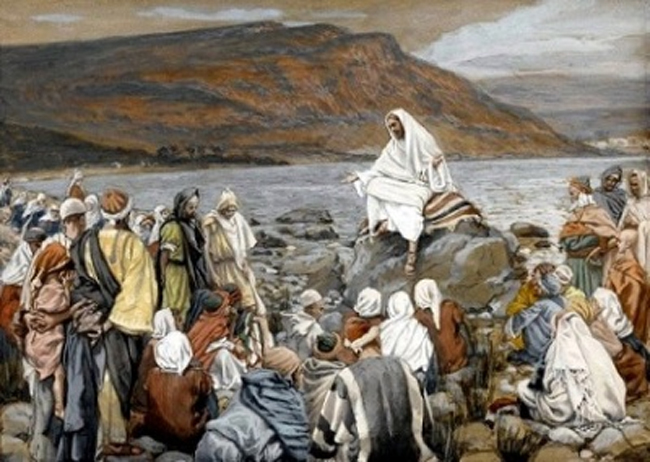
We learn so much about our true relationship with God and with other people in these Gospel verses. Perhaps we might say rather, we are reminded of so much, because these are Christian truths we have long been taught and have long known, but which often are neglected and forgotten. We are recalled in these Gospel verses to Christian truth [ … ]
In this poem, Herbert reflects on the limits of human strength and importance of divine assistance. The poem begins with the modest admission that ‘to write a verse or two is all the praise, / That I can raise’, indicating that any expression of gratitude or devotion Herbert offers to God is inherently limited. This acknowledgment of inadequacy runs throughout the poem, shaping a tone of humility and dependence on divine strength [ … ]

Saint Aelred of Rievaulx presents the highest expression of Christian love: the love of one’s enemies. His reflection is deeply rooted in the Gospel, particularly in Christ’s own example on the cross, where Jesus prays, “Father, forgive them, for they do not know what they are doing.” For Aelred, this moment encapsulates the essence of divine love—self-giving, patient, and without retaliation [ … ]
