

Christian Art | A Boy At Prayer With Jesus | Baptism And The Holy Spirit
Office Of Readings | Eastertide Week 4, Monday | A Reading From The Treatise Of Saint Basil The Great On The Holy Spirit | The Spirit Gives Life
‘The Spirit gives life.’
The Spirit Gives Life | A Commentary On Saint Basil The Great | On The Holy Spirit
Saint Basil the Great’s reflection on baptism and the Holy Spirit is grounded in the rich theological and liturgical tradition of the fourth-century Church, when the doctrine of the Holy Spirit was under fierce debate. Writing against those who denied the divinity of the Spirit (notably the Pneumatomachians), Basil’s On the Holy Spirit defends the Spirit’s full equality with the Father and the Son. In this passage, he focuses on baptism as the sacrament by which the believer enters into new life, through the cooperation of both water and Spirit.
Baptism As Death And Life | Symbol And Reality
Basil begins by interpreting baptism as a symbolic and sacramental participation in both death and life. The water represents death—a kind of burial—while the Holy Spirit is the active agent of new life. This echoes Romans 6:4: ‘We were buried with him by baptism into death, so that, just as Christ was raised from the dead… we too might walk in newness of life.’
For Basil, the water is not merely cleansing dirt from the body—it is a tomb. The descent into water marks the end of the ‘body of sin’. Yet this death is not an end, but a threshold. The Spirit is the one who raises us up again, quickening the soul. The two movements—descent and ascent, dying and rising—are central to Christian initiation. This dual motion is why Jesus says in John 3:5, ‘No one can enter the kingdom of God unless they are born of water and the Spirit.’
The Triple Immersion | The Liturgical Act
Basil highlights the threefold immersion and invocation of the Trinity in baptism. This refers to the ancient rite—still used in the Eastern Church—where the person being baptized is submerged three times, once for each Person of the Trinity. This liturgical form enacts the mystery of the triune God into whose life the baptized is incorporated. It is not only a symbol but a real participation in divine life.
The ‘passing on of divine knowledge’ mentioned by Basil is the catechesis that accompanies baptism, ensuring that the initiate receives not just a ritual washing, but enlightenment—both spiritual and doctrinal. Baptism is therefore a mystery that engages the whole person: body, mind, and soul.
The Grace Is From The Spirit | Not From The Water
Basil makes a crucial clarification: the power of baptism does not reside in the water itself, but in the presence of the Spirit. The water is the sign; the Spirit is the substance. This guards against any magical or superstitious interpretation of the sacrament. Quoting 1 Peter 3:21, Basil reminds us that baptism is ‘not the removal of dirt from the body, but the pledge of a good conscience toward God’.
Thus, baptism is effective not only because it is performed properly, but because it is received in faith, as the response of a renewed heart.
Life After Baptism | Ethics And Eschatology
Basil connects baptism not only to the forgiveness of sin but to the transformation of life. Baptism is the beginning of a journey. The Spirit enables us to live according to the Gospel: with gentleness, endurance, detachment from pleasure and greed. The baptized must grow into the likeness of Christ.
This moral dimension of baptism is important in Basil’s theology. The sacrament is not simply a past event; it initiates a lifelong call to holiness, anticipating the life of the resurrection. Basil sees Christian life as a preparation for eternity—training for the life of the world to come.
The Work Of The Spirit | Adoption And Glory
In a crescendo of theological depth, Basil describes the Spirit as the agent of the entire process of salvation. Through the Spirit:
- We are restored to paradise (symbolizing communion with God),
- We ascend into the kingdom of heaven,
- We are adopted as sons and daughters of God,
- We gain the freedom to call God Abba,
- We receive a share in the grace of Christ,
- We are called children of light,
- We are given a foretaste of eternal glory.
This comprehensive vision of salvation highlights the Spirit’s role not only at baptism but throughout the Christian life. For Basil, everything that brings us into union with God—everything we hope for—is mediated by the Holy Spirit.
Already And Not Yet | The Promise And The Fulfilment
Finally, Basil reflects on the tension between present grace and future fulfilment. By faith, we see the reflection of what is to come. We already possess the ‘first fruits’ of glory through the Spirit, but we await its full unveiling. This eschatological tension is deeply biblical—echoing Paul’s words in Romans 8:23: ‘we ourselves… groan inwardly while we wait for adoption, the redemption of our bodies.’
For Basil, the wonder of the promise already overwhelms the imagination—how much more the reality? The Spirit gives us not only grace but the longing for glory. This longing is itself a sign of the Spirit’s presence.
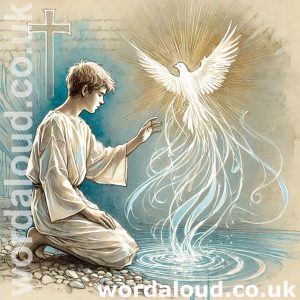
A Reading From The Treatise Of Saint Basil The Great On The Holy Spirit | The Spirit Gives Life
For this cause the Lord, who gives us our life, gave us the covenant of baptism, containing a type of life and death, for the water fulfils the image of death, and the Spirit gives us the promise of life. Hence it follows that the answer to our question why the water was associated with the Spirit is clear. The reason is because in baptism two ends were proposed: on the one hand, the destroying of the body of sin, that it may never ripen into death; on the other hand, our coming to life in the Spirit, ripening and having our fruit in holiness. Like a tomb, the water receives the body, symbolizing death; while the Spirit pours in the quickening power, renewing our souls from the deadness of sin into their original life. This then is what it is to be born again of water and of the Spirit, the water bringing the necessary death while the Spirit creates life within us.
In three immersions, then, and with three invocations, the great mystery of baptism is performed. Thus the symbol of death is made complete, and by the passing on of the divine knowledge the baptized have their souls enlightened. It follows that if there is any grace in the water, it is not of the nature of the water, but of the presence of the Spirit. For baptism is not the putting away of the filth of the flesh, but the answer of a good conscience towards God. So in training us for the life that follows on the resurrection the Lord sets out all the manner of life required by the Gospel, laying down for us the law of gentleness, of endurance of wrong, of freedom from the defilement that comes of the love of pleasure, and from covetousness – all this so that we can by our own choice achieve all that the life to come of its inherent nature possesses.
Through the Holy Spirit comes our restoration to paradise, our ascension into the kingdom of heaven, our return to the status of adopted sons, our liberty to call God our Father, our being made partakers of the grace of Christ, our being called children of light, our sharing in eternal glory – in a word, our being brought into a state of all fullness of blessing both in this world and in the world to come, of all the good gifts that are in store for us. Through faith we behold the reflection of their grace as though they were already present, but we still have to wait for the full enjoyment of them. If such is the promise, what will the perfection be like? If these are the first fruits, what will be the complete fulfilment?
Glossary Of Terms
- Baptism – The Christian sacrament of initiation, involving water and (usually) a Trinitarian formula, through which a person is spiritually reborn.
- Catechesis – Instruction given to those preparing for baptism or deeper Christian understanding; from the Greek katecheo, ‘to instruct’.
- Pneumatomachians – A 4th-century heretical group that denied the full divinity of the Holy Spirit; the term means ‘fighters against the Spirit’.
- Sacrament – A visible sign instituted by Christ to convey spiritual grace.
- Triune / Trinity – Refers to the threefold nature of God as Father, Son, and Holy Spirit.
- Liturgy – The official public worship of the Church, especially the rites of sacraments like baptism and the Eucharist.
- Mystery (Greek: mysterion) – A divine truth revealed by God, often associated with the sacraments in early Church language.
- Quickening – An older term meaning ‘bringing to life’ or ‘making alive’, especially used in reference to the Spirit’s role in renewal.
- Eschatology – The branch of theology concerned with the final events of history, such as resurrection, judgment, and eternal life.
- First fruits – A biblical term (e.g., Romans 8:23) meaning the initial signs or foretaste of a future, fuller harvest—in this case, of eternal life.
- Adoption (in theology) – The idea that Christians become sons and daughters of God through grace, not by nature.
- Contemplation – Deep spiritual reflection or vision of divine realities, especially associated with the experience of God.




When our hearts are pure, our vision becomes clear. We are able to recognize God’s hand at work, His love in action, and His guidance in our lives. We see the beauty of His creation, the divine purpose in every circumstance, and the ways in which God is leading us on the path of righteousness [ … ]

This sermon by Isaac of Stella offers a sustained meditation on charity as the governing principle of Christian life. Its argument is both moral and theological, moving from practical exhortation to a more fundamental claim: that charity is not one virtue among others, but the form and fulfilment of all virtue [ … ]
Saint Clement I, Bishop of Rome, likely writing around AD 96, addresses this letter to the Corinthian church during a period of turmoil. Corinth was a Roman colony steeped in competition for status and influence, and such cultural factors likely influenced tensions within the Christian community there. The division in question seems to have been caused by a rebellion against duly appointed presbyters, leading to strife and disunity [ … ]
