
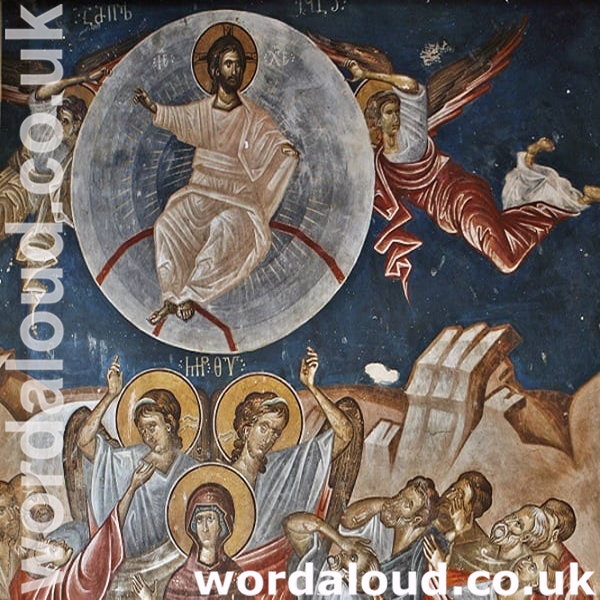
Christian Art | Jesus Christ Ascension | Love Revealed By Jesus
Office Of Readings | Week 19, Thursday, Ordinary Time | A Reading From The Treatise Of Saint Gregory Of Nyssa On Christian Perfection | We Have Jesus Christ Who Is Our Peace And Our Light
‘Jesus Christ is our peace and our light.’
Saint Gregory of Nyssa draws together two biblical images of Christ—peace and light—and makes them measures of Christian authenticity. He begins with peace, taking his cue from Ephesians 2:14: ‘He is our peace, for he has made both one.’ Gregory treats peace not as an abstract quality but as the practical end of reconciliation. Christ has destroyed the ‘enmity’ between Jew and Gentile, and, more fundamentally, between humanity and God. That enmity, he says, must remain dead; resentment and grudges are signs of calling it back to life.
Gregory applies this both outwardly and inwardly. Outwardly, believers are to be reconciled even with those who oppose or harm them. Inwardly, they are to resolve the ‘civil war’ between flesh and spirit. Here he follows Paul’s teaching that the ‘wisdom of the flesh’ can be brought into obedience to God’s law (cf. Romans 8:6–7). When a person is reconciled within, body and soul aligned in the pursuit of virtue, he or she becomes peace—not merely at peace, but embodying it.
The second image is light. Christ, as ‘the true light’ (John 1:9), is utterly without deceit. His light is refracted through the virtues, which Gregory calls ‘rays of the Sun of Justice’ (cf. Malachi 4:2). These virtues dispel darkness, understood here as sin and moral compromise. Walking in the light means living openly and honourably, with nothing hidden or corrupt. For Gregory, this ‘illumination’ is not only personal; like light itself, it radiates outward, influencing and guiding others.
The theme of holiness completes the picture. If Christ is our holiness (cf. 1 Corinthians 1:30), then holiness must be visible in conduct, not just claimed in words. Holiness is demonstrated when thoughts, actions and desires are free from impurity. Gregory’s point is uncompromising: calling oneself a Christian is only truthful if one’s life reflects the peace, light, and holiness of Christ.
Gregory’s teaching challenges readers to examine their relationships, their inner conflicts, and the moral transparency of their actions. The unity he describes—within oneself, with others, and with God—is not achieved through sentiment but through deliberate transformation in the likeness of Christ.

A Reading From The Treatise Of Saint Gregory Of Nyssa On Christian Perfection | We Have Jesus Christ Who Is Our Peace And Our Light
He is our peace, for he has made both one. Since we think of Christ as our peace, we may call ourselves true Christians only if our lives express Christ by our own peace. As the Apostle says: He has put enmity to death. We must never allow it to be rekindled in us in any way but must declare that it is absolutely dead. Gloriously has God slain enmity, in order to save us; may we never risk the life of our souls by being resentful or by bearing grudges. We must not awaken that enmity or call it back to life by our wickedness, for it is better left dead.
No, since we possess Christ who is peace, we must put an end to this enmity and live as we believe he lived. He broke down the separating wall, uniting what was divided, bringing about peace by reconciling in his single person those who disagreed. In the same way, we must be reconciled not only with those who attack us from outside, but also with those who stir up dissension within; flesh then will no longer be opposed to the spirit, nor the spirit to the flesh. Once we subject the wisdom of the flesh to God’s law, we shall be re-created as one single man at peace. Then, having become one instead of two, we shall have peace within ourselves.
Now peace is defined as harmony among those who are divided. When, therefore, we end that civil war within our nature and cultivate peace within ourselves, we become peace. By this peace we demonstrate that the name of Christ, which we bear, is authentic and appropriate.
When we consider that Christ is the true light, having nothing in common with deceit, we learn that our own life also must shine with the rays of that true light. Now these rays of the Sun of Justice are the virtues which pour out to enlighten us so that we may put away the works of darkness and walk honorably as in broad daylight. When we reject the deeds of darkness and do everything in the light of day, we become light, and, as light should, we give light to others by our actions.
If we truly think of Christ as our source of holiness, we shall refrain from anything wicked or impure in thought or act and thus show ourselves to be worthy bearers of his name. For the quality of holiness is shown not by what we say but by what we do in life.
Christian Prayer With Jesus Christ
Lord Jesus Christ,
You are our peace, breaking down the walls that divide us.
Quell the quarrels in our hearts, heal our grudges,
and reconcile what is torn within us.
Shine upon us with the light of Your truth,
that our lives may reflect Your virtues
and give light to those around us.
Keep us in holiness of thought and action,
so that we may bear Your name with truth
and walk always in the day of Your presence.
Amen.
Glossary Of Christian Terms
Enmity – Deep-seated hostility or hatred; in Scripture, often referring to the state of opposition between humanity and God, or between divided groups.
Flesh and spirit – In Pauline thought, ‘flesh’ refers not simply to the body but to human nature inclined toward sin; ‘spirit’ refers to the human self renewed and led by God’s Spirit.
Wisdom of the flesh – A biblical phrase (cf. Romans 8:6–7) for thinking and desiring according to sinful self-interest rather than God’s will.
Civil war within our nature – Gregory’s image for the inner conflict between sinful desires and the call to virtue.
Sun of Justice – A messianic title from Malachi 4:2 (Hebrew 3:20) describing Christ as the source of righteousness and healing.
Works of darkness – Actions, attitudes, or habits that are morally corrupt or hidden in secrecy, opposed to the light of God’s truth.
Holiness – Separation from sin and dedication to God in thought, word, and deed; not just a status but a lived reality.



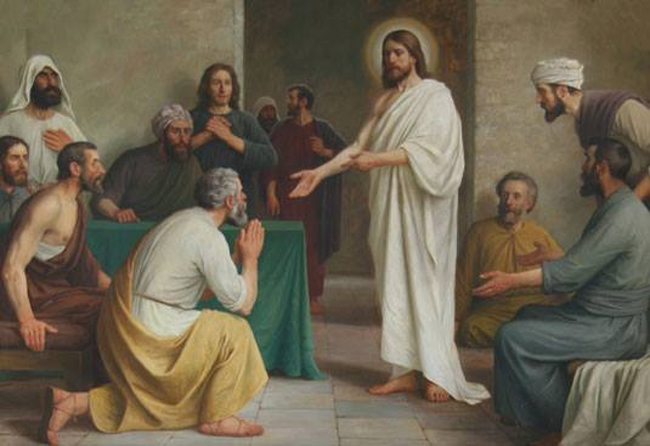
The disciples who encountered Jesus on their way to Emmaus have returned in haste to tell the disciples in Jerusalem what they have heard and seen. Jerusalem has long been a city special to God. It is the Holy City. The Church of Christ is described, in the New Testament, as the Jerusalem above, the heavenly Jerusalem, and the new Jerusalem [ … ]

Psalm 139 meditates on the nature of God and God’s relationship with humanity. The psalm combines awe for God’s transcendent knowledge and presence with a deep sense of personal connection and care. This psalm resonates with themes of God’s unfathomable knowledge, unwavering presence, and the sacredness of human life, making it a significant piece for contemplation and spiritual reflection [ … ]
Psalm 48 is a tribute to the city of God – Mount Zion. This psalm extols the greatness of the Lord and splendour of the holy city, portraying Zion as a place of refuge and rejoicing. The psalm underscores the enduring nature of God’s protection and guidance [ … ]
