
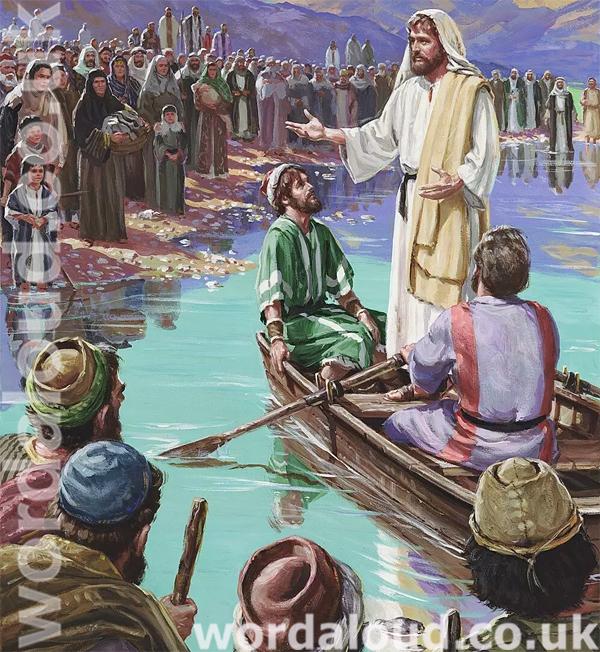
Christian Art | Jesus Preaches To The Multitudes From A Fishing Boat
Office Of Readings | Week 30, Tuesday, Ordinary Time | A Reading From The Letter Of Pope Saint Clement I To The Corinthians | God Is Ever True To His Word
‘God is faithful in his promises.’
Saint Clement’s reflection on divine fidelity presents an early instance of Christian reasoning that links observation of the natural order with trust in the promise of resurrection. The structure of the argument proceeds by analogy: the visible alternation of night and day, the decay and renewal of seed, the continuous pattern of the seasons, all provide evidence that death does not end a process but belongs within it. The ordered rhythm of nature is treated not as mere metaphor but as a form of testimony, available to perception and open to interpretation by faith.
In the world that Clement describes, nothing stands apart from divine intention. The same power that establishes natural processes also governs their renewal. The resurrection of Christ is described as the ‘first fruits’, an agricultural term which positions his rising as the beginning of a wider harvest. The sequence of sowing and reaping thus becomes both a sign and a demonstration: what occurs in the field displays what God will accomplish in humanity. The pattern of life emerging from decay is not random but indicative of a universal principle sustained by divine reliability.
Clement’s statement that ‘nothing is impossible for God except to tell a lie’ sets a boundary on the understanding of omnipotence. The divine will cannot contradict the divine nature. Power and truth are not separable attributes; they belong to a single reality in which action and being are consistent. This principle ensures that the promises of God, once given, cannot fail. For Clement, the reliability of creation reflects the reliability of its maker, and therefore belief in the resurrection rests upon observation of the world as it is maintained by that maker.
The reading moves from cosmology to ethics. Because all things are known and sustained by God, the human response must be reverence expressed through moral discipline. Clement quotes and reinterprets verses from the Psalms to illustrate the inescapability of the divine presence. The awareness that nothing is hidden is not treated as threat but as condition: existence itself takes place within the range of divine perception. To live rightly, therefore, is to live in accordance with the structure of that perception, with no division between inward thought and outward act.
The reading turns to worship. The image of ‘hands pure and undefiled’ links the inner life to the external gesture of prayer. Purity is defined not as withdrawal from the world but as fitness for communication with the one whose ‘hands embrace the universe’. Clement’s thought remains consistent: the same divine reality that orders the cosmos receives the prayer of the individual. The believer stands within a comprehensive order that includes both nature and grace, both the processes of the earth and the promise of resurrection.
A Reading From The Letter Of Pope Saint Clement I To The Corinthians | God Is Ever True To His Word
Consider, beloved, how the Lord keeps reminding us of the resurrection that is to come, of which he has made the Lord Jesus Christ the first fruits by raising him from the dead. Let us look, beloved, at the resurrection that occurs as its appointed time. Day and night show us a resurrection; the night lies in sleep, day rises again; the day departs, night takes its place. Let us think about the harvest; how does the sowing take place, and in what manner? The sower goes out and casts each seed onto the ground. Dry and bare, they fall into the earth and decay. Then the greatness of the Lord’s providence raises them up again from decay, and out of one many are produced and yield fruit.
In this hope, then, let our hearts be bound fast to him who is faithful in his promises and just in his judgments. He forbade us to tell lies; still less will he himself tell a lie. Nothing is impossible for God except to tell a lie. Then let our faith in him be awakened; let us reflect that everything is close to him.
By the word of his power he established all things, and by his word he can reduce them to ruin. Who shall say to him: What have you done? Who shall stand up against the power of his might? He will accomplish everything when he wills and as he wills, and nothing that he has decreed shall pass away. All things stand in his presence, and nothing lies hidden from his counsel, if the heavens tell forth the glory of God, the firmament reveals the work of his hands, day speaks to day, and night shares knowledge with night; there are no words, no speeches, and their voices are not heard.
Since all things lie open to his eyes and ears, let us hold him in awe and rid ourselves of impure desires to do works of evil, so that we may be protected by his mercy from the judgment that is to come. Which of us can escape his mighty hand? What world will give asylum to one who deserts him? Where will I go, where will I hide from his face? If I go up to heaven, you are there; if I go to the limits of the earth, your right hand is there; if I lie down in the deep, your spirit is there. Where, then, can one go, where can one escape to, from the presence of him whose hands embrace the universe?
Let us then approach him in holiness of soul, raising up to him hands pure and undefiled, out of love for our good and merciful Father who made us a chosen portion for himself.
Christian Prayer With Jesus
Faithful God,
whose word sustains all things in order and truth,
renew in us the hope of the resurrection,
and cleanse our hearts from all deceit,
that with pure hands and steadfast faith
we may draw near to you in holiness and peace.
Through Jesus Christ our Lord,
who lives and reigns with you and the Holy Spirit,
one God, now and for ever. Amen.
Glossary Of Christian Terms
Analogy – A form of reasoning in which one reality is interpreted through another; in this context, the natural cycle of decay and renewal is read as a sign of the resurrection.
Providence – The divine ordering and sustaining of creation; not an intervention into chaos but the continuous operation of purpose within the world.
First fruits – A biblical term for the earliest yield of a harvest, consecrated to God; here, it signifies Christ’s resurrection as the initial instance of the general resurrection.
Omnipotence – The attribute of divine power understood as limitless in scope but self-consistent; God cannot act contrary to his own nature or truth.
Immutability – The quality of being unchanging; used of God to denote constancy in will, character and promise.
Epistemology – The study of how knowledge is acquired or justified; relevant here where Clement implies that perception of nature can lead to knowledge of divine purpose.
Ontology – The study of being; in theological terms, the nature of existence as created and sustained by God.
Cosmology – The understanding of the universe as an ordered whole; for Clement, the cosmos is a manifestation of divine harmony.
Teleology – Explanation in terms of purpose or end; Clement’s argument assumes that creation possesses direction and finality under God’s design.
Eschatology – The branch of theology concerned with the last things: death, resurrection, judgment, and the ultimate destiny of creation.
Ethics – The practice of conduct in accordance with divine order; moral discipline as response to the knowledge that all things are open to God.
Immanence – The presence of God within creation; distinct from transcendence yet inseparable from it in Clement’s description of a world held within divine awareness.
Transcendence – The aspect of God’s being that surpasses and contains creation; the source of order that is not itself contained by the created order.
Theophany – A manifestation of the divine within the created world; the natural order can be read as such a manifestation for those with the perception of faith.
Soteriology – The doctrine of salvation; implied in Clement’s claim that resurrection and renewal are the fulfilment of divine promise.
Ascesis – A term from Greek spiritual vocabulary meaning disciplined practice or self-restraint; the ethical form of reverence urged by Clement.
Veracity – Truthfulness or reliability; used here of God’s nature as incapable of falsehood, ensuring the trustworthiness of his promises.




The Sabbath is rooted in God’s own example. After creating the heavens and the earth in six days, God rested on the seventh day and blessed it, setting it apart as a holy day (Genesis 2:2-3). This pattern of rest and blessing established the foundation for the observance of the Sabbath [ … ]

The Windhover by Gerard Manley Hopkins is a richly layered poem exploring the beauty of a kestrel in flight, while presenting a complex meditation on spiritual revelation, self-sacrifice, and divine glory. Hopkins dedicates the poem ‘To Christ our Lord’, indicating that the bird’s physical mastery mirrors the divine majesty of Christ [ … ]

Saint Ambrose begins his meditation on the Psalms by praising their special role in Scripture: not simply as theological texts, but as a unique blending of prayer, beauty, and doctrine. He writes that a psalm is ‘a blessing on the lips’, ‘a cry of happiness’, and ‘a promise of peace and harmony’. Such language reflects the early Christian sense that the Psalms were the heartbeat of both private devotion and public worship — the school of prayer, to use a phrase echoed by Saint Augustine and, centuries later, by Pope Benedict XVI [ … ]
