Loading...
George Herbert | The TemplePoems With Jesus | Christian Faith In Poetry

George Herbert | The Temple | Praise (1) | Church | Christian Poems | Metaphysical Poetry

George Herbert | The Temple | Praise | Church | Poem | Audio

Christian Art | George Herbert | The Temple | The Church | Praise (1)

George Herbert | The Temple | The Church | Praise (1)

To write a verse or two, is all the praise,
That I can raise:
Mend my estate in any wayes,
Thou shalt have more.

I go to Church; help me to wings, and I
Will thither flie;
Or, if I mount unto the skie,
I will do more.

Man is all weaknesse; there is no such thing
As Prince or King:
His arm is short; yet with a sling
He may do more.

An herb destill’d, and drunk, may dwell next doore,
On the same floore,
To a brave soul: Exalt the poore,
They can do more.

O raise me then! poore bees, that work all day,
Sting my delay,
Who have a work, as well as they,
And much, much more.

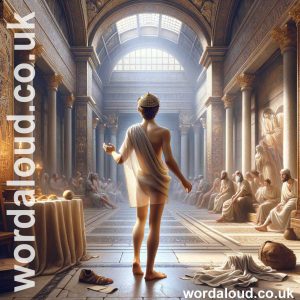
George Herbert | The Temple | Praise | Church | Poem | Audio

George Herbert | The Temple | The Church | Praise

In this poem, Herbert reflects on the limits of human strength and importance of divine assistance. The poem begins with the modest admission that ‘to write a verse or two is all the praise, / That I can raise’, indicating that any expression of gratitude or devotion Herbert offers to God is inherently limited. This acknowledgment of inadequacy runs throughout the poem, shaping a tone of humility and dependence on divine strength.

The poem is structured around a sequence of conditional promises: if God improves Herbert’s situation or ‘mends’ his condition, Herbert pledges to offer more in return. In the second stanza, for instance, the poet states that he goes to church, but with divine help, he could ‘fly’ there, suggesting he desires not just to meet the minimum expectation but to exceed any such if enabled by God. The request for ‘wings’ evokes a desire for spiritual elevation, implying that mere attendance or passive devotion is insufficient; Herbert aspires to a more fervent, active spirituality, one he can achieve only through divine support.

The poem then transitions to a broader commentary on human frailty, emphasizing that ‘man is all weakness’ and dismissing a notion of human authority by stating that there is ‘no such thing as prince or king’. This statement positions human power as ineffectual, highlighting that even strongest individuals are limited without God’s strength. The reference to the ‘short arm’ of human beings suggests a physical and metaphorical limitation, underscoring humanity’s inherent helplessness in the face of divine power. Despite these limitations, the line ‘yet with a sling he may do more’ alludes to the biblical story of David and Goliath, where a seemingly insignificant weapon in a humble hand can be transformative. This story underscores the theme that God’s power, when granted, enables individuals to transcend limitations.

Herbert’s reflections deepen with the mention of ‘an herb distilled, and drunk’, which he says could reside ‘next door / On the same floor, / To a brave soul’. This suggests that even smallest elements of creation have inherent potency, potentially close to divine strength when magnified by God. Herbert emphasizes that if the humble and ‘exalted poor’ receive divine help, they too ‘can do more’. This theme of reversal—where weakness becomes strength through divine intervention—reinforces Herbert’s sense of reliance on God’s grace to achieve any meaningful or extraordinary accomplishments.

In the final stanza, Herbert likens himself to ‘poor bees’ who labour tirelessly. Here, bees serve as a metaphor for industriousness and purposeful work, qualities Herbert aspires to in his spiritual life. The reference to the bee also connects to the theme of collective humility, as each bee contributes to a larger purpose. Herbert acknowledges that he ‘has a work’ to do, paralleling the purposeful existence of the bees. His request for the bees to ‘sting my delay’ suggests that he recognizes a need to be jolted into action, spurred by a kind of spiritual urgency.

The poem explores a paradox that while human efforts are limited, such efforts are made meaningful through divine empowerment. The repetition of ‘more’ reflects Herbert’s desire to extend his own capacities, while continually acknowledging that such aspirations can only be fulfilled with God’s aid. The final line, ‘And much, much more,’ captures a yearning to transcend earthly limitations, a desire for divine enablement that would allow Herbert to fulfil his potential to its fullest extent. The poem presents a vision of spirituality grounded in humility, active purpose, and recognition of human dependence on God’s grace.

Meditations On The Love Of Jesus Christ | Word Aloud | Prayer And Reflection
  • Audio Bible | Advent | John The Baptist And Jesus

    Jesus pays tribute to John as a great prophet, bringing the truth of God to the people, as a burning and a shining light. There is perhaps a veiled rebuke as Jesus reminds the people that they flocked to him for a period, as if theirs was a fickle and fleeting regard. Nonetheless, Jesus speaks of John now to help the people, because John witnessed Christ and that witness could help people to believe and so be saved [ … ]

  • Audio Bible | Jesus | God Father Son

    Jesus explains certain aspects of the truth of his relationship with his Father. He explains that he is consubstantial with the Father. He is not created as we are; he is the Son; he has life in himself. On earth, Jesus is the mirror of the Father. It is through Christ that we may approach God. God the Father and God the Son share one being. The Father and the Son are equal [ … ]

  • Saint Bernadette | Lourdes | Audio Bible | KJV | King James Version | Word Aloud

    John 4:13-14 (KJV) ‘Jesus answered and said unto her, Whosoever drinketh of this water shall thirst again: But whosoever drinketh of the water that I shall give him shall never thirst; but the water that I shall give him shall be in him a well of water springing up into everlasting life.’ Introduction to the Life of Saint Bernadette Saint Bernadette Soubirous, a humble peasant girl from Lourdes, France, lived her life of faith, humility, and divine grace. Born on January 7, 1844, in the small town of Lourdes, Bernadette was the eldest of nine children in a poor and struggling family. Her father, François Soubirous, was a miller, and her mother, Louise, a laundress. The family lived in a former prison cell known as the Cachot, a damp and cramped space, according to their dire financial situation. Despite their poverty, the Soubirous family was deeply rooted in their Christian faith, a foundation that would profoundly shape Bernadette’s life and spiritual journey. Bernadette’s early years were marked by significant health challenges. She suffered from asthma and other respiratory ailments, which often left her weak and unable to attend school regularly. This lack of formal education meant that Bernadette struggled with reading and writing, and her understanding of Christian doctrine was limited. Nevertheless, she possessed a remarkable simplicity and purity of heart, qualities that would make her an ideal recipient of divine revelations. Bernadette’s life changed irrevocably on February 11, 1858, when she experienced the first of eighteen apparitions of the Blessed Virgin Mary at the grotto of Massabielle. On that cold winter day, Bernadette, her sister Toinette, and a friend were gathering firewood near the grotto when she heard a rustling sound and saw a beautiful lady dressed in white with a blue sash, holding a rosary. The lady, who later identified herself as the Immaculate Conception, appeared to Bernadette over the course of several months, delivering messages of penance, prayer, and the need for a chapel to be built at the site. Despite initial skepticism from her family and the local authorities, Bernadette remained steadfast in her account of the apparitions, enduring intense scrutiny and even ridicule. The apparitions drew enormous attention. Soon, people from all over France and beyond began to visit Lourdes, hoping to witness a miracle. One of the most significant messages conveyed by the Virgin Mary to Bernadette was the instruction to dig in the ground near the grotto, which led to the discovery of a spring. This spring, believed to have healing properties, became the focal point of the pilgrimage to Lourdes. Many miraculous healings have been attributed to the waters of Lourdes, reinforcing the belief in Bernadette’s visions and the sanctity of the site. As the apparitions concluded, Bernadette’s life took a different turn. In 1866, she joined the Sisters of Charity in Nevers, taking the name Sister Marie-Bernard. Her time in the convent was marked by continued poor health and humility, as she carried out menial tasks and lived a life of quiet service. Despite her physical suffering, Bernadette remained devout and accepted her hardships with grace, often repeating the phrase, “I am happier here in my little corner of the convent.” Her unwavering faith and dedication to her religious duties exemplified the depth of her spiritual commitment. Bernadette Soubirous passed away on April 16, 1879, at the age of 35, after a prolonged battle with tuberculosis. Her legacy, however, endured far beyond her earthly life. In 1933, she was canonized as a saint by Pope Pius XI, recognized for her humility, faith, and the miraculous events associated with her life. Today, millions of pilgrims flock to Lourdes each year, seeking spiritual renewal and physical healing at the site of her visions. Saint Bernadette’s life continues to inspire countless individuals around the world, reminding us of the power of faith, the virtue of humility, and the enduring presence of divine grace in our lives. To Visit Lourdes Visiting Lourdes, in the picturesque foothills of the Pyrenees in southwestern France, is an experience that transcends the physical journey, drawing pilgrims into a profound spiritual adventure. The small town, known for the Marian apparitions witnessed by Saint Bernadette Soubirous in 1858, has become one of the world’s most revered pilgrimage sites. As we approach the Sanctuary of Our Lady of Lourdes, the atmosphere is imbued with a palpable sense of reverence and anticipation. The grand basilicas, the tranquil Grotto of Massabielle and the gently flowing waters of the miraculous spring together create a sacred environment that invites reflection, prayer, and a deep connection with the divine. The focal point of any visit to Lourdes is the Grotto, where Bernadette experienced the apparitions of the Blessed Virgin Mary. Here, pilgrims can touch the rock face, light candles, and drink or bathe in the spring’s water, believed to possess healing properties. The profound silence and sense of sacredness at the Grotto allow visitors to contemplate their faith, seek solace and find spiritual renewal. The Rosary Basilica, with its mosaics, and the Basilica of the Immaculate Conception, perched above the Grotto, offer spaces for communal worship and personal meditation. The nightly candlelight processions, where pilgrims from around the globe unite in prayer and song, highlight the universal bond of faith and hope that Lourdes represents. Beyond its physical beauty and historical significance, visiting Lourdes offers a deeply personal and transformative experience. Pilgrims often arrive burdened with ailments, grief, or spiritual crises, seeking comfort and miracles. The stories of healing and faith that emerge from Lourdes are testimonies to the enduring power of belief and the intercession of the Blessed Virgin Mary. The communal aspect of the pilgrimage—sharing meals, prayers, and stories with fellow believers—fosters a sense of solidarity and mutual support. For many, the visit to Lourdes is a journey of healing, not only of the body but also of the soul, providing a renewed sense of purpose, peace, and spiritual clarity that lingers long after returning home. Prayer With Saint Bernadette Prayer for Intercession Dear […]

Search Google Here | A Holy Land Jerusalem Pilgrimage? | A Safari? | An Escape..