
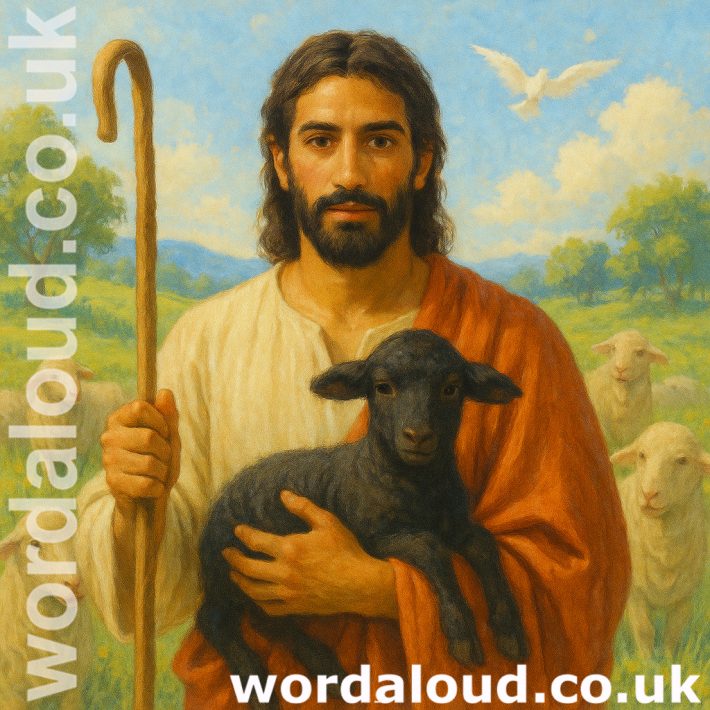
Christian Art | Jesus Christ Is The Good Shepherd
Office Of Readings | Week 13, Monday, Ordinary Time | A Reading From The Sermons Of Saint Augustine | He Is Our God And We Are The Sheep Of His Flock
‘He is the Lord our God and we are the people of his pasture.’
We Are God’s Flock | Created And Cared For
Saint Augustine opens with a profoundly theological insight: unlike earthly shepherds who receive flocks they did not create, God both made and tends his sheep. This evokes both Genesis and John 1, affirming the Creator as the ongoing sustainer. It also draws on the imagery of Ezekiel 34, where God denounces negligent shepherds and declares: ‘I myself will shepherd my sheep.’
By referencing that we are ‘the sheep of his hands’, Augustine brings to the fore the intimacy of divine care. God’s hands form us (cf. Psalm 139), hold us, and lead us. This tactile language of creation and guidance sets a tone of gratitude and reverence, reminding the listener that their existence and salvation are entirely God’s work.
The Dual Role Of The Bishop | Shepherd And Sheep
Augustine’s rhetorical brilliance lies in his refusal to separate himself from the flock. Though a bishop – a shepherd – he insists that he too is a sheep. This admission is not only an act of humility, but a profound ecclesiological statement. In Augustine’s ecclesiology, the Church is one body; even those who guide must be guided.
He warns that a bishop who listens only to warnings directed at pastors, and not to those directed at the sheep, is dangerously indifferent. His heart, like that of every Christian, must remain ‘always concerned’. This reflects Augustine’s fear of episcopal complacency – a recurrent theme in his sermons. Here we also see the influence of Cicero’s rhetorical model: Augustine teaches, delights, and moves his audience by confessing his own vulnerability.
Divine Judgment And Human Patience
A striking element of the sermon is Augustine’s treatment of divine judgment. Echoing Matthew 25, he reminds his audience that goats and sheep co-exist in the same pasture – for now. The Church, in this life, is a corpus permixtum – a mixed body. The separation will come at the end, when Christ, the true Shepherd, will divide the flock.
But this delay in judgement is not arbitrary; it is the arena of mercy. God’s patience, says Augustine, is a model for our own. Just as God tolerates the unrighteous among his people, so must the faithful resist the temptation to judge prematurely. This teaching is especially poignant in Augustine’s own context, as he grappled with the Donatist schism, where some Christians argued for a Church of only the visibly righteous.
By contrast, Augustine urges patience, humility, and trust in God’s timing. Even now, the goats drink from the same springs as the sheep. The visible Church includes saints and sinners alike, and only the final judgement will reveal each one’s place.
Consolation And Responsibility
The sermon oscillates between comfort and challenge. On the one hand, Augustine assures the faithful that they are the sheep of God, under the care of a shepherd who neither slumbers nor sleeps (cf. Psalm 121). This is a source of unshakable security: not only does God tend the flock, but he created it, redeemed it, and dwells among it.
Yet this security brings responsibility. ‘What happiness, what great joy it is to realise that we are God’s flock!’ But with that joy comes the duty of listening to God’s voice, remaining in his pasture, and not becoming goats through pride or disobedience. This recalls John 10, where Christ says, ‘My sheep hear my voice; I know them, and they follow me.’
Jesus Christ The True Shepherd
Finally, the backdrop to all of Augustine’s reflections is the person of Jesus Christ the Good Shepherd. While Augustine does not name Christ explicitly in this section, the Christological framework is implicit throughout. It is Jesus Christ who watches, judges, forgives, and gathers. He is both the Shepherd and the Lamb – the one who leads and the one who lays down his life for the sheep.
The confidence of the Church, then, is not in the holiness of her members or the competence of her leaders, but in the faithfulness of Christ. The sheep are safe because the shepherd is divine. That is the centre of Augustine’s ecclesial and pastoral vision.

A Reading From The Sermons Of Saint Augustine | He Is Our God And We Are The Sheep Of His Flock
The words we have sung contain our declaration that we are God’s flock: For he is the Lord our God who made us. He is our God, and we are the people of his pasture and the sheep of his hands. Human shepherds did not make the sheep they own; they did not create the sheep they pasture. Our Lord God, however, because he is God and Creator, made for himself the sheep which he has and pastures. No one else created the sheep he pastures, nor does anyone else pasture the sheep he created.
In this song we have declared that we are his flock, the people of his pasture, and the sheep of his hands. Let us listen therefore to the words he addresses to us as his sheep. Earlier he addressed the shepherds, but now he speaks to the sheep. We listened to those earlier words of his and we – the shepherds – trembled, but you listened without a qualm.
What is to happen when we hear these words today? Are we in turn to be without a qualm while you tremble? By no means! We are shepherds, and the shepherd listens and trembles not only at what is said to the shepherds but also at what is said to the sheep. If he does listen without a qualm to what is said to his sheep, he is not concerned for them. And further, on that occasion we asked you in your charity to remember two points about us: first, that we are Christians, and second, that we are placed in charge. Because we are placed in charge, we are ranked among the shepherds, if we are good; but because we are Christians, we too are members of the flock with you. Therefore, whether the Lord is addressing the shepherds or the sheep, we must listen to all his words and tremble; our hearts must always remain concerned.
And so, my brothers, let us listen to the words with which the Lord upbraids the wicked sheep and to the promises he makes to his own flock. You are my sheep, he says. Even in the midst of this life of tears and tribulations, what happiness, what great joy it is to realise that we are God’s flock! To him were spoken the words: You are the shepherd of Israel. Of him it was said: The guardian of Israel will not slumber, nor will he sleep. He keeps watch over us when we are awake; he keeps watch over us when we sleep. A flock belonging to a man feels secure in the care of its human shepherd; how much safer should we feel when our shepherd is God. Not only does he lead us to pasture, but he even created us.
You are my sheep, says the Lord God. See, I judge between one sheep and another, and between rams and goats. What are goats doing here in the flock of God? In the same pastures, at the same springs, goats – though destined for the left – mingle with those on the right. They are tolerated now, but will be separated later. In this way the patience of the flock develops and becomes like God’s own patience. For it is he who will do the separating, placing some on the left and others on the right.
Prayer With Jesus Christ
Shepherd of Israel, our Lord and our God,
You formed us with your own hands and called us into your fold.
You neither slumber nor sleep, but keep watch over us in love.
Help us, your sheep, to hear your voice and follow faithfully,
to remain patient with one another,
and to trust in your perfect timing for justice and mercy.
Make us humble as you were humble;
make us vigilant as you are ever watchful.
Strengthen your shepherds, that they may lead with holiness and wisdom;
and guide your flock into unity, peace, and truth.
May we rejoice in being your people,
and never take lightly the privilege of belonging to your pasture.
Through Christ our Lord, the Good Shepherd,
who lives and reigns with you in the unity of the Holy Spirit,
God for ever and ever.
Amen.
Glossary Of Christian Terms
Flock – A biblical metaphor for God’s people, likening them to sheep under the care of a divine shepherd (cf. Psalm 95, John 10).
Pasture – A symbol of spiritual nourishment and safety, often representing God’s providential care.
Shepherd – A title for both God and human Church leaders. God is the true shepherd of Israel (Psalm 23), while bishops and priests are under-shepherds tasked with guiding his people.
Bishop – From the Greek episkopos, meaning overseer. In the early Church, a bishop was responsible for teaching, governing, and sanctifying the faithful in his care.
Corpus permixtum – Latin for ‘mixed body’, a term used especially by Augustine to describe the Church on earth, composed of both saints and sinners.
Donatist schism – A fourth-century North African controversy in which some Christians claimed that only the morally pure could belong to the Church. Augustine opposed this, insisting on God’s grace and the Church as a mixed body.
Right and Left (Matthew 25) – In Jesus’ parable of the final judgement, those on the right inherit the kingdom, while those on the left are sent away. This reflects the biblical symbolism of blessing (right hand) and judgement (left hand).
Goats and Sheep – A metaphor from Matthew 25:31–46, where Jesus likens the righteous to sheep and the unrighteous to goats, pointing to the final separation at the last judgement.
Guardian of Israel – A title for God expressing his faithful protection over his people (cf. Psalm 121:4).



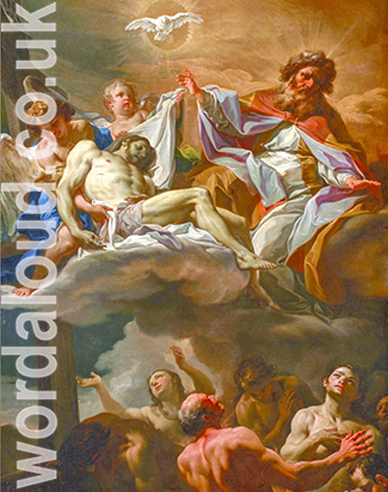
Saint Fulgentius reminds us that the great transformation of the resurrection begins now, in the hidden conversion of the heart. The ‘first resurrection’ is not merely an image but a real spiritual event: the passage from sin to grace, from darkness to light, from unbelief to faith. In this life, God works the first change within us — a change that prepares and guarantees the glorious change to come [ … ]

Saint Cyprian of Carthage, writing in the 3rd century during times of persecution and doctrinal unrest, offers a spiritually profound and pastorally sensitive reflection on the opening petitions of the Lord’s Prayer. His meditation on ‘Hallowed be thy name’ invites us to reflect not only on what we say in prayer, but how we live as those who call God ‘Father’ [ … ]
The KJV Bible is a rich and beautiful text which might be considered intended to be read aloud. It is powerful poetry. It is of immense significance in the English literary and oral traditions. A variety of audio KJV is available, and each has a contribution to make [ … ]
