
Christian Art | Jesus Is Crucified
Office Of Readings | Week 19, Tuesday, Ordinary Time | A Reading From The Treatise Of Theodoret Of Cyr On The Incarnation Of The Lord Jesus | By His Wounds We Are Healed
‘By his wounds we are healed.’
Theodoret takes his starting point from Isaiah 53, the ‘Suffering Servant’ passage, which early Christians read as a direct prophecy of Christ’s passion. The language of wounds, bruises and chastisement is interpreted not as a description of punishment deserved by Jesus himself, but as the cost he bore to heal humanity. For Theodoret, the cross is not only an act of endurance but also a medicine—a deliberate remedy for the sickness of sin.
He illustrates the work of salvation with a pastoral image. Just as a shepherd might keep one sheep close to guide the others home, so the eternal Word took on human nature to draw humanity back from danger. By uniting himself to our nature, Christ became the visible, tangible means by which God led his people from ‘bad pastures’ into the safety of divine life.
Theodoret links the passion to the resurrection. The sufferings and death of Christ were not the end but the breaking of ‘age-old tyranny’—a phrase that points to the power of death and corruption over humankind. When Christ’s body, described as the ‘temple’ in John 2:19–21, was raised, it served as a pledge of what God intended for all believers: freedom from decay, suffering, and mortality.
He presents the risen Christ as speaking directly to the faithful, promising that just as his own human nature was made incorruptible by union with divinity, so they too will share in immortality. The logic is that what is true of Christ’s humanity will also be true for those joined to him, since they are united to the same life-giving source.
The final section of the passage connects these promises to baptism. Theodoret emphasises that baptism is not merely a ritual but a participation in Christ’s death, echoing Romans 6:5. It is through this sacramental union that believers share both in the dying and the rising of Jesus, receiving the assurance of resurrection life.
The reading is tightly woven around three movements: the passion as healing, the resurrection as promise, and baptism as the means of sharing in that promise. For Theodoret, each is inseparable from the others; together they form the pattern of salvation.

A Reading From The Treatise Of Theodoret Of Cyr On The Incarnation Of The Lord Jesus | By His Wounds We Are Healed
Our Saviour’s passion is a healing remedy for us, as the prophet teaches when he cries out: He bears our sins and suffers pain for us, and we esteemed him stricken, smitten by God and afflicted. But for our sins he was wounded, for our iniquities he was bruised; upon him fell the chastisement that brought us peace, and by his wounds we are healed. We had all gone astray like sheep, and therefore he was led like a lamb to the slaughter, and was dumb like a sheep before its shearer.
When a shepherd sees that his sheep have scattered, he keeps one of them under his control and leads it to the pastures he chooses, and thus he draws the other sheep back to him by means of this one. And so it was when God the Word saw that the human race had gone astray: he took the form of a slave and united it to himself, and by means of it won over the whole race of men to him, enticing the sheep that were grazing in bad pastures and exposed to wolves, and leading them to the pastures of God.
This was the purpose for which our Saviour assumed our nature, this was why Christ the Lord accepted the sufferings that brought us salvation, was sent to his death and was committed to the tomb. He broke the grip of the age-old tyranny and promised incorruptibility to those who were prisoners of corruption. For when he rebuilt that temple which had been destroyed and raised it up again, he thereby gave trustworthy and firm promises to those who had died and were awaiting his resurrection.
Jesus tells us: ‘Just as my human nature, which I took from you, has won its resurrection in virtue of the Godhead that dwelt in it and with which it was united, just as this nature has shed decay and suffering and passed over to incorruptibility and immortality; so, in the same way, you too will be set free from the grievous slavery of death; you too will cast aside your corruptible nature and your sufferings and you will be clothed with impassibility.’
To this end he imparted the gift of baptism to all mankind through his apostles. Go, he said, make disciples of all nations, baptizing them in the name of the Father and of the Son and of the Holy Spirit. Baptism is a kind of symbol and type of the Lord’s death, which is why Paul says: If we have shared with God’s Son in a death like his, we shall certainly share in his resurrection.
A Brief Biography Of Theodoret Of Cyr
Theodoret of Cyr (c. AD 393–c. 466) was a bishop, theologian, and biblical commentator in the Roman province of Syria, serving as bishop of Cyr (modern-day al-Nabk, Syria) from around 423. Educated in Antioch and influenced by the Antiochene school of exegesis, he became known for his careful, historical interpretation of Scripture and his defence of orthodox Christology during the theological controversies of the fifth century. Theodoret played a prominent role in the debates surrounding Nestorianism and the Council of Chalcedon (451), advocating for a clear distinction between Christ’s divine and human natures while maintaining their unity in one person. His extensive writings include biblical commentaries, apologetic works, and theological treatises, many of which sought to clarify the Incarnation and counter heretical teachings. Despite periods of political and ecclesiastical opposition, he remained a respected figure in the Eastern Church and is remembered for his learning, pastoral leadership, and contributions to the development of Christian doctrine.
Christian Prayer With Jesus Christ
Lord Jesus Christ,
You bore our wounds and carried our sorrows,
leading us from the barren fields of sin into the pastures of your life.
By your death you broke the power of corruption,
and by your resurrection you opened the way to immortality.
Through the waters of baptism you have joined us to your cross and your rising.
Grant that we may walk in the freedom you have won,
clothed in the hope of the life to come,
until we share the glory you have promised.
Amen.
Glossary Of Christian Terms
Passion – The suffering and death of Jesus Christ, particularly his arrest, trial, crucifixion, and burial.
Suffering Servant – A figure described in Isaiah 52–53, interpreted by Christians as a prophecy of Christ’s sacrificial death.
Corruption – In theological terms, the state of decay and mortality resulting from sin.
Incorruptibility – The state of being free from decay, mortality, and the effects of sin.
Impassibility – The condition of being unable to suffer or be affected by pain; attributed to the risen life of Christ and the redeemed.
Baptism – The Christian sacrament of initiation, involving water, which unites the believer with the death and resurrection of Christ.
Temple – Here used by Christ as a metaphor for his body, which would be destroyed (in death) and rebuilt (in resurrection).
Age-old tyranny – A phrase describing the reign of sin and death over humanity before Christ’s victory.


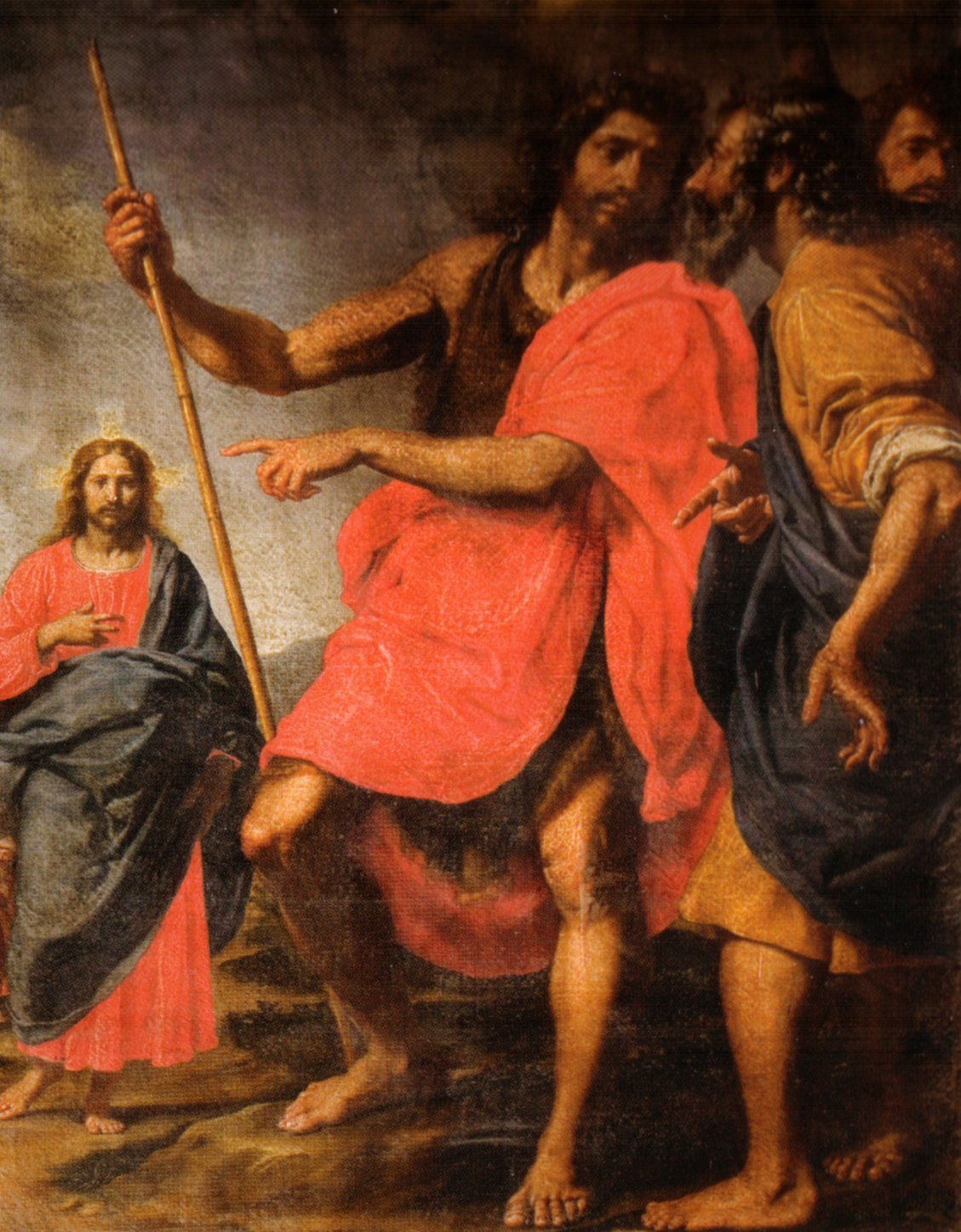
The first two disciples called by Jesus are disciples of John the Baptist. It is he who looks to Jesus and directs his disciples to look and so behold the Lamb of God. They are sent by John, through being told by him to recognize Jesus. John shows them the way to Jesus – as ‘the voice of one crying in the wilderness, Make straight the way of the Lord.’ [ … ]

In the Catholic Church, Purgatory is believed to be a place or state of suffering that is temporary and where the souls of those who have died in a state of grace but are not yet fully purified are purified before they can enter heaven. It is believed to be a place of spiritual and moral purification, where the soul is cleansed of any remaining attachments to sin [ … ]

In this reading from his letter to the Ephesians, Saint Ignatius of Antioch reflects on the importance of unity within the Christian community. Writing as a prisoner on his way to martyrdom, Ignatius speaks with humility and urgency. He does not present himself as a figure of authority, but as a fellow disciple who is still learning what it means to follow Christ [ … ]