
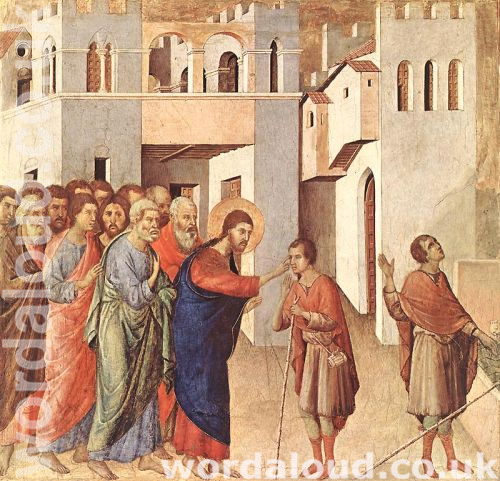
Christian Art | Jesus Heals A Blind Man | Love Revealed By Jesus Christ
Office Of Readings | Week 23, Thursday, Ordinary Time | A Reading From The Commentary Of Saint Bruno On the Psalms | If I Forget You, O Jerusalem
‘If I should forget you Jerusalem.’
Saint Bruno reflects on the longing expressed in Psalm 84[83]: ‘How lovely are your tabernacles, O Lord of hosts.’ He interprets this not only as a reference to the Temple of Jerusalem but as pointing beyond it to the heavenly Jerusalem, the eternal dwelling place of God. For Bruno, the psalmist’s desire is ultimately for the courts of heaven, where blessedness consists in unending praise of God.
The text highlights the distinction between earthly life—described as a ‘vale of tears’—and the life of heaven, symbolised as a ‘mountain of joy’. This contrast echoes traditional biblical imagery: the valley as a place of struggle and mortality (cf. Psalm 23:4), and the mountain as a symbol of God’s presence and glory (cf. Isaiah 2:2–3).
Bruno emphasises that entry into the courts of the Lord cannot be achieved by human effort alone. While the psalmist ‘sets his heart on ascending’, the ascent requires divine grace. The journey is made possible only through Christ, who alone ascends by his own power (cf. John 3:13). Believers are lifted up through stages of virtue and good works, but these are effective only because Christ the Lawgiver bestows grace. This mirrors the wider Christian tradition in which grace and human effort are seen not in opposition but in cooperation, with God’s initiative always primary.
The journey described is progressive: believers ‘go from strength to strength’ until they arrive at Zion. The vision promised at the end of this ascent is the beatific vision, when the faithful will behold God ‘as the God of gods’, that is, the Trinity, no longer through faith but directly. Bruno notes that in this final vision, God will be ‘all in all’ (1 Corinthians 15:28), the culmination of Christian hope.
The passage thus presents a theology of pilgrimage: life on earth as a journey marked by tears, aided by grace, and ordered towards the eternal vision of God.

A Reading From The Commentary Of Saint Bruno On the Psalms | If I Forget You, O Jerusalem
How beautiful are your tabernacles! My soul longs to reach the courts of the Lord, the fullness of the heavenly Jerusalem, the city of the Lord. He then explains why he desires to enter the courts of the Lord. It is because they are blessed who dwell in your house, the heavenly Jerusalem, Lord, God of the heavenly powers, my King and my God. It is as if he were to say: Who does not long to enter your courts since you are God, the Creator and King and Lord of hosts, and all who dwell in your house are blessed? For him courts and house are the same. When he says blessed, he means that they enjoy as much happiness as can be conceived. Clearly they are blessed because out of their devoted love they will praise you for ever, that is, for all eternity. For they would not offer praise for all eternity unless they were blessed for all eternity.
Now even though we may have faith, hope and love, none of us can attain this state of blessedness by ourselves. Rather, blessed is the man – he alone attains blessedness – whose help is from you in rising to the heights of happiness on which he has set his heart. In other words, he alone can be said to come to true blessedness who, having resolved in his heart to rise to this state of happiness by the many stages of the virtues and good works, receives the help of your grace. No one can rise up by himself as the Lord testifies: No one ascends into heaven, of his own power, except the Son of Man who is in heaven. Thus he contemplates this journey, living as he does in a vale of tears, for this life is lowly and full of tears and sorrow. The life of heaven, by contrast, is called a mountain of joy. But since the psalmist said: Blessed is the man whose help comes from you, someone might ask: Does God really help us in this? And the answer is that God does help the blessed. For our lawgiver Christ, who gave us the law, gives now and will continue to give his blessings, the abundant gifts of grace, by which he will bless his own, that is, raise them to beatitude. By these blessings, then, they will rise from strength to strength. One day in the heavenly Zion they will see Christ as the God of gods, as the one who, being God, will deify his own. Or, again, those who are to be the new Zion will see in spirit the God of gods – the Trinity. In other words, then their minds will see God, who cannot be seen in this life. For then God will be all in all.
Christian Prayer With Jesus
Lord,
you are our help and our strength.
Guide us through this vale of tears,
and grant us the grace to ascend the path of virtue.
Lift our hearts to the heavenly Jerusalem,
where we shall praise you without end,
and behold you as you are,
Father, Son, and Holy Spirit,
for ever and ever. Amen.
Glossary Of Christian Terms
Heavenly Jerusalem – The biblical image (cf. Revelation 21) of the eternal dwelling place of God with his people, symbolising the fulfilment of salvation.
Blessedness – The state of eternal happiness in God’s presence, often described as beatitude.
Vale of tears – A traditional expression for earthly life, marked by suffering and mortality.
Stages of virtue – The progressive growth in moral and spiritual life through practice of virtues.
Grace – God’s free and unmerited gift, enabling human beings to live in friendship with him.
Lawgiver Christ – A title for Christ as the one who fulfils and surpasses the Law, providing both command and grace.
Beatific vision – The direct vision of God in heaven, the ultimate goal of human life.
‘God will be all in all’ – A phrase from 1 Corinthians 15:28, describing the final state when creation is fully united with God.



Oh my Jesus, I come before you in faith and trust, asking for your healing touch upon my body. You are the great physician who can heal all afflictions, and I pray that you would bring your healing power into my life. May your love and mercy flow through me, renewing my body, mind, and soul. Grant me the strength to endure any pain and the courage to face any challenge. I ask this in your holy name. Amen [ … ]

Psalm 131, attributed to David, begins with a declaration of humility: ‘Lord, my heart is not haughty, nor mine eyes lofty.’ Here, the psalmist asserts a conscious rejection of pride and arrogance, setting the tone for a meditation on humility and trust in God [ … ]
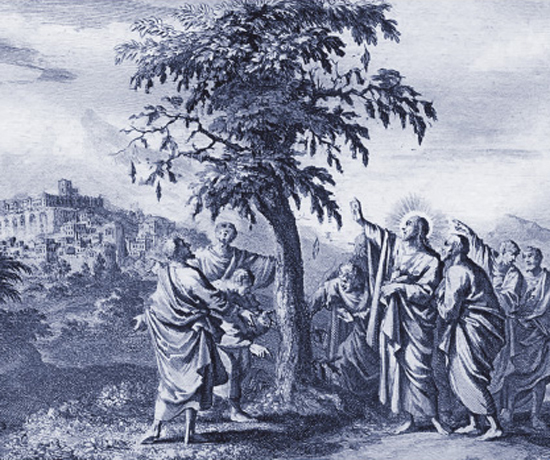
Just as Jesus’ listeners know how to interpret signs in nature, the trees beginning to bud and shoot new leaves as they come to life in spring, so Jesus tells them that, when they see and experience the upheavals described by Jesus in our Gospel verses of the past few days, they will know that the Kingdom of God is near [ … ]