
Christian Art | The Narrow Gate To Heaven | King James Audio Bible KJV
Luke 13: 22-30 – Week 30 Ordinary Time, Wednesday; Week 21 Sunday (C) (King James Audio Bible KJV, Spoken Word)
22 And he went through the cities and villages, teaching, and journeying toward Jerusalem.
23 Then said one unto him, Lord, are there few that be saved? And he said unto them,
24 ¶ Strive to enter in at the strait gate: for many, I say unto you, will seek to enter in, and shall not be able.
25 When once the master of the house is risen up, and hath shut to the door, and ye begin to stand without, and to knock at the door, saying, Lord, Lord, open unto us; and he shall answer and say unto you, I know you not whence ye are:
26 Then shall ye begin to say, We have eaten and drunk in thy presence, and thou hast taught in our streets.
27 But he shall say, I tell you, I know you not whence ye are; depart from me, all ye workers of iniquity.
28 There shall be weeping and gnashing of teeth, when ye shall see Abraham, and Isaac, and Jacob, and all the prophets, in the kingdom of God, and you yourselves thrust out.
29 And they shall come from the east, and from the west, and from the north, and from the south, and shall sit down in the kingdom of God.
30 And, behold, there are last which shall be first, and there are first which shall be last.
Christ’s journey from Galilee to Jerusalem is an ascent, literally, that occupies the central third of Luke’s Gospel. When the journey begins, it is made explicit that this is a journey toward the cross: ‘And it came to pass, when the time was come that he should be received up, he stedfastly set his face to go to Jerusalem…’ (Luke 9: 51) Christ’s teachings as he and his disciples travel are cued to the sense of steady, deliberate movement toward the Passion.
Today’s verses further illuminate our path to salvation in Jesus. Jesus advises us to seek to enter into heaven by the narrow door, and warns that it does take serious effort to reach the goal of salvation. It is not enough simply to have heard Christ’s teaching, or to have eaten and drunk in his presence; the necessary conversion should radiate through our life and actions, as we resist evil and give ourselves to the good.
We may ask, then: What is the narrow door? What does this mean? In the Sermon on the Mountain, Jesus suggests that the entrance into the Kingdom has eight doors. These are the eight categories of persons of the Beatitudes:
3 Blessed are the poor in spirit: for theirs is the kingdom of heaven.
4 Blessed are they that mourn: for they shall be comforted.
5 Blessed are the meek: for they shall inherit the earth.
6 Blessed are they which do hunger and thirst after righteousness: for they shall be filled.
7 Blessed are the merciful: for they shall obtain mercy.
8 Blessed are the pure in heart: for they shall see God.
9 Blessed are the peacemakers: for they shall be called the children of God.
10 Blessed are they which are persecuted for righteousness’ sake: for theirs is the kingdom of heaven. (Matthew 5: 3-10)
Here we have the model of the human being we can become through Christian conversion. As we conform to the image of the Beatitudes, we imitate Jesus. To journey with Jesus, as a disciple, through the text of the Gospels and toward Jerusalem and the cross, is to centre our lives upon Jesus. He is the absolute good to which we align ourselves. He is the gateway.
‘We must devote ourselves heart and soul to the task of well-doing, for everything comes from the hand of God and he has already warned us, “See, the Lord is approaching, with his reward before him, to pay every man as his work deserves.” That is why he bids us believe him implicitly and never be slothful or remiss in any good work.
‘How blessed, how marvellous are the gifts of God, my friends! Some of them, indeed, already lie within our comprehension – the life that knows no death, the shining splendour of righteousness, the truth that is frank and full, the faith that is perfect assurance, the holiness of chastity – but what of the things prepared for those who wait? Who but the Creator and Father of eternity, the Most Holy himself, knows the greatness and beauty of these?
‘Then let us strain every nerve to be found among those who wait in patience for him, so that we too may earn a share of his promised gifts. And how is this to be done, my friends? Why, by fixing our minds trustfully on God; by finding out what is pleasing and acceptable to him; by doing whatever agrees with his perfect will; by following the paths of truth. Wickedness and wrongdoing of every kind must be utterly renounced.’ Pope St Clement I
Concluding Prayer | Love Revealed By Jesus Christ
Shed your clear light on our hearts, Lord
so that walking continually in the way of your commandments,
we may never be deceived or misled.
We make our prayer through our Lord.




The name ‘Uriel’ means ‘God is my light’ or ‘fire of God’ in Hebrew, and Uriel is often depicted holding a flame or a lantern, representing his role as the angel of illumination and divine wisdom. Uriel’s presence is believed to bring clarity and understanding, and his intercession is often sought by those seeking spiritual guidance, wisdom, and discernment [ … ]

As I contemplate the Baptism of Jesus, I am invited to reflect on my own baptism and the significance of this sacrament in my life. I am reminded that, like Jesus, I am a beloved child of God, called to participate in Jesus’ mission of love and reconciliation. I am challenged to live out my baptismal promises, to renounce sin and evil, and to follow Jesus on the path of discipleship. And I am encouraged to draw upon the grace of the Holy Spirit, which is poured out upon me in my baptism, to transform me from within and to make me a new creation in Christ [ … ]
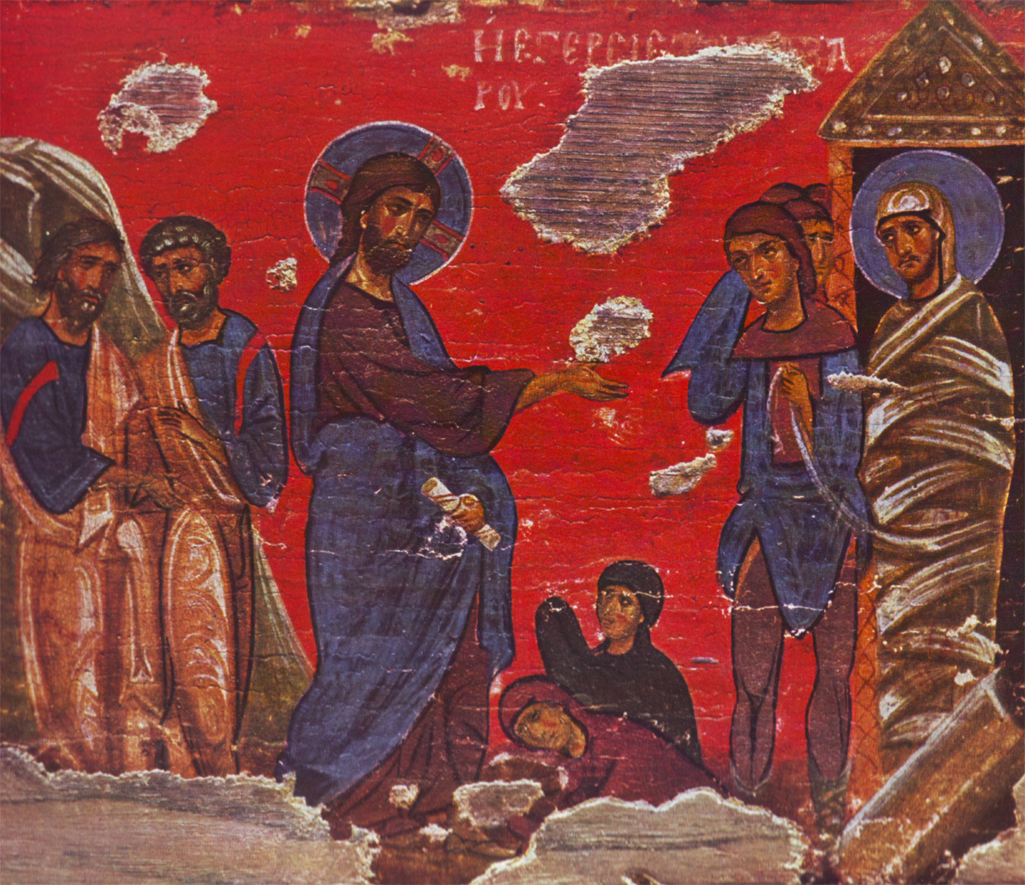
‘Death,’ says His Grace, ‘throws it all apart. For we are not as we should be. Faith requires our adjustment to God’s truth. God’s triumph in a very real sense requires in us the loss of our everything. Which, as with Mary at the other end of Jesus’s life, is God’s truth.’ The Gospel reading is of John 11: 1-45, which is a long passage, and His Grace’s homiletic theme commences in textual wilderness. Our brokenness – in this place – a family home. Our faith, our doubt, our death… The irruption – death, doubt, fear – within our precious scenes and our most intimate places. Our domesticity. His Grace speaks from the chair, as is a bishop’s prerogative, and says: ‘So much is obscure in the Gospels. We’re always reaching through them. We’re never there. Really, we never are. Our knowledge, our understanding, of the Gospels is never complete, and with each reading comes a new revelation. There are always new riches there. Just as there are between all of us, between myself and you. The Gospels are living texts. This is a part of the conversation we have with our own Christianity. It is a part of who we are in our relationship with Jesus. We are in this sense always on the brink. ‘So yes, there is plenty that doesn’t seem to make sense. As one of the order of bishops, we would be lying if we said that weren’t the case. They are not easy texts to encounter, if by that word we may signify something more than a superficial glancing off against, but rather a profound search for the word of God. The Gospels are written by people who had their own ideas, and often didn’t know what had really happened. Luke is quite explicit on this point. His is an investigation, from the explicitly claimed point of view of an historian, rather than that of a first-hand witness, who attempts, so he says, to set out an orderly account, out of the chaos, the sheer muddle, that has been handed down to him. It is possible to imagine Luke researching and composing his account after many years, when there has arisen a desire to know what exactly happened, and this implies a certain call to faith and certain demands of historicity, to historical exactitude. So in these different ways, the people of the first years of Christian faith are in the dark. There is also a decisive need to define the life of Jesus. And people didn’t get Jesus. The whole meaning of Christianity is only now beginning to take root throughout the composition. So much needs to be evangelized. The light shines almost in tentative fashion like that first star, which drew the wise men from the east to our Lord’s cradle. ‘John’s is widely held to be a very late Gospel. There are others who say that John’s Gospel might have been the first to acquire its true shape, because it most fully expresses Jesus, as we know him to be, as members of the Catholic Church. We don’t really know when any of this is being written, but we get a feel in John of a Gospel refined over many years, through a community. So there’s a lot going on there that I’d like you to think about. ‘What I would like to suggest to you is that, while within the Gospels we are often confronted with clues, guesswork, stories that have been handed down through so many people, and so in this sense we might find ourselves to be in the wilderness, this is the very desolate space itself to which we must give ourselves in order to experience Christ’s full redemption in our lives. I suggest it is for God’s glory that we do so. ‘As we become aware of ourselves, in this seminary, we find ourselves in a very secure, comfortable setting, and there are signs of Easter everywhere. Within the very fabric of these buildings, our Lord is risen; our Lord lives. But now this is our Lenten journey, where death enters, where death breaks us. We are to ride into Jerusalem in triumph, and then we are to be utterly broken, all hope gone, our hope extinguished. And really, I suggest to you, it is only by inhabiting this thought, as if we don’t know Easter is there, that our new life can follow, just when we have given up all hope, when every promise that Jesus made to us seems to have been cancelled. ‘And here now we have the story of Lazarus. I should like to suggest to you that we have a very powerful call now. In our very comfortable space, our domesticity, with all this comfort, where so very little might seem to happen each day, so it might seem to you, there is a disturbance within all of this comfort, and that is a disturbance within ourselves, and that is our call to Jesus. I think it is correct to say that our most comfortable places break in the light of Jesus from the inside, in order that we may take the necessary steps to be with Jesus. ‘Faith is not comfortable. I think that we can all receive the message of the rolling away of the rock from the tomb of Lazarus to say something of vital importance to ourselves concerning our openness to God’s love. The rock we roll away can come in all sorts of guises, but we know when we are blocked, and I firmly believe if we are truthful then we know where those blocks might be. ‘Next Sunday, which will be Palm Sunday, we process as it were to Jerusalem, to begin our Holy Week. Now as I speak to you we are on the brink. Even now, I suggest it might be very good for all of us to lay aside what we think we know, to fall apart a little, and so […]
