
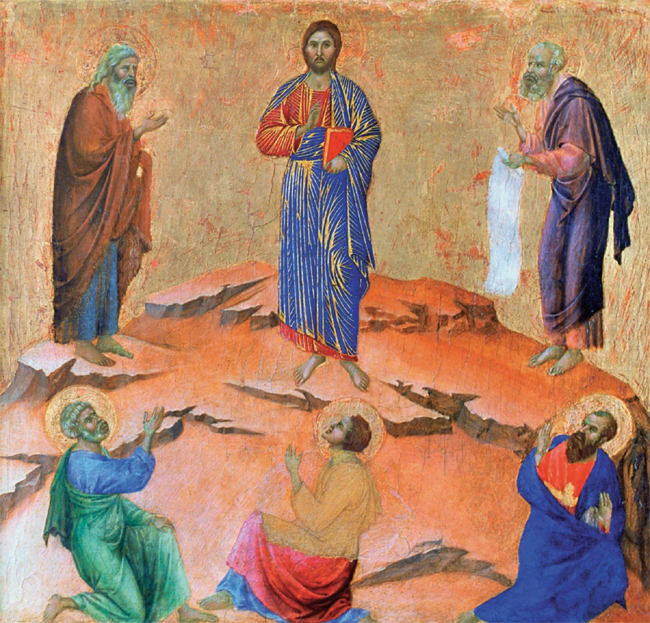
Mark 9: 2-10 – Lent Week 2, Sunday (Year B) ; also, Mark 9: 2-13 for Week 6 Ordinary Time, Saturday (King James Audio Bible, Spoken Word)
2 ¶ And after six days Jesus taketh with him Peter, and James, and John, and leadeth them up into an high mountain apart by themselves: and he was transfigured before them.
3 And his raiment became shining, exceeding white as snow; so as no fuller on earth can white them.
4 And there appeared unto them Elias with Moses: and they were talking with Jesus.
5 And Peter answered and said to Jesus, Master, it is good for us to be here: and let us make three tabernacles; one for thee, and one for Moses, and one for Elias.
6 For he wist not what to say; for they were sore afraid.
7 And there was a cloud that overshadowed them: and a voice came out of the cloud, saying, This is my beloved Son: hear him.
8 And suddenly, when they had looked round about, they saw no man any more, save Jesus only with themselves.
9 And as they came down from the mountain, he charged them that they should tell no man what things they had seen, till the Son of man were risen from the dead.
10 And they kept that saying with themselves, questioning one with another what the rising from the dead should mean.
11 ¶ And they asked him, saying, Why say the scribes that Elias must first come?
12 And he answered and told them, Elias verily cometh first, and restoreth all things; and how it is written of the Son of man, that he must suffer many things, and be set at nought.
13 But I say unto you, That Elias is indeed come, and they have done unto him whatsoever they listed, as it is written of him.
As they travel on the way to Jerusalem, Jesus throws his disciples into confusion by telling them about the suffering and death he must undergo. The disciples simply do not understand. For centuries, the Jews have awaited the coming of the Messiah, whom they envisaged as a glorious warrior king, not as one who would suffer and die the most ignominious of deaths, on a cross, of all things. A person condemned to die on a cross could not be the Messiah; rather, according to the Old Law, he had to be “cursed by God” (Deuteronomy 21: 22-23). The disciples cannot see the divine plan for our salvation, while the command for all who would be saved to ‘take up his cross and follow me’ must have seemed both strange and terrifying. To reassure his disciples, Jesus allows them to witness his glorious body through the transfiguration.
To understand, then, the significance of the transfiguration, we should remember that it was to redeem us through his passion and death that the Lord freely renounced his divine glory, shared with the Father and the Spirit before all time, to assume flesh like our own, inglorious and capable of suffering, becoming like us in all things except sin. This is the Jesus, the man, whom the disciples have known. The intersection of the glorious body of Christ and our fleshly human form is now made manifest.
According to Deuteronomy (19: 15), the agreement of two or three offering evidence must concur. Perhaps this is why our Lord chose Peter, James and John to accompany him up the mountain. The mountain recalls Mount Sinai, where God presented the Law to Moses, and the shining white clothes of Jesus additionally recall Moses being shrouded in light as he speaks with God. The Old Testament of the Bible has prepared the way for the New.
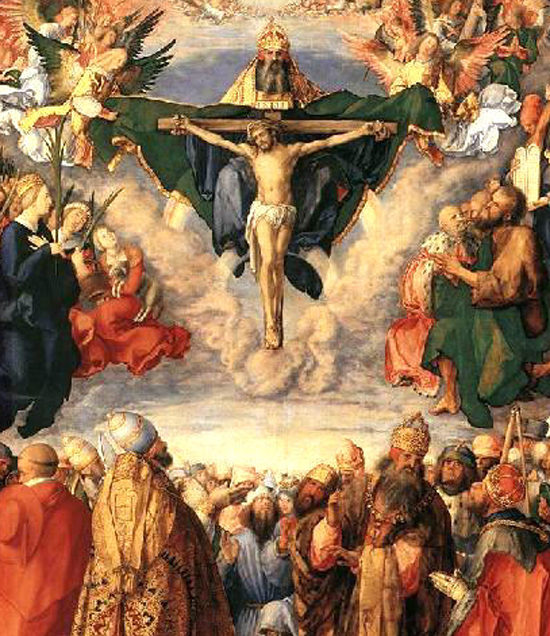
It is Elijah (Elias) and Moses, two great authorities of the Old Testament, who appear to speak with Jesus. Moses represents the Law and Elijah the prophets. Luke additionally tells us that they ‘spake of his decease which he should accomplish at Jerusalem’. Both the Law and the prophets of the Old Testament affirm that the way to salvation and glory lies through the cross.
Peter rejoices at what he sees, though he is afraid and does not know what to say. His offer to make three tents (tabernacles/dwellings) is to honour Jesus, Moses and Elijah. Some scholars believe that this may because it is the sixth day of the Feast of the Tents – hence the opening words of this reading: ‘And after six days…’ – during which feast the people would remember their time in the wilderness and celebrate God’s gift of the Law to Moses. It is as the disciples rejoice that a cloud overshadows them and God’s voice from heaven proclaims Jesus as His Son, the Beloved. (Cf. Isaiah 42: 1: ‘BEHOLD my servant, whom I uphold; mine elect, in whom my soul delighteth; I have put my spirit upon him: he shall bring forth judgment to the Gentiles.’)
God commands the disciples: ‘Listen to him.’ This is a time of Jesus’ ministry when the miracles so prevalent at the start are becoming the exception. Jesus’ teaching, of his death, resurrection and of the coming of the Kingdom, becomes more forceful now. He is particularly concerned to educate his disciples and to form them for the task that is to come, whereas earlier preaching was to the great crowds of people who flocked to hear him. The disciples will be enabled by God’s command and by the transfiguration to know that Jesus’ teaching of his death and resurrection is true to God’s saving plan. Similarly, those hearing the Gospel of Mark, who may themselves have baulked at the thought of our Saviour, the Messiah, dying on the cross like a criminal, may be given confidence.
The disciples remain confused and are told by Jesus to keep what they have witnessed a secret. Jesus must suffer and die and then rise from the dead before the truth of his divinity may be declared to all. There are many difficult truths for the disciples to learn. These include the expectation of persecutions to come, the demand for a renunciation of fleshly pleasures, the extreme vigilance, or watchfulness, required as we await the coming, and the demand to make the most we can of the gifts God has given us as we spread the good news and build his Church. The time is short. The passion is imminent. There is an urgency now to Christ’s teaching his disciples of the way to salvation.
‘The Lord revealed his glory in the presence of chosen witnesses, and made that form of his body which he shared with other men to shine with such splendour that his face was as bright as the sun, and his clothes became as white as snow… None must fear to suffer for righteousness’ sake. None must doubt that God will fulfil his promises. For through toil comes rest; through death comes life. Jesus has taken upon his own shoulders all the weakness of our humanity. If we are steadfast in our acknowledgment and love of him, in him we win the victory he won, and receive the reward that he has promised.’ Pope St Leo the Great




As Jesus walks ahead of his disciples on the road to Jerusalem, the people who follow Jesus are amazed and afraid. This is the response of the people, not merely to a great teacher or to a nice man, but to God among them. So often in the Bible, the response of a person to God or to one of God’s messengers, the angels, is just this: they are amazed and they are afraid. Mark’s Gospel is telling us here that, on his way to his Passion, his brutal death, Jesus is God become man [ … ]
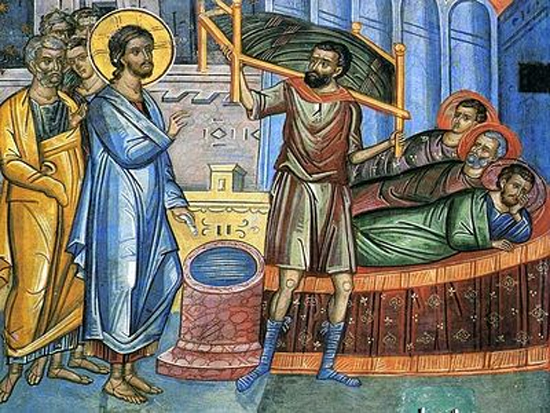
For the Jewish people, the sickness of the paralyzed man was a symptom of underlying sin. It was a punishment, a consequence of one’s own moral evil or of one’s parents. We can imagine the social consequences for the paralyzed man, in the light of the various exclusions which were applied to disabled people [ … ]

Jesus explains certain aspects of the truth of his relationship with his Father. He explains that he is consubstantial with the Father. He is not created as we are; he is the Son; he has life in himself. On earth, Jesus is the mirror of the Father. It is through Christ that we may approach God. God the Father and God the Son share one being. The Father and the Son are equal [ … ]
