

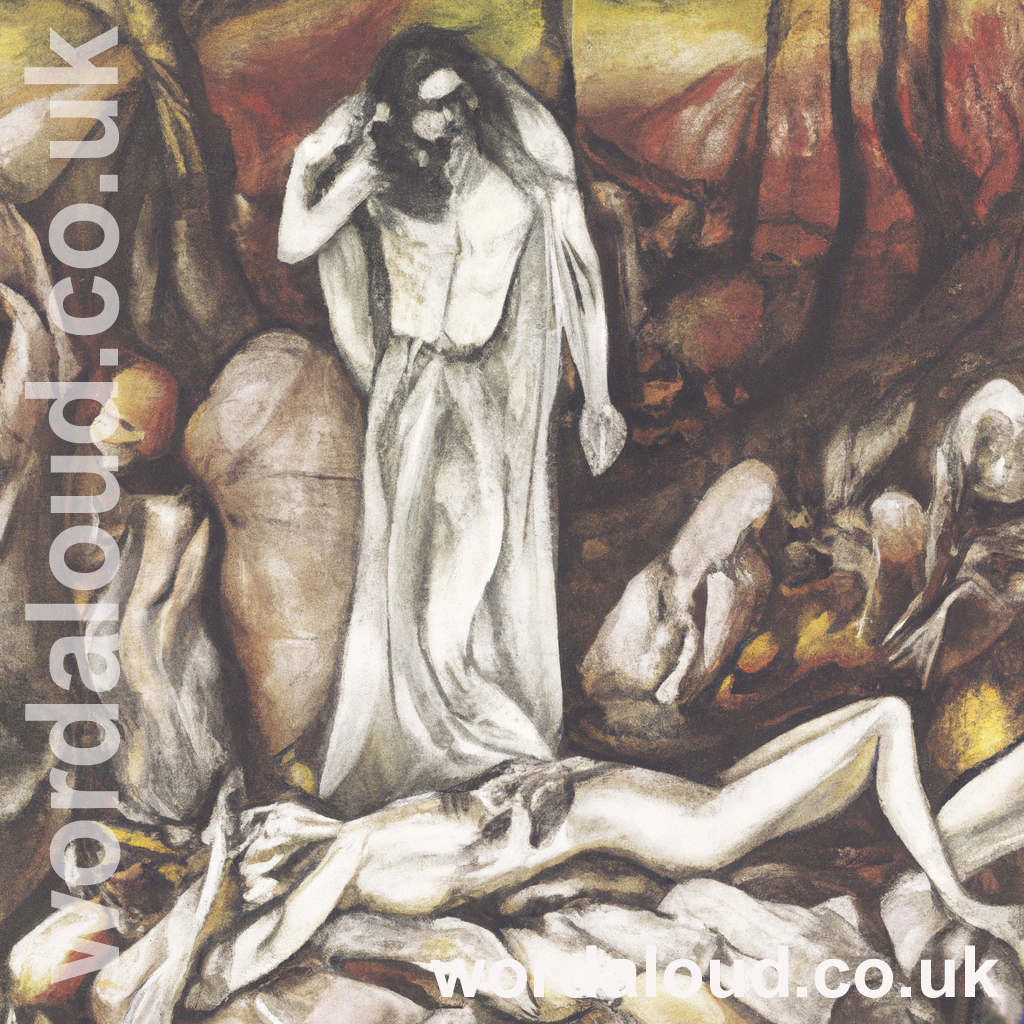
Christian Art | Road To Emmaus
Gospel Of Luke 24: 13-35 | King James Audio Bible | King James Version KJV
13 ¶ And, behold, two of them went that same day to a village called Emmaus, which was from Jerusalem about threescore furlongs.
14 And they talked together of all these things which had happened.
15 And it came to pass, that, while they communed together and reasoned, Jesus himself drew near, and went with them.
16 But their eyes were holden that they should not know him.
17 And he said unto them, What manner of communications are these that ye have one to another, as ye walk, and are sad?
18 And the one of them, whose name was Cleopas, answering said unto him, Art thou only a stranger in Jerusalem, and hast not known the things which are come to pass there in these days?
19 And he said unto them, What things? And they said unto him, Concerning Jesus of Nazareth, which was a prophet mighty in deed and word before God and all the people:
20 And how the chief priests and our rulers delivered him to be condemned to death, and have crucified him.
21 But we trusted that it had been he which should have redeemed Israel: and beside all this, to day is the third day since these things were done.
22 Yea, and certain women also of our company made us astonished, which were early at the sepulchre;
23 And when they found not his body, they came, saying, that they had also seen a vision of angels, which said that he was alive.
24 And certain of them which were with us went to the sepulchre, and found it even so as the women had said: but him they saw not.
25 Then he said unto them, O fools, and slow of heart to believe all that the prophets have spoken:
26 Ought not Christ to have suffered these things, and to enter into his glory?
27 And beginning at Moses and all the prophets, he expounded unto them in all the scriptures the things concerning himself.
28 And they drew nigh unto the village, whither they went: and he made as though he would have gone further.
29 But they constrained him, saying, Abide with us: for it is toward evening, and the day is far spent. And he went in to tarry with them.
30 And it came to pass, as he sat at meat with them, he took bread, and blessed it, and brake, and gave to them.
31 And their eyes were opened, and they knew him; and he vanished out of their sight.
32 And they said one to another, Did not our heart burn within us, while he talked with us by the way, and while he opened to us the scriptures?
33 And they rose up the same hour, and returned to Jerusalem, and found the eleven gathered together, and them that were with them,
34 Saying, The Lord is risen indeed, and hath appeared to Simon.
35 And they told what things were done in the way, and how he was known of them in breaking of bread.
This is a dark time, and, as Luke writes his Gospel, it is a dark time for the Christian communities. Jesus has been crucified. Well then, so the logic of the Old Law states, Jesus could not possibly have been the Messiah. Except he was.
Luke writes primarily for the communities of Greece, mostly pagan converts. There has been the great persecution of Nero. Jerusalem has been destroyed in the year 70 by the Romans. The Apostles and other disciples of Jesus have progressively disappeared or been martyred. It must have been hard to believe in Jesus in these times. Christians must have felt tired on their journey. We needed to be reassured, to be given the confidence to keep going. In this sense, these early Christians were in a similar position to the disciples on the road to Emmaus.
On the road to Emmaus, the disciples are lost and despondent. They are talking with each other to try to make some sense out of what has happened. Their Lord has been crucified. According to their understanding, the Messiah could not have met with such a fate. It seems to them that all their faith in Jesus has been in vain. They feel great sorrow. Jesus comes to them to reassure them, to help them to see the truth of what has happened through the crucifixion, to give them hope to go on.
The disciples do not initially recognize Jesus. This tells us something about how Jesus approaches us in our lives. It can take a long time before we recognize the call to vocation, and then we realise just how often we have been called in the past without our realizing that we are called. It is when we are truly open to our Lord that we know that he has been calling to us so much before to have faith and to follow him.
Jesus asks the disciples what is wrong and he patiently hears them recount what we know of the death of Jesus, and his burial, and the events of Easter Sunday when Jesus’ tomb was found empty. The disciples even speak of the witness of Mary Magdalene and the other women, who have told them what the angels have said to them, and yet they have not seen what the women saw. The disciples are shrouded in gloom and the failing of faith. Their world at this time must have seemed a very hollow space, emptied of life and hope.
Jesus now, without directly revealing himself, teaches the disciples again about the Scriptures. Jesus presents to the disciples the truth of faith, tells them once again of the necessity of his death on the cross to bring about all men’s salvation, of his path to glorification being via the cross, and Jesus interprets the Scriptures to them, leading the disciples to a new and truer understanding of the words with which they were already familiar. Jesus wants the disciples to realise they already know the truth; that what they need to do is to free themselves from the preconceptions of the old way of seeing things, and with the eyes of faith understand the reality of Scripture.
The disciples are energised by Jesus’ words. They beg Jesus to stay with them and Jesus consents. And so a stranger on the road is offered and consents to receive hospitality. There is friendship, the sharing of a meal, just as there was at the feast of the Passover, the Last Supper. Trust has been offered, received, shared.
It is perfectly fitting that recognition comes to the disciples as our Lord blesses and breaks the bread at this meal, and shares it. Now the disciples see who has been with them. Our High Priest has shared his body once again, bloodlessly now. The disciples’ eyes are opened. They now understand how their hearts have burned through Jesus’ presence. They have shared Christ’s body. They are a part of the body of Christ. Jesus can leave them now, knowing that they can walk onwards together, as it were by themselves, without further immediate assistance. We might be reminded of the time we learned to ride a bicycle, when the stabilizers were removed and our mother or father who had supported us let us go.
The disciples’ faith has been restored. It is beautiful to know that the first instinct of these disciples was to return to Jerusalem, no matter the danger, to share the good news with their friends.
Lord God, Lamb of God, Son of the Father, you take away the sins of the world, have mercy on us; you take away the sins of the world, receive our prayer.



From Sin to Salvation | The Significance of Ash Wednesday and Lent | Ash Wednesday marks the beginning of the Lent, the Lenten season, and falls 46 days before Easter – which is to say 40 days plus Sundays. A day of fasting and penitence, Christians are called to acknowledge their sinfulness and repent. On Ash Wednesday, ashes are placed on the forehead of each person in the sign of the Cross as a symbol of mortality and penitence [ … ]

Saint Peter Chrysologus reflects on the Incarnation as God’s deliberate choice to make himself known in a way human beings can receive. Although Christ’s divine nature was always present, it is disclosed through concrete events that speak to human senses and understanding. God does not remain hidden in abstraction, but enters history so that knowledge of him may be grounded in what can be seen, heard, and encountered [ … ]

As I meditate on the love of Jesus Christ, I am reminded of the institution of the Lord’s Supper and the profound love Jesus revealed in doing so. In the midst of his last meal with his disciples, Jesus took bread and wine, gave thanks, and gave them to his disciples, saying, ‘This is my body, which is given for you. Do this in remembrance of me.’ (Luke 22:19, KJV)
