
Christian Art | Prayer With Jesus | Psalms | Prayer For Deliverance From Slanderers | A Song Of Ascents | King David As A Boy | Audio KJV | Love Revealed By Jesus Christ | King James Audio Bible
Psalm 120 | King James Audio Bible
YouTube | Psalm 120 KJV | A Song Of Ascents
Psalm 120, a cry for deliverance and peace, is the first of the fifteen Songs of Ascents (Psalms 120-134) in the Book of Psalms. Traditionally attributed to King David, these psalms were sung by pilgrims journeying to Jerusalem for the great feasts. Psalm 120 reflects a deep yearning for deliverance from deceit and falsehood.
The opening verse, ‘In my distress I cried unto the LORD, and he heard me,’ sets a tone of urgency and vulnerability. The psalmist’s distress is not a fleeting emotion but an experience that drives him to seek divine intervention. This opening appeal to the Lord is a powerful reminder of the psalmist’s dependence on God for deliverance and relief. The phrase ‘In my distress’ suggests a situation of intense difficulty or trouble, indicating that the psalmist’s plea arises from a place of deep personal anguish.
The verse, ‘Deliver my soul, O LORD, from lying lips, and from a deceitful tongue,’ expresses the nature of the psalmist’s distress. Reference to ‘lying lips’ and a ‘deceitful tongue’ highlights the struggle against falsehood and dishonesty. This plea for deliverance from deceit is especially relevant in our contemporary world, where truth is often obscured or manipulated.
Verses 3 and 4 pose a rhetorical question and provide an answer: ‘What shall be given unto thee? or what shall be done unto thee, thou false tongue? Sharp arrows of the mighty, with coals of juniper.’ These verses evoke destructive power of deceitful words, likening them to ‘sharp arrows’ and ‘coals of juniper’. The imagery of arrows suggests the piercing, wounding nature of lies, while the coals of juniper, known for their intense heat, symbolize the burning, lingering pain caused by deceit.
The psalm shifts to lamentation of the psalmist’s circumstances in verses 5 and 6: ‘Woe is me, that I sojourn in Mesech, that I dwell in the tents of Kedar! My soul hath long dwelt with him that hateth peace.’ The locations Mesech and Kedar, interpreted as symbolic of barbarous and hostile lands, metaphorically represent the psalmist’s alienation in a world filled with deceit and conflict. The psalmist feels like an outsider, weary from living among those who oppose peace. This sense of alienation expresses the psalmist’s longing for a different, more harmonious existence.
In the final verse, the psalmist declares, ‘I am for peace: but when I speak, they are for war.’ This stark contrast between the psalmist’s desire for peace and the reality of war encapsulates the central theme of the psalm – the struggle between truth and falsehood, peace and conflict. It underscores the challenges faced by those who seek peace in a world marred by strife and deception.
Psalm 120 can be seen as a microcosm of human experience, with themes of honesty, conflict, alienation and yearning for peace. Powerful imagery and heartfelt pleas resonate with anyone who has ever felt besieged by falsehood or longing for a more truthful and peaceful existence. The psalm’s structure, oscillating between personal lament and universal longing, allows it to transcend time and culture, speaking to the core of the human condition.
Psalm 120 | Song Of Ascents
Psalm 120 is an introduction to the Songs of Ascents, setting the stage for a spiritual journey. This journey is not just a physical pilgrimage to Jerusalem but also a metaphorical journey towards spiritual growth and enlightenment. Each subsequent psalm builds on this theme, exploring various facets of human life and the soul’s journey toward God.
In a broader theological context, Psalm 120 illustrates the essential role of prayer in seeking divine guidance and intervention. The psalmist’s direct appeal to God demonstrates a profound faith in the Almighty’s ability to deliver and protect. This act of turning to God in times of distress is a foundational aspect of many religious traditions and underscores the importance of faith and reliance on a higher power.
Psalm 120 | King James Audio Bible
In my distress I cried unto the LORD, and he heard me.
Deliver my soul, O LORD, from lying lips, and from a deceitful tongue.
What shall be given unto thee? or what shall be done unto thee, thou false tongue?
Sharp arrows of the mighty, with coals of juniper.
Woe is me, that I sojourn in Mesech, that I dwell in the tents of Kedar!
My soul hath long dwelt with him that hateth peace.
I am for peace: but when I speak, they are for war.


Psalm 120 | King James Audio Bible
- Cry For Deliverance: The psalmist’s urgent plea to God for rescue from distress, highlighting a deep yearning for divine intervention in times of trouble.
- Conflict With Deceit: A strong emphasis on the struggle against lies and deceitful speech, portraying the pain and turmoil caused by dishonesty and false accusations.
- Desire For Peace: A profound longing for peace in the midst of conflict and hostility, underscoring the psalmist’s inclination towards harmony over discord.
- Sense Of Alienation: Feelings of isolation and being an outsider in a hostile environment, as symbolized by the references to Mesech and Kedar, places perceived as distant or foreign.
- Contrast Between Peace And War: The stark contrast between the psalmist’s peaceful intentions and the aggressive, war-like stance of others, highlighting the tension between the desire for peace and the reality of conflict.
- Dependence On God: The psalmist’s reliance on God for protection and justice, indicating a deep faith in divine power and righteousness.
- Symbolism And Imagery: Use of vivid imagery, such as ‘sharp arrows’ and ‘coals of juniper’, to convey the harmful impact of deceitful words and actions.
- Human Struggle And Resilience: The psalm reflects the universal human experience of dealing with adversity, maintaining integrity in the face of deceit, and the resilience required to continue seeking truth and peace.
- Introduction To The Songs Of Ascents: Setting the tone for the subsequent collection of psalms, which are characterized by themes of journeying, both physically and spiritually, towards a state of higher understanding and closer relationship with God.



This is an extraordinary scene. Many, many people are gathered with Jesus to hear his teaching, which is the Sermon on the Mount. The people will not all be friends; there will be different, sectarian groups, and rivalries between them. Some of those gathered to listen to Jesus will be suspicious of others. Nor can the people yet understand what is happening here, just who and what Jesus is. The people have flocked to – see someone, hear someone, someone new and extraordinary, someone perhaps who can answer their needs. Their coming to Jesus is an expression of hope and longing. Who knows what thoughts there must have been as people looked around to see all those others gathered. This is a vast company of strangers [ … ]
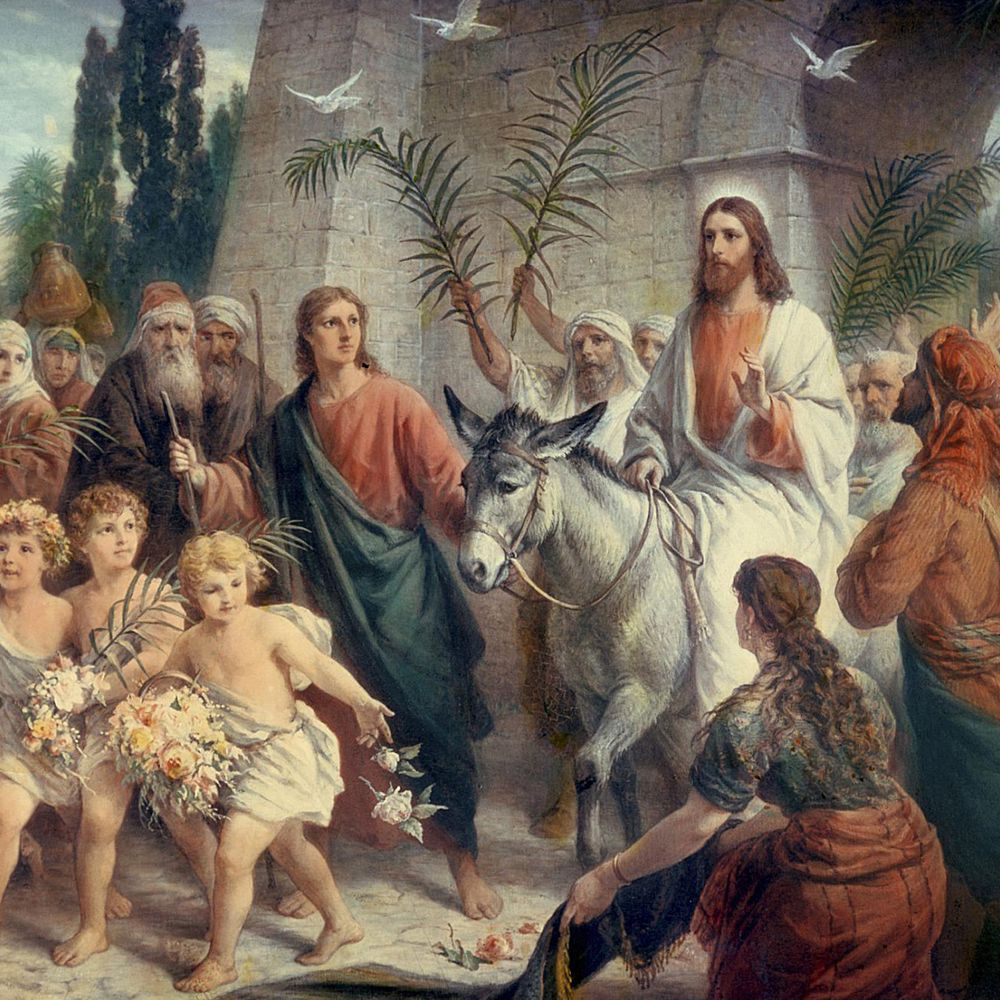
We process. Glass exhibition cases, old reliquaries. A forearm here; here a nun’s fingertip. In chapel, at a glance, there are the usual faces. But they all stand to attention. Jonathan breaks from the procession to – fire the organ with oomph and dignity: Ride on! ride on in majesty! The angel-squadrons of the sky look down with sad and wondering eyes to see the approaching sacrifice. When we’ve done the readings, the Arch holds that tree in his hands to deliver the homily. He rocks quietly on his feet, some few seconds, as if balance defeated it. A way you might affect as the Spirit moves… Copying. Then he says: ‘Our palm fronds may seem to us today rather dry. I mean this not in a literal sense, but by the standards of those who originally lined the roadways in order to welcome Jesus into Jerusalem, as they proclaimed Jesus to be the Messiah, who would be clambering up and ripping their palm branches fresh from off the trees. I think perhaps also our faith is somewhat distant from that of the people there on that highroad into Jerusalem, and something of our sense of the meaning has shifted in vividness from what it was then. And of course the expectation of all those many people is markedly different, but in many important respects the same. There are the same essential qualities to all our faith in God, which springs complete from our humanity, and that is one and the same in value for all of us, and time is consistent on this point. So then, let us renew the fullness of Catholic faith, and let us ask the Lord’s blessing as we embark upon our Holy Week. ‘Our Lord enters into Jerusalem in order to refresh us. He is to die in order that we may have life. There is a living reality here, both spiritual and as entangled in the joy of our daily living. We have Ladies’ Day where I grew up. They still have it, and they close the roads off, and little children parade, dressed-up like spring brides. When I was a boy, there was a May Day festival, and there was a May pole on the field, with the people dancing, like Morris dancers might be one way of visualizing this if you’ve never seen it, with their ribbons tied onto the top of the May pole, and they would weave around each other, dressing the pole, which is what we called it. It was like a dance with red and white and blue ribbons all hung off of the top of the May pole, which stood there all year, only like a telegraph pole, but it was concreted in, and then there was a slide, and swings – one baby-swing and two you could have a go at – terrible health and safety but that’s what it was in those days. ‘There was a round-a-bout – we used to run it round and round to try to get it off its central axis. It were rusty as anything and creaked like mad – on concrete. And climb up where it was all greased up at the top. Ruth, who was big as the next four of us, used to sit there sucking on the lollipops we nicked for her from Raddies, and she’d direct matters. We were trying to destroy it, and get it to dislodge from its central axis, and fly away – roll off into that farmer’s field, which he only ever kept for silage, but we never succeeded. There was a car someone had left there so we spent forever smashing that up, until someone who lived in one of the houses there took exception to our doing that, so he put thick grease under the door handles and gave us a right talking to. ‘It would only be a few stands, hot-dogs and things like that. The man selling the hot dogs would have his records on full blast. There’d be a couple of set-up stalls. Air-rifles – that sort of thing. But we all had them, and we all went shooting, of course, if not with twelve bores then with smaller gauge. Or pay a pound – I have no idea how much it was in actual fact then – it might have only been a few pennies – and we’d get all that time smashing up the crockery the man would put up for us to smash on the dressers. That was my particular favourite thing to do at these festivals, by the way, in case you were wondering. You got a little bucket of so many cricket balls. ‘I dread to think what went into those hot dogs. Probably EE rules would forbid it now. But it was a fair mix in those days. A lot of young people then were C of E. We’ve done a lot to hang onto our young people, which is a tremendous encouragement when you consider how things are, while in recent decades the Church of England hasn’t been so successful. People still want it on feast days and what are essentially now civic celebrations. It’s strange to see, though, how all the little stands there people have are run by the police and people like that along those lines. There’s no May pole. That was a sort of faith that ran and ran beneath all the theoreticals of it in the 1960s and the 1970s and into the 1980s. The May pole isn’t there now in the particular place I’m thinking of. Considering May poles were officially suppressed hundreds of years ago – as a part of the protestant reformation. One or two of you are probably thinking I’m remembering things from that time! ‘I should have liked to say that those processionals were so hardwired into us, that even after the last thirty years, when I became a bishop, they are still with us. They were […]
This passage from Maximus the Confessor presents a rigorous and integrated account of charity as the decisive principle of the Christian life. Its argument is both ascetical and theological, insisting that love of God cannot coexist with disordered attachment to created things, and that authentic faith is inseparable from active love [ … ]