
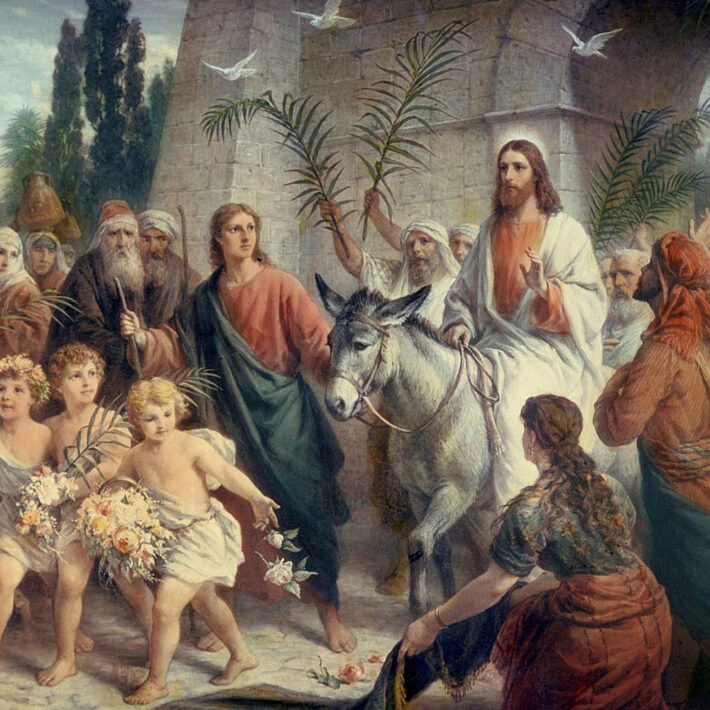
We process. Glass exhibition cases, old reliquaries. A forearm here; here a nun’s fingertip. In chapel, at a glance, there are the usual faces. But they all stand to attention. Jonathan breaks from the procession to – fire the organ with oomph and dignity:
Ride on! ride on in majesty!
The angel-squadrons of the sky
look down with sad and wondering eyes
to see the approaching sacrifice.
When we’ve done the readings, the Arch holds that tree in his hands to deliver the homily. He rocks quietly on his feet, some few seconds, as if balance defeated it.
A way you might affect as the Spirit moves… Copying. Then he says:
‘Our palm fronds may seem to us today rather dry. I mean this not in a literal sense, but by the standards of those who originally lined the roadways in order to welcome Jesus into Jerusalem, as they proclaimed Jesus to be the Messiah, who would be clambering up and ripping their palm branches fresh from off the trees. I think perhaps also our faith is somewhat distant from that of the people there on that highroad into Jerusalem, and something of our sense of the meaning has shifted in vividness from what it was then. And of course the expectation of all those many people is markedly different, but in many important respects the same. There are the same essential qualities to all our faith in God, which springs complete from our humanity, and that is one and the same in value for all of us, and time is consistent on this point. So then, let us renew the fullness of Catholic faith, and let us ask the Lord’s blessing as we embark upon our Holy Week.
‘Our Lord enters into Jerusalem in order to refresh us. He is to die in order that we may have life. There is a living reality here, both spiritual and as entangled in the joy of our daily living. We have Ladies’ Day where I grew up. They still have it, and they close the roads off, and little children parade, dressed-up like spring brides. When I was a boy, there was a May Day festival, and there was a May pole on the field, with the people dancing, like Morris dancers might be one way of visualizing this if you’ve never seen it, with their ribbons tied onto the top of the May pole, and they would weave around each other, dressing the pole, which is what we called it. It was like a dance with red and white and blue ribbons all hung off of the top of the May pole, which stood there all year, only like a telegraph pole, but it was concreted in, and then there was a slide, and swings – one baby-swing and two you could have a go at – terrible health and safety but that’s what it was in those days.
‘There was a round-a-bout – we used to run it round and round to try to get it off its central axis. It were rusty as anything and creaked like mad – on concrete. And climb up where it was all greased up at the top. Ruth, who was big as the next four of us, used to sit there sucking on the lollipops we nicked for her from Raddies, and she’d direct matters. We were trying to destroy it, and get it to dislodge from its central axis, and fly away – roll off into that farmer’s field, which he only ever kept for silage, but we never succeeded. There was a car someone had left there so we spent forever smashing that up, until someone who lived in one of the houses there took exception to our doing that, so he put thick grease under the door handles and gave us a right talking to.
‘It would only be a few stands, hot-dogs and things like that. The man selling the hot dogs would have his records on full blast. There’d be a couple of set-up stalls. Air-rifles – that sort of thing. But we all had them, and we all went shooting, of course, if not with twelve bores then with smaller gauge. Or pay a pound – I have no idea how much it was in actual fact then – it might have only been a few pennies – and we’d get all that time smashing up the crockery the man would put up for us to smash on the dressers. That was my particular favourite thing to do at these festivals, by the way, in case you were wondering. You got a little bucket of so many cricket balls.
‘I dread to think what went into those hot dogs. Probably EE rules would forbid it now. But it was a fair mix in those days. A lot of young people then were C of E. We’ve done a lot to hang onto our young people, which is a tremendous encouragement when you consider how things are, while in recent decades the Church of England hasn’t been so successful. People still want it on feast days and what are essentially now civic celebrations. It’s strange to see, though, how all the little stands there people have are run by the police and people like that along those lines. There’s no May pole. That was a sort of faith that ran and ran beneath all the theoreticals of it in the 1960s and the 1970s and into the 1980s. The May pole isn’t there now in the particular place I’m thinking of. Considering May poles were officially suppressed hundreds of years ago – as a part of the protestant reformation. One or two of you are probably thinking I’m remembering things from that time!
‘I should have liked to say that those processionals were so hardwired into us, that even after the last thirty years, when I became a bishop, they are still with us. They were a part of what it is as we understand Jesus’ entrance into Jerusalem. They were a part of who we are as human beings, which is to say little less than that Jesus is a part of our biological make-up as human beings.
‘Well, we look at these things increasingly from an historical perspective. In this day and age, we might often feel that all that Jesus gave himself to be, and to be a part of, is barely involved for most. As Catholics, we experience a uniquely spiritual dimension to the greenery on the renewed trees, and the birds, to the hay-fever in my case, which I suffer from quite severely. These are our spring rites, and Easter is our spiritual spring, which turns to summer.
‘I suggest to you that it is no accident Jesus went to die for us in spring. It really isn’t. The Romans would have understood this. I believe that as Catholics we are called to carry this true understanding of all life’s blessings. That God has come to talk to us, and to set up his tent with us, to live with us, and to give up all that he has and is for us, this within the most fundamental rhythms of our lives, and when, especially in the regions of the Holy Land, the natural world is at its loveliest.
‘I expect this week will be a great journey for all of you. It may be an emotional experience. I think I can promise you it will be a profound experience. Certainly, Holy Week is of all weeks a very profound experience. That we shall see something of this tonight, in the streets of this wonderful city, I have no doubt. I expect you will become very involved in the spectacle. I should like you to think of the mysteries we all experience in this time. Even now, as we absorb ourselves within the mysteries of Easter, we are afforded additional insights, which might be highly personal, into what happened when Jesus gave himself to death, to be crucified. So much comes from within. Really, in a sense, and through our blessings as being one with the true Church, it is all in here.
‘I’d like to ask one thing more of you. And it’s only this. Let us make this a special journey, for each one of us. Here we are, on the edge of the mystery, and we have this Holy Week to prepare ourselves for the glorious truth of the fullness of Catholic faith. Through the Cross, as through Good Friday, as through Holy Saturday, and in all the anticipated joy of Easter, our eternal Sunday, let us stand now and renew our commitment and say our prayers.’



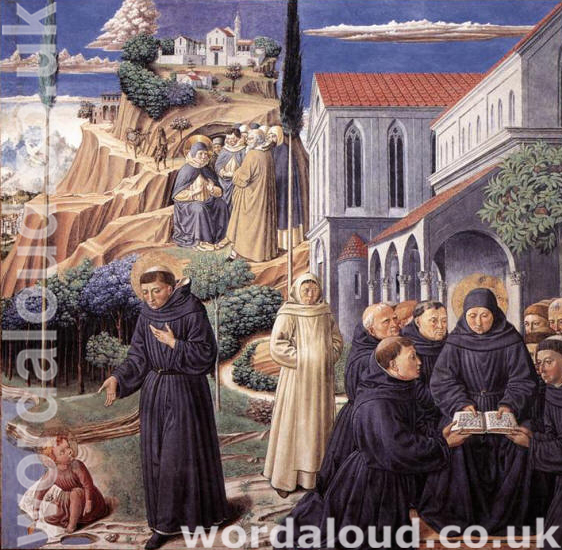
Saint John Eudes reminds us that Christ’s mysteries are not only past events but living realities meant to take shape within us. Everything that Jesus lived on earth—his birth, his hidden life, his suffering, his rising, his glory—he desires to live again in his members. The Christian life, then, is not merely imitation from a distance; it is Jesus Christ quietly forming his own life in us, day by day [ … ]
YouTube: Ash Wednesday | T.S. Eliot | Audio Christian Poetry | Word Aloud Ash Wednesday, one of T.S. Eliot’s most profound and enigmatic poems, marks a significant transition in his life and work. Written in 1930, it is the first long poem Eliot composed after his conversion to Anglicanism in 1927. The poem, often considered one of Eliot’s masterpieces, delves into themes of faith, redemption, and spiritual struggle. It reflects the poet’s personal journey towards spiritual enlightenment and serves as a testament to his newfound religious beliefs. A reading of Ash Wednesday is an exploration of the poem’s religious, literary, and personal contexts, as of the poem’s complex structure and themes. Religious Context And Symbolism Ash Wednesday is deeply embedded in Christian symbolism and tradition. The title refers to the first day of Lent in the Christian liturgical calendar, a day marked by penance, fasting, and prayer. Ash Wednesday is a time for reflection on mortality and repentance, themes that are intricately woven throughout the poem. Eliot’s conversion to Anglicanism profoundly influenced his writing; ‘Ash Wednesday’ is an expression of spiritual awakening and quest for redemption. The poem is replete with religious imagery and references, drawing on Christian doctrine and scripture. The use of liturgical language, biblical allusions, and references to saints and spiritual figures creates a tapestry of faith that invites readers to contemplate deep spiritual truths with which Eliot is grappling. The repetitive and prayer-like quality of the verses echoes meditative practices of the faithful, in part enabling the contemplative nature of the poem. Literary Influences And Techniques T.S. Eliot was a master of literary allusion and technique, and Ash Wednesday expresses Eliot’s ability to blend various influences into a cohesive whole. The poem reflects the influence of Dante, particularly The Divine Comedy, which Eliot admired for its exploration of spiritual ascent and redemption. Dante’s journey through Hell, Purgatory and Heaven parallels Eliot’s own spiritual journey, and the structure of Ash Wednesday can be seen as a reflection of this pilgrimage. Eliot’s use of fragmented narrative, a hallmark of his earlier work such as The Waste Land, is also present in Ash Wednesday. However, in this poem, the fragmentation serves a different purpose. Instead of depicting the disintegration of modern society, it mirrors the fragmented and often painful process of spiritual rebirth. The disjointed structure reflects the internal struggle of the speaker, who is torn between the pull of worldly desires and the aspiration for divine grace. The poem’s language is rich and varied, combining the lyrical and the obscure, the personal and the universal. Eliot employs a range of poetic forms and devices, including free verse, rhyme and meter, to convey the tumultuous journey of faith. The shifting tone and style reflect the complexities and contradictions inherent in the spiritual quest, capturing moments of doubt, despair, hope, and transcendence. Personal Significance Ash Wednesday is a deeply personal work. Eliot’s conversion to Anglicanism marked a profound shift in his life, providing a sense of purpose and direction that had been missing. The poem can be read as a reflection of Eliot’s own struggles with faith and his efforts to reconcile his intellectual skepticism with his desire for spiritual certainty. Eliot’s personal experiences, including his troubled marriage and professional pressures, also inform the poem. Themes of renunciation and acceptance, sin and redemption, are not merely abstract concepts but lived realities for the poet. This personal dimension adds a layer of intimacy and urgency to the poem, which thereby resonates with readers who have faced their own spiritual crises. Thematic Exploration At its core, Ash Wednesday is a meditation on the possibility of spiritual renewal in a world that often seems devoid of meaning. The poem grapples with the tension between faith and doubt, reflecting the existential struggles of modernity. The poem acknowledges the difficulties of maintaining belief in an age of skepticism but ultimately affirms the possibility of redemption and grace. The central theme of renunciation is explored through imagery of ascension and purification. The speaker’s journey is marked by a series of renunciations, symbolizing the shedding of earthly attachments in pursuit of spiritual truth. This process is neither straightforward nor easy; it involves moments of intense struggle and introspection. Yet, through this arduous journey, the speaker moves closer to a state of spiritual clarity and acceptance. Ash Wednesday | T. S. Eliot Because I do not hope to turn again Because I do not hope Because I do not hope to turn Desiring this man’s gift and that man’s scope I no longer strive to strive towards such things (Why should the agèd eagle stretch its wings?) Why should I mourn The vanished power of the usual reign? Because I do not hope to know The infirm glory of the positive hour Because I do not think Because I know I shall not know The one veritable transitory power Because I cannot drink There, where trees flower, and springs flow, for there is nothing again Because I know that time is always time And place is always and only place And what is actual is actual only for one time And only for one place I rejoice that things are as they are and I renounce the blessèd face And renounce the voice Because I cannot hope to turn again Consequently I rejoice, having to construct something Upon which to rejoice And pray to God to have mercy upon us And pray that I may forget These matters that with myself I too much discuss Too much explain Because I do not hope to turn again Let these words answer For what is done, not to be done again May the judgement not be too heavy upon us Because these wings are no longer wings to fly But merely vans to beat the air The air which is now thoroughly small and dry Smaller and dryer than the will Teach us to care and not to care Teach us to sit still. Pray for us sinners now […]
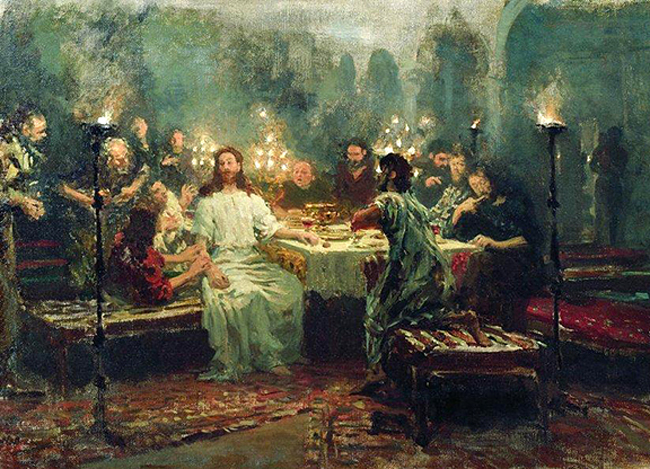
This is the third day of Holy Week. Through these verses of John’s Gospel, Jesus experiences great emotion, great sorrow, as he prepares for his betrayal and passion. He has given everything to Judas. He has washed his feet along with those of the other disciples. He shares an intimate and important meal with him. Judas has been one of the closest with Jesus for three years. Even now he shows compassion and does not name his betrayer to the other disciples. Instead he says: ‘One of you shall betray me.’ [ … ]