
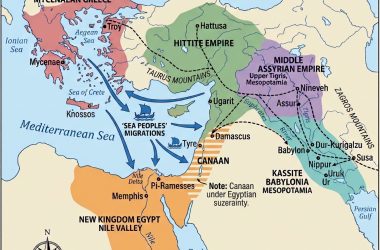
The world described in the earliest books of the Bible did not arise in isolation. Canaan (the southern Levant, broadly corresponding to present-day Israel, the Palestinian territories and adjoining parts of Lebanon, Syria and Jordan) had already been inhabited for millennia when Israel appears in the surviving historical record. Its towns and villages belonged to a region linked by trade, warfare, diplomacy and imperial government to Egypt (in northeastern Africa, centred on the Nile Valley), Anatolia (the peninsula comprising most of present-day Turkey), Syria (on the eastern Mediterranean coast and its inland hinterland, within and around modern Syria), Cyprus (the island in the eastern Mediterranean, south of present-day Turkey) and the Aegean (the sea and surrounding lands between present-day Greece and western Turkey). During the centuries around 1200 BC, much of that political world changed. Some kingdoms disappeared; others survived in reduced form; new settlements and communities became visible. The transition is conventionally called the Bronze Age Collapse [ … ]
King David

Was There An Historical King David? | What Can We Know?
Almost everything we know about David’s life and reign comes from the biblical narrative itself. No surviving inscription from David’s lifetime identifies him as king. No contemporary archive records his administration. No independent account describes his campaigns, his relationships or the circumstances of his death. The biblical texts provide an abundance of information, but the means of verifying much of it are limited. The question of David’s existence might be distinguished from the historical accuracy of his biography. A man named David may have ruled in the southern highlands of the Levant around the beginning of the tenth century BC without having accomplished everything attributed to him. The narratives may preserve authentic memories of his life alongside later interpretation, literary development and theological reflection. The historical question cannot be answered by accepting or rejecting the biblical account as a whole [ … ]