Christian Art | George Herbert | Sepulchre| The Church | Mattens
George Herbert | The Temple | The Church | Mattens
I cannot ope mine eyes,
But thou art ready there to catch
My morning-soul and sacrifice:
Then we must needs for that day make a match.
My God, what is a heart?
Silver, or gold, or precious stone,
Or starre, or rainbow, or a part
Of all these things, or all of them in one?
My God, what is a heart,
That thou shouldst it so eye, and wooe,
Powring upon it all thy art,
As if that thou hadst nothing els to do?
Indeed mans whole estate
Amounts (and richly) to serve thee:
He did not heav’n and earth create,
Yet studies them, not him by whom they be.
Teach me thy love to know;
That this new light, which now I see,
May both the work and workman show:
Then by a sunne-beam I will climbe to thee.
George Herbert | The Temple | The Church | Mattens
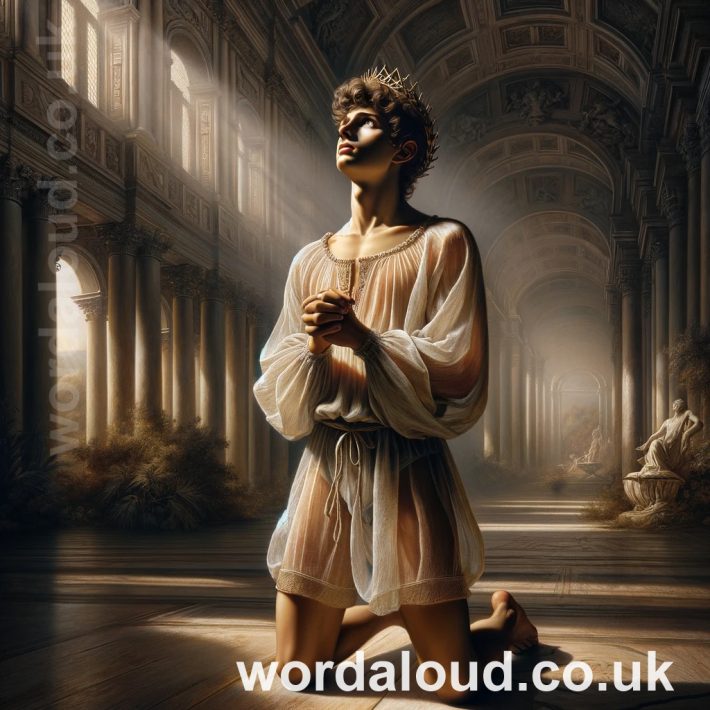
The poem reflects an intimate conversation between the poet and God, exploring the nature of human devotion, the human heart, and divine presence. It begins with Herbert’s realization that God is present from the very moment Herbert opens his eyes each morning, indicating God’s constant vigilance and readiness to connect with the human soul. This immediate presence of God suggests that each day is a fresh opportunity for a ‘match’ or covenant, where both God and the poet engage in a continuous relationship of devotion and acknowledgment.
Herbert then contemplates the essence of the human heart, wondering why God would focus so much attention on something seemingly humble and ordinary. He questions what a heart is made of, comparing it to valuable and radiant elements like silver, gold, precious stones, stars, and rainbows, only to dismiss these comparisons by asking if the heart is perhaps all these things combined. Through these comparisons, Herbert explores the heart’s potential value in the eyes of God, emphasizing such depth and complexity of what might appear to be a simple human attribute.
In the third stanza, Herbert marvels that God would devote such careful attention to the human heart. The phrase ‘pouring upon it all thy art’ suggests that God engages in an intentional and tender effort to nurture the heart, as if He had nothing else to occupy Him. This line highlights the poet’s wonder at the profound care and affection God shows toward humans, even though humans themselves are so often preoccupied with the material world rather than with their Creator.
The poem meditates on human priorities. Herbert reflects that humanity, though created by God and with the purpose of serving Him, often chooses instead to focus on studying ‘heaven and earth’—the physical universe and its phenomena—while neglecting the Creator who brought all these things into being. This observation criticizes human tendencies to be absorbed by worldly pursuits and intellect, rather than by spiritual understanding or reverence for God.
In the final stanza, Herbert expresses a desire to truly understand God’s love. He asks for divine instruction so that he may fully comprehend this ‘new light’ he has glimpsed, a light representing awareness or insight into God’s nature. The poet hopes this enlightenment will reveal both the divine work—the world and everything in it—and the ‘workman,’ God Himself. The metaphor of the ‘sunbeam’ in the closing line symbolizes a path or bridge to God, suggesting that Herbert, having been enlightened by divine love, seeks to ascend spiritually toward the divine.
The poem is an exploration of the poet’s relationship with God, his sense of awe at God’s focus on human hearts, and his aspiration to rise above worldly distractions. The language of light and ascent underscores a desire for spiritual elevation and a deeper understanding of divine purpose, concluding with a yearning to bridge the gap between the human and the divine.
Christian Art | Parousia | Second Coming | Lamb Of God, You Take Away The Sins Of The World Luke 17: 26-37 (Audio Bible KJV, Spoken Word) Early Christian thought about the Parousia – the second coming – was largely influenced by the teachings of Jesus and the writings of Saint Paul. In the early Christian community, expectation of Christ’s return was strong, and many Christians believed that it would happen in their lifetime. This belief is evident in the New Testament, where the authors express a sense of urgency in their writings and encourage their readers to be prepared for Christ’s imminent return. As Christianity spread throughout the Roman Empire, the idea of the Parousia became more complex and nuanced. Theological debates arose around the nature of Christ’s return and the events that would precede it. Some theologians, such as Origen and Augustine, saw the Parousia as a spiritual event that was already happening in the Church. Others, such as the Montanists and the millenarians, believed in a literal, physical return of Christ and the establishment of a new, earthly Kingdom. In the Middle Ages, the Parousia was often associated with apocalypticism and the idea of a final, cataclysmic battle between good and evil – the last battle. The idea of the Antichrist, who would precede Christ’s return, became a popular theme in Christian literature, and the book of Revelation (Apocalypse – meaning to reveal, to uncover) was interpreted as a prophetic guide to the end of the world. Biblical Basis For The Parousia | The Second Coming The concept of the Parousia, or the Second Coming of Jesus Christ, is central to Christian eschatology and is supported by numerous biblical passages in both the Old and New Testaments. In the Old Testament, there are numerous passages that refer to the coming of a Messiah who will restore Israel and bring about the final judgment. For example, in Daniel 7:13-14, it is written: ‘I saw in the night visions, and, behold, one like the Son of man came with the clouds of heaven, and came to the Ancient of days, and they brought him near before him. And there was given him dominion, and glory, and a kingdom, that all people, nations, and languages, should serve him: his dominion is an everlasting dominion, which shall not pass away, and his kingdom that which shall not be destroyed.’ This passage describes a divine figure who comes in the clouds and is given dominion over all nations. In the New Testament, the Parousia is described in greater detail, particularly in the teachings of Jesus and the writings of Saint Paul. Jesus speaks of his return in many passages, including Matthew 24:30-31, where Jesus says: ‘And then shall appear the sign of the Son of man in heaven: and then shall all the tribes of the earth mourn, and they shall see the Son of man coming in the clouds of heaven with power and great glory. And he shall send his angels with a great sound of a trumpet, and they shall gather together his elect from the four winds, from one end of heaven to the other.’ Here, Jesus describes his return in power and glory, accompanied by angels who gather Jesus’ elect from all over the world. In Saint Paul’s letters, the Parousia is also described in detail. In 1 Thessalonians 4:16-17, Saint Paul writes: ‘For the Lord himself shall descend from heaven with a shout, with the voice of the archangel, and with the trump of God: and the dead in Christ shall rise first: Then we which are alive and remain shall be caught up together with them in the clouds, to meet the Lord in the air: and so shall we ever be with the Lord.’ This passage describes a resurrection of the dead and the gathering of believers to meet the Lord Jesus in the air. The language and imagery used to describe the Parousia are often dramatic and apocalyptic in nature. The Parousia is often described as a time of judgment, when the righteous will be separated from the wicked, and God’s justice will be fully revealed. The imagery of clouds, trumpets, and angels is used to depict the power and glory of Christ’s return. Theological Interpretations Of The Parousia | Jesus’ Second Coming The concept of the Parousia has been interpreted in a variety of ways throughout Christian history. Dispensationalism Dispensationalism is a theological framework that emerged in the 19th Century and has since become popular among some evangelical and fundamentalist Christians. Dispensationalists believe that history is divided into distinct periods or ‘dispensations’, each of which is marked by a particular mode of divine revelation and a specific plan of salvation. According to dispensationalist theology, the Parousia will be preceded by a period of tribulation, during which the Antichrist will establish a one-world government and the Jews will be restored to their homeland. The Parousia itself will involve a physical, visible return of Christ, who will establish a thousand-year reign on earth before the final judgment. Preterism Preterism is a theological interpretation of the Parousia that holds that many of the prophecies in the New Testament, particularly those in the book of Revelation, were fulfilled in the first century AD. According to this view, the Parousia occurred in a spiritual sense when Christ ascended to heaven and sent the Holy Spirit to empower the Church. Preterists argue that the tribulation and other end-time events predicted in the New Testament were fulfilled in the destruction of the Temple in Jerusalem in AD 70. Postmillennialism Postmillennialism is a theological view that holds that the Parousia will occur after a period of history in which the Church will gradually bring about the kingdom of God on earth. According to this view, the Church will spread the gospel throughout the world, and social, political, and economic conditions will gradually improve. Eventually, Christ will return to a world that has been largely transformed by the Gospel. Amillennialism […]
In today’s Gospel reading, Jesus continues to teach the people the true meaning of purity. In preceding verses, Jesus has told the scribes they are hypocrites, with a mistaken idea of what truly constitutes prayer, who lead people through their teachings to distorted and false understandings of how to love God and how to do well by other people within the community [ … ]
Psalm 56 is a heartfelt prayer and an expression of profound trust in God amid distress and persecution. The psalmist begins by pleading for God’s mercy, feeling besieged by adversaries who seek to oppress and swallow him up. This prayer encapsulates the psalmist’s raw emotions and the desire for divine intervention in the face of adversity [ … ]
Search Google Here | A Holy Land Jerusalem Pilgrimage? | A Safari? | An Escape..