
Christian Art | George Herbert | The Temple | The Church | The World
George Herbert | The Temple | The Church | The World
Love built a stately house; where Fortune came,
And spinning phansies, she was heard to say,
That her fine cobwebs did support the frame,
Whereas they were supported by the same:
But Wisdome quickly swept them all away.
Then Pleasure came, who liking not the fashion,
Began to make Balcones, Terraces,
Till she had weakned all by alteration:
But rev’rend laws, and many a proclamation
Reformed all at length with menaces.
Then enter’d Sinne, and with that Sycomore,
Whose leaves first sheltred man from drought and dew,
Working and winding slily evermore,
The inward walls and Sommers cleft and tore:
But Grace shor’d these, and cut that as it grew.
Then Sinne combin’d with Death in a firm band
To rase the building to the very floore:
Which they effected, none could them withstand.
But Love and Grace took Glorie by the hand,
And built a braver Palace then before.

George Herbert | The Temple | The Church | The World
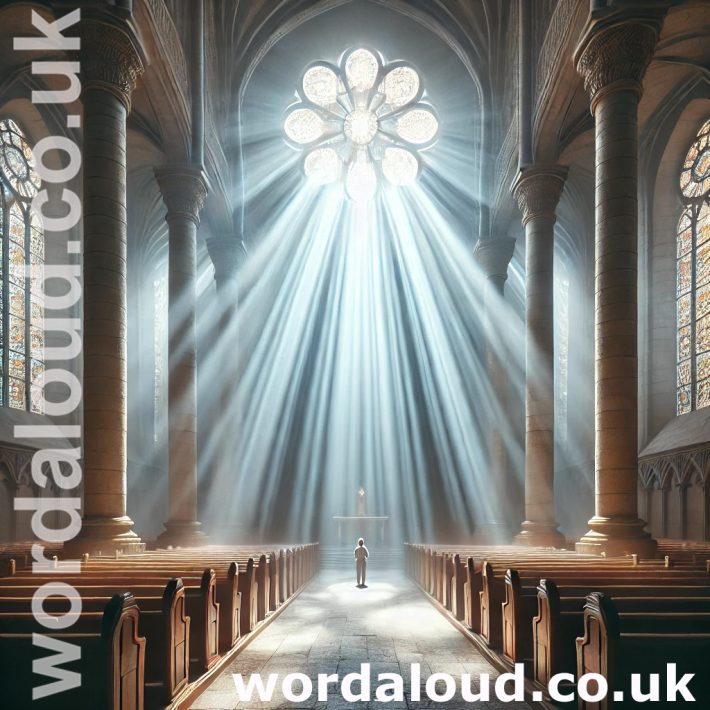
George Herbert’s ‘Love Built a Stately House’ is an allegorical poem exploring themes of divine grace, human fallibility, and spiritual struggle between sin and redemption. The poem uses the metaphor of a grand house to represent the soul and its vulnerability to the forces of Fortune, Pleasure, Sin, and ultimately, divine restoration through Love and Grace.
The poem opens with the image of a ‘stately house’ built by Love, suggesting a structure founded on divine principles. Love, personified as the ultimate creative force, constructs a place of spiritual integrity and strength. However, Fortune enters, spinning her fragile ‘cobwebs’, symbolic of worldly illusions and transient success. Though she claims her delicate webs support the house, they are in fact reliant on the underlying divine foundation. Wisdom, a stabilizing force, arrives and clears these deceptions, emphasizing the ultimate futility of human pride and superficial pursuits when weighed against divine truth.
Next, Pleasure attempts to alter the structure, dissatisfied with its simplicity and spiritual focus. Her modifications— ‘balconies’ and ‘terraces’—introduce instability, highlighting how indulgence and excess weaken the soul. The intervention of ‘reverend laws’ and ‘proclamations’ restores the original order, suggesting the importance of divine commandments and moral discipline in maintaining spiritual integrity.
Sin’s arrival marks a deeper threat to the house’s foundation. The reference to the ‘sycamore’ recalls the biblical story of Adam and Eve, whose first act of covering their nakedness with fig leaves represents human attempts to conceal sin. Sin works insidiously, ‘winding slyly’ and causing internal damage, yet Grace intervenes, restoring the structure by ‘shoring’ the damaged areas. This image of support conveys divine intervention as both a healing and protective force against moral decay.
The poem’s climax involves the alliance of Sin and Death, who conspire to completely destroy the house. Their destructive power brings the structure down to ‘the very floor’, an image of total collapse and the consequences of unchecked spiritual corruption. Yet, the poem does not end with despair. Love and Grace, personified once more, take ‘Glory by the hand’ and rebuild the house, making it ‘braver than before’. This final image emphasizes redemption and the transformative power of divine mercy. The house, once weakened by sin, is restored to an even greater spiritual strength through the actions of Love and Grace working in harmony with divine Glory.
The structure of the poem reflects its themes, with carefully balanced stanzas and controlled rhyme scheme suggesting a moral order that, despite disturbance, is ultimately restored. Herbert’s use of personification deepens the poem’s theological message, making abstract concepts vivid and immediate. The narrative progression—from initial construction to decay and eventual restoration—parallels the Christian understanding of Fall, Redemption, and the promise of spiritual renewal through Christ’s grace.
‘Love Built a Stately House’ explores how spiritual integrity can be compromised by worldly distractions and sin, yet ultimately restored through divine intervention. Herbert’s emphasis on Love and Grace as active, restorative forces underscores his belief in the redemptive power of divine mercy, offering hope for spiritual renewal. The poem becomes not just a meditation on the vulnerability of the soul but also celebration of the transformative power of divine compassion.
- The Temple by George Herbert (Complete Collection)
- George Herbert: A Literary Life by Sidney Gottlieb
- The English Poems of George Herbert edited by Helen Wilcox
- George Herbert and the Seventeenth-Century Religious Poets edited by Mario Di Cesare
- Metaphysical Poetry: A New Perspective by Colin Burrow
- The Devotional Poetry of George Herbert by Chana Bloch
- George Herbert and the Mystery of the Word by Richard Strier


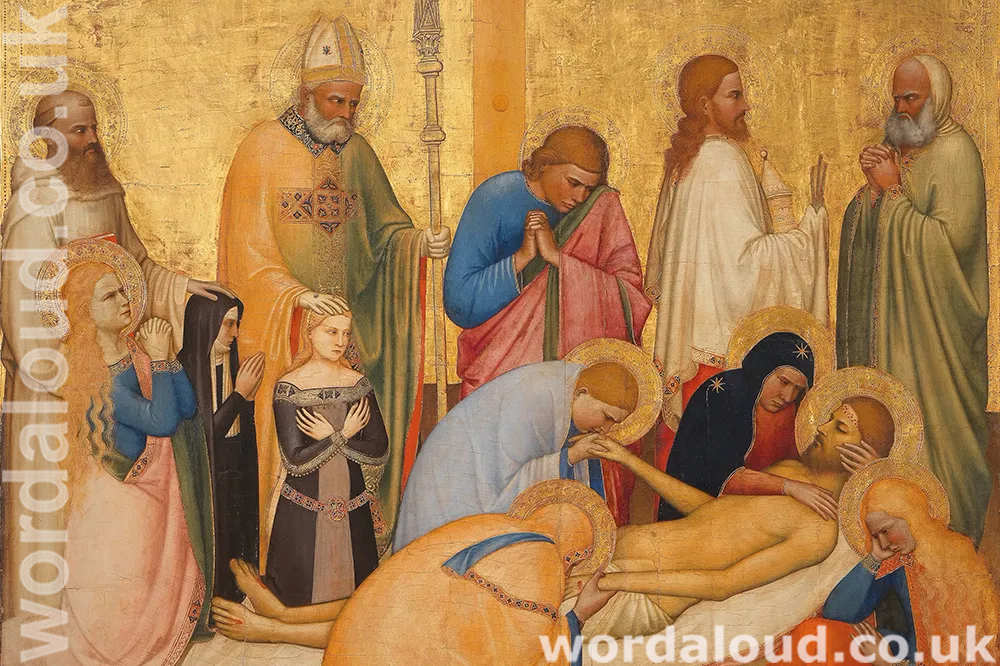
Saint Augustine reflects on the words of Christ in John 6:44: ‘No one comes to me unless the Father draws him.’ He examines how divine grace and human freedom cooperate in faith. The verb ‘draws’ might suggest compulsion, but Augustine explains that this drawing occurs through love and desire, not force [ … ]

The poem centres on a reflection of sin and redemption, using a natural metaphor to illustrate the poet’s spiritual journey. In the opening lines, the poet likens himself to someone who stands at the edge of a dark, shadowy grove but looks beyond it toward the sky. This image suggests the poet’s desire to move past his sins, as represented by the grove, and seek out the purity and grace symbolized by the open sky above. Rather than remaining fixated on his wrongdoings, he wishes to direct his gaze toward salvation [ … ]
Faith healing, also known as spiritual healing, is the belief that illness can be cured through prayer, divine intervention, or the power of the Holy Spirit. It is a practice that has been present in Christianity since its inception and has been the subject of much debate and discussion within the Christian community [ … ]
