
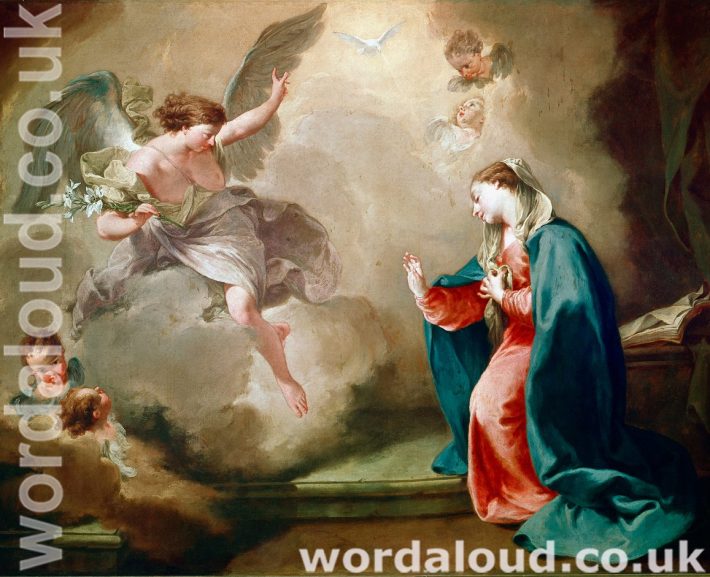
Christian Art | The Annunciation | The Angel Gabriel Visits Mary | Be It Done Unto Me According To Thy Word
Office Of Readings | Advent December 20th | A Reading From The Homilies Of Saint Bernard In Praise Of The Virgin Mother | The Whole World Awaits Mary’s Reply
‘The whole world waits for Mary’s answer.’
In this reading, Bernard of Clairvaux reflects on the moment of the annunciation, focusing on Mary’s reply to the angel Gabriel. The reading does not retell the biblical narrative in a descriptive way but pauses at the moment before Mary speaks, treating her response as a decisive point in salvation history.
Bernard presents Mary as standing at the meeting point of God’s promise and humanity’s need. He speaks as though the whole human race is waiting with her, using figures from the Old Testament such as Adam, Abraham, and David to represent humanity before Christ. This reflects a common patristic and medieval approach in which earlier generations are seen as awaiting fulfilment in the incarnation.
The reading emphasises that God’s plan does not bypass human freedom. Although salvation comes from God alone, Bernard insists that Mary’s consent is real and necessary. Her reply is brief and ordinary in form, yet it has universal significance because it allows the eternal Word to enter human history. Bernard’s repeated appeals underline the seriousness of this moment, not to suggest uncertainty in God’s will, but to highlight the dignity given to human response.
When Bernard urges Mary to ‘speak’ and ‘receive the Word’, he is drawing on the Johannine identification of Christ as the Word of God. Mary’s spoken consent and the Word’s taking flesh are held together: her word makes room for God’s Word. The sermon therefore links obedience, faith, and incarnation without separating them.
The conclusion returns to Mary’s own words from the Gospel. Bernard allows Scripture to resolve the tension he has built up, showing that the decisive act is not dramatic speech but humble assent. The reading presents Mary as the servant of the Lord, whose consent is personal, free, and given in faith.

A Reading From The Homilies Of Saint Bernard In Praise Of The Virgin Mother | The Whole World Awaits Mary’s Reply
You have heard, O Virgin, that you will conceive and bear a son; you have heard that it will not be by man but by the Holy Spirit. The angel awaits an answer; it is time for him to return to God who sent him. We too are waiting, O Lady, for your word of compassion; the sentence of condemnation weighs heavily upon us.
The price of our salvation is offered to you. We shall be set free at once if you consent. In the eternal Word of God we all came to be, and behold, we die. In your brief response we are to be remade in order to be recalled to life.
Tearful Adam with his sorrowing family begs this of you, O loving Virgin, in their exile from Paradise. Abraham begs it, David begs it. All the other holy patriarchs, your ancestors, ask it of you, as they dwell in the country of the shadow of death. This is what the whole earth waits for, prostrate at your feet. It is right in doing so, for on your word depends comfort for the wretched, ransom for the captive, freedom for the condemned, indeed, salvation for all the sons of Adam, the whole of your race.
Answer quickly, O Virgin. Reply in haste to the angel, or rather through the angel to the Lord. Answer with a word, receive the Word of God. Speak your own word, conceive the divine Word. Breathe a passing word, embrace the eternal Word.
Why do you delay, why are you afraid? Believe, give praise, and receive. Let humility be bold, let modesty be confident. This is no time for virginal simplicity to forget prudence. In this matter alone, O prudent Virgin, do not fear to be presumptuous. Though modest silence is pleasing, dutiful speech is now more necessary. Open your heart to faith, O blessed Virgin, your lips to praise, your womb to the Creator. See, the desired of all nations is at your door, knocking to enter. If he should pass by because of your delay, in sorrow you would begin to seek him afresh, the One whom your soul loves. Arise, hasten, open. Arise in faith, hasten in devotion, open in praise and thanksgiving. Behold the handmaid of the Lord, she says, be it done to me according to your word.
Christian Prayer With Jesus Christ
Lord God,
you chose to enter the world through the free consent of the Virgin Mary.
Teach us to listen attentively to your word
and to respond without fear or delay.
As Mary received your Word in faith,
may we also receive Christ into our lives
and serve your purposes with humility and trust.
Through the same Christ our Lord.
Amen.
Glossary Of Christian Terms
Annunciation | The event described in Luke 1:26–38, when the angel Gabriel announced to Mary that she would conceive and bear Jesus by the power of the Holy Spirit.
Incarnation | The Christian belief that the Son of God took human nature and became man in the person of Jesus Christ.
The Word | A title for Christ, drawn especially from John 1:1, expressing the belief that the Son is God’s self-expression and agent of creation and salvation.
Salvation | God’s act of delivering humanity from sin and death and restoring communion with himself.
Obedience | In Christian theology, a response of trust and submission to God’s will, often associated with faith rather than mere compliance.
Patriarchs | Key figures of the Old Testament, such as Abraham, Isaac, and Jacob, regarded as ancestors of the people of Israel.
Handmaid of the Lord | Mary’s self-description in Luke 1:38, expressing her willingness to serve God according to his will.



It is the Sermon on the Mount. Our Lord has presented the crowd with the Beatitudes. We have been taught to know the gateway to heaven. These are the great Christian truths to which we aspire [ … ]

Psalm 117 is a bridge between the particular experiences of the Israelite community and universal aspects of God’s grace. By inviting all nations to participate in praise, the psalm anticipates the expansion of God’s covenantal blessings beyond confines of a single people or nation, pointing toward a more inclusive understanding of God’s kingdom [ … ]

Psalm 145, attributed to David, is acclamation of God’s sovereign rule, a declaration of God’s goodness, and a commitment to perpetual praise. The psalm is tapestry of worship, characterizing God with honorific titles and extolling God’s attributes and deeds. The psalm begins with a personal vow from the psalmist to extol God, ‘I will extol thee, my God, O king; and I will bless thy name for ever and ever.’ [ … ]
