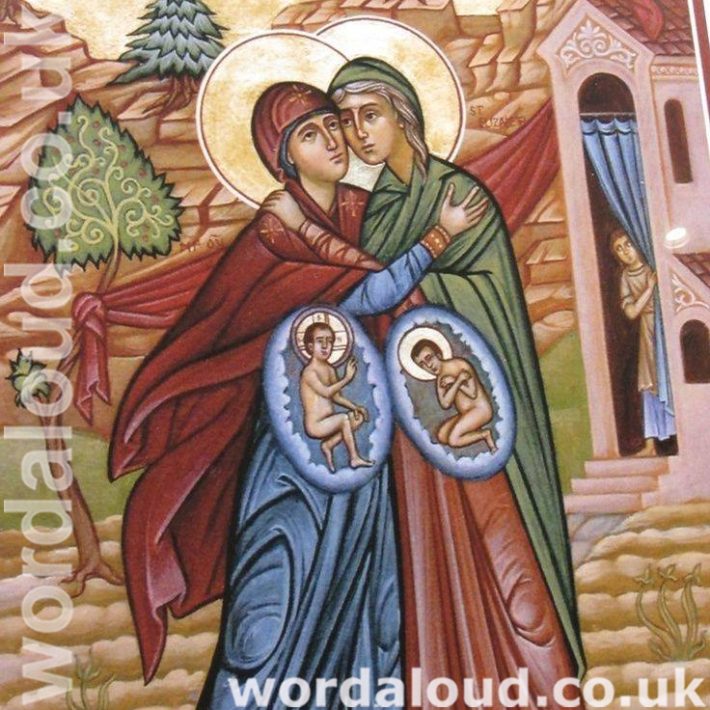
Christian Art | Mary And Elizabeth | The Visitation | Magnificat
Office Of Readings | Advent December 22nd | A Reading From The Commentary Of Saint Bede On Saint Luke’s Gospel | Visitation Of The Blessed Virgin Mary | Magnificat
‘The Magnificat.’
Saint Bede’s commentary follows the structure of Mary’s song the Magnificat in Luke 1:46–55 and explains the song with close attention to Scripture. Bede treats the Magnificat both as Mary’s personal thanksgiving and as a proclamation that concerns Israel and the fulfilment of God’s promises.
Bede begins with Mary’s opening words: ‘My soul proclaims the greatness of the Lord.’ He understands this as a response to what God has done for her. Mary does not claim greatness for herself; rather, she recognises God’s action and responds with praise. For Bede, true praise arises only where God’s work is acknowledged. The soul that has received God’s gift is the soul that can speak rightly of his greatness.
When Mary says that her spirit rejoices in God her Saviour, Bede notes the unity of humility and joy. Mary rejoices not in herself, but in God, and she names him as her Saviour. This affirms that Mary herself stands in need of salvation and receives it from God, even as she bears the Saviour in her womb.
Bede then turns to the words, ‘The Almighty has done great things for me, and holy is his name.’ He explains that God’s holiness lies in his complete otherness from creation. God’s name is holy not because it is praised by creatures, but because God surpasses all that he has made. Mary’s praise, therefore, does not add to God’s holiness but rightly acknowledges it.
In Mary’s words, ‘He has come to the help of his servant Israel,’ Bede interprets ‘Israel’ as the people who serve God in humility and obedience. He draws on the prophetic tradition to show that God’s help is given to those who accept their dependence upon God. Salvation, in this account, is inseparable from humility.
When Mary refers to God’s promise to Abraham and his descendants, Bede is careful to clarify that this promise is not limited to physical descent. Abraham’s true descendants are those who share his faith. Bede aligns this reading with the teaching of Saint Paul, who speaks of believers in Christ as heirs of the promise made to Abraham.
Finally, Bede notes the significance of women speaking prophetically at this point in salvation history. Just as the fall is associated in Genesis with the disobedience of a woman, so the announcement of redemption is associated with the faithful speech of women. In Luke’s Gospel, the voices of Mary and Elizabeth mark the beginning of the fulfilment of God’s saving plan.
A Reading From The Commentary Of Saint Bede On Saint Luke’s Gospel | The Magnificat
And Mary said: My soul proclaims the greatness of the Lord, my spirit rejoices in God my Saviour.
The Lord has exalted me by a gift so great, so unheard of, that language is useless to describe it; and the depths of love in my heart can scarcely grasp it. I offer then all the powers of my soul in praise and thanksgiving. As I contemplate his greatness, which knows no limits, I joyfully surrender my whole life, my senses, my judgement, for my spirit rejoices in the eternal Godhead of that Jesus, that Saviour, whom I have conceived in this world of time.
The Almighty has done great things for me, and holy is his name.
Mary looks back to the beginning of her song, where she said: My soul proclaims the greatness of the Lord. Only that soul for whom the Lord in his love does great things can proclaim his greatness with fitting praise and encourage those who share her desire and purpose, saying: Join with me in proclaiming the greatness of the Lord; let us extol his name together.
Those who know the Lord, yet refuse to proclaim his greatness and sanctify his name to the limit of their power, will be considered the least in the kingdom of heaven. His name is called holy because in the sublimity of his unique power he surpasses every creature and is far removed from all that he has made.
He has come to the help of his servant Israel for he has remembered his promise of mercy.
In a beautiful phrase Mary calls Israel the servant of the Lord. The Lord came to his aid to save him. Israel is an obedient and humble servant, in the words of Hosea: Israel was a servant, and I loved him.
Those who refuse to be humble cannot be saved. They cannot say with the prophet: See, God comes to my aid; the Lord is the helper of my soul. But anyone who makes himself humble like a little child is greater in the kingdom of heaven.
The promise he made to our fathers, to Abraham and his children for ever.
This does not refer to the physical descendants of Abraham, but to his spiritual children. These are his descendants, sprung not from the flesh only, but who, whether circumcised or not, have followed him in faith. Circumcised as he was, Abraham believed, and this was credited to him as an act of righteousness.
The coming of the Saviour was promised to Abraham and to his descendants for ever. These are the children of promise, to whom it is said: If you belong to Christ, then you are descendants of Abraham, heirs in accordance with the promise.
But it is right that before the birth of the Lord or of John, their mothers should utter prophecies; for just as sin began with a woman, so too does redemption. Through the deceit of one woman, grace perished; the prophecies of two women announce its return to life.
Christian Prayer With Jesus
Lord God,
you fulfilled your promises through the coming of your Son
and placed words of praise upon the lips of the humble.
Grant that we may recognise your work in our lives
and proclaim your greatness with faith and obedience.
Through Jesus Christ our Lord.
Amen.
Glossary Of Christian Terms
Magnificat — Mary’s song of praise in Luke 1:46–55, named from its opening word in Latin.
Saviour — One who brings deliverance; in Christian belief, Jesus Christ, through whom God brings salvation.
Holiness — God’s complete otherness and perfection, surpassing all created things.
Israel — In this context, not only the historical people, but those who serve God in faith and obedience.
Promise to Abraham — God’s covenant in Genesis, understood by the New Testament as fulfilled in Christ and extended to all believers.
Humility — Recognition of dependence upon God; a key disposition for receiving salvation in Scripture.



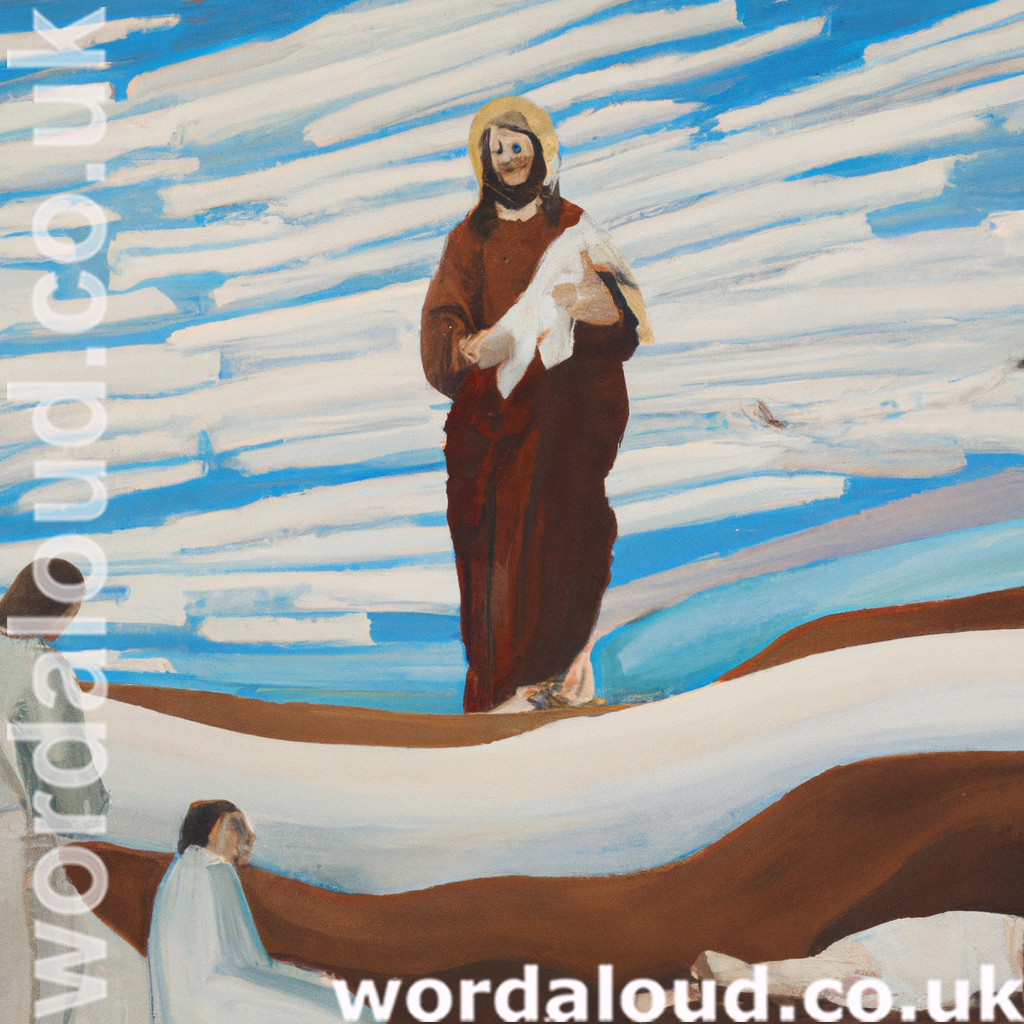
Christian Art | Parousia | Second Coming | Lamb Of God, You Take Away The Sins Of The World Luke 17: 26-37 (Audio Bible KJV, Spoken Word) Early Christian thought about the Parousia – the second coming – was largely influenced by the teachings of Jesus and the writings of Saint Paul. In the early Christian community, expectation of Christ’s return was strong, and many Christians believed that it would happen in their lifetime. This belief is evident in the New Testament, where the authors express a sense of urgency in their writings and encourage their readers to be prepared for Christ’s imminent return. As Christianity spread throughout the Roman Empire, the idea of the Parousia became more complex and nuanced. Theological debates arose around the nature of Christ’s return and the events that would precede it. Some theologians, such as Origen and Augustine, saw the Parousia as a spiritual event that was already happening in the Church. Others, such as the Montanists and the millenarians, believed in a literal, physical return of Christ and the establishment of a new, earthly Kingdom. In the Middle Ages, the Parousia was often associated with apocalypticism and the idea of a final, cataclysmic battle between good and evil – the last battle. The idea of the Antichrist, who would precede Christ’s return, became a popular theme in Christian literature, and the book of Revelation (Apocalypse – meaning to reveal, to uncover) was interpreted as a prophetic guide to the end of the world. Biblical Basis For The Parousia | The Second Coming The concept of the Parousia, or the Second Coming of Jesus Christ, is central to Christian eschatology and is supported by numerous biblical passages in both the Old and New Testaments. In the Old Testament, there are numerous passages that refer to the coming of a Messiah who will restore Israel and bring about the final judgment. For example, in Daniel 7:13-14, it is written: ‘I saw in the night visions, and, behold, one like the Son of man came with the clouds of heaven, and came to the Ancient of days, and they brought him near before him. And there was given him dominion, and glory, and a kingdom, that all people, nations, and languages, should serve him: his dominion is an everlasting dominion, which shall not pass away, and his kingdom that which shall not be destroyed.’ This passage describes a divine figure who comes in the clouds and is given dominion over all nations. In the New Testament, the Parousia is described in greater detail, particularly in the teachings of Jesus and the writings of Saint Paul. Jesus speaks of his return in many passages, including Matthew 24:30-31, where Jesus says: ‘And then shall appear the sign of the Son of man in heaven: and then shall all the tribes of the earth mourn, and they shall see the Son of man coming in the clouds of heaven with power and great glory. And he shall send his angels with a great sound of a trumpet, and they shall gather together his elect from the four winds, from one end of heaven to the other.’ Here, Jesus describes his return in power and glory, accompanied by angels who gather Jesus’ elect from all over the world. In Saint Paul’s letters, the Parousia is also described in detail. In 1 Thessalonians 4:16-17, Saint Paul writes: ‘For the Lord himself shall descend from heaven with a shout, with the voice of the archangel, and with the trump of God: and the dead in Christ shall rise first: Then we which are alive and remain shall be caught up together with them in the clouds, to meet the Lord in the air: and so shall we ever be with the Lord.’ This passage describes a resurrection of the dead and the gathering of believers to meet the Lord Jesus in the air. The language and imagery used to describe the Parousia are often dramatic and apocalyptic in nature. The Parousia is often described as a time of judgment, when the righteous will be separated from the wicked, and God’s justice will be fully revealed. The imagery of clouds, trumpets, and angels is used to depict the power and glory of Christ’s return. Theological Interpretations Of The Parousia | Jesus’ Second Coming The concept of the Parousia has been interpreted in a variety of ways throughout Christian history. Dispensationalism Dispensationalism is a theological framework that emerged in the 19th Century and has since become popular among some evangelical and fundamentalist Christians. Dispensationalists believe that history is divided into distinct periods or ‘dispensations’, each of which is marked by a particular mode of divine revelation and a specific plan of salvation. According to dispensationalist theology, the Parousia will be preceded by a period of tribulation, during which the Antichrist will establish a one-world government and the Jews will be restored to their homeland. The Parousia itself will involve a physical, visible return of Christ, who will establish a thousand-year reign on earth before the final judgment. Preterism Preterism is a theological interpretation of the Parousia that holds that many of the prophecies in the New Testament, particularly those in the book of Revelation, were fulfilled in the first century AD. According to this view, the Parousia occurred in a spiritual sense when Christ ascended to heaven and sent the Holy Spirit to empower the Church. Preterists argue that the tribulation and other end-time events predicted in the New Testament were fulfilled in the destruction of the Temple in Jerusalem in AD 70. Postmillennialism Postmillennialism is a theological view that holds that the Parousia will occur after a period of history in which the Church will gradually bring about the kingdom of God on earth. According to this view, the Church will spread the gospel throughout the world, and social, political, and economic conditions will gradually improve. Eventually, Christ will return to a world that has been largely transformed by the Gospel. Amillennialism […]

This early Christian text, traditionally attributed to Barnabas and likely written by an anonymous Christian teacher in the late first or early second century, reflects on key themes of Christian belief and practice. The author addresses a group of Christians with a greeting of peace, expressing gratitude for the presence of God’s Spirit among them. He states that their spiritual condition has encouraged him to reflect on his own faith and prompted him to share what he has received in teaching [ … ]
The three synoptic Gospels tell us of this episode of Jesus’ life, when he returned home to Nazareth and preached in the synagogue there. Luke’s Gospel gives us the text of Isaiah read by Jesus, in which Jesus’ announces his messianic mission – to bring the good news to the poor, to live and to identify with the poor, to heal us and set us at liberty from sin. As Jesus closes the book, he omits the following from Isaiah 61: 2: ‘…and the day of vengeance of our God.’ This is deliberate interruption. Jesus is not come to maintain old enmities. Jesus’ way is peace. It is the people of all the world who are to be blessed in Christ [ … ]