
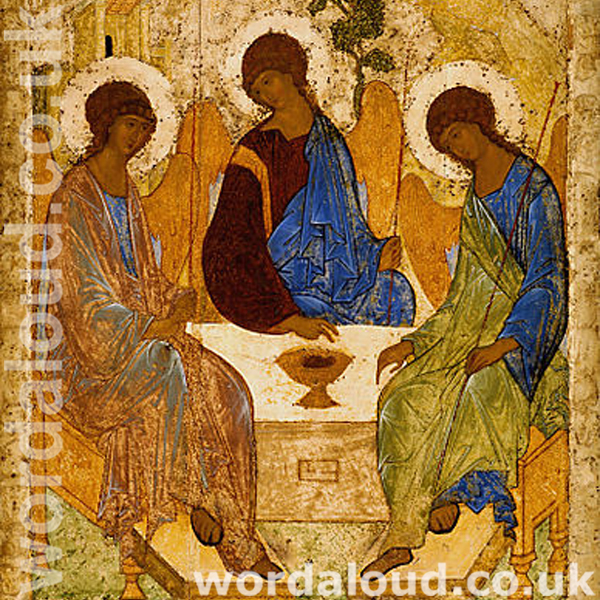
Christian Art | Trinity
Office Of Readings | Monday, Week 6, Ordinary Time | A Reading From A Sermon Of Saint Bernard | The Pursuit Of Wisdom
‘On the search for wisdom.’
This sermon by Bernard of Clairvaux presents a disciplined and practical account of the search for wisdom, framed within the moral and spiritual demands of the Christian life. Its structure is hortatory, yet it rests upon a coherent theological vision in which wisdom is both a divine gift and a task requiring sustained human response.
The opening exhortation establishes the governing contrast: perishable versus imperishable ‘food’. The language recalls the teaching of Jesus Christ, directing attention away from transient concerns towards salvation. Bernard’s use of the image of labour—working in the vineyard, digging for hidden treasure—signals that wisdom is not passively received. It must be sought through effort, yet always as something already present within the field of the world. This duality—gift and task—runs throughout the passage.
A central tension emerges in the discussion of the will. Bernard calls for conversion ‘from your own willfulness’, yet acknowledges the natural desire of the soul for wisdom. The difficulty lies not in desire as such, but in its orientation. Self-will, when left unchecked, becomes an obstacle rather than a guide. Thus, the search for wisdom requires not the suppression of desire, but its reordering. The insistence on ‘honest seeking’ suggests an interior purification: wisdom is near, but not accessible without sincerity.
The claim that ‘the word is near you, in your heart and on your lips’ situates wisdom within the interior life. Bernard draws on scriptural language associated with Paul the Apostle, emphasising that wisdom is not distant or esoteric. Yet its nearness does not remove the need for discernment. The movement from heart to lips is particularly significant. Wisdom must be internalised before it is expressed; otherwise, speech becomes empty or even harmful. Bernard’s warning against ‘vomiting’ wisdom is deliberately stark. It conveys the danger of superficial appropriation—taking in more than one can assimilate, or speaking beyond one’s true understanding.
The metaphor of honey develops this caution. Wisdom is both nourishing and delightful, but it must be received in due measure. Excess here does not signify abundance in a positive sense, but imbalance. To ‘eat too much’ is to lose proportion, leading to the loss of what has been gained. Bernard links this to the pursuit of self-glorification. Wisdom sought for the sake of reputation becomes self-defeating. This reflects a consistent monastic concern: that spiritual goods may be corrupted by pride.
The latter part of the sermon offers a more constructive outline. Wisdom is said to abound in three ways: confession of sin, praise of God, and edification of others. These correspond to three movements—self-knowledge, Godward orientation, and outward charity. The sequence is deliberate. One begins with truthfulness about oneself, proceeds to recognition of God’s primacy, and culminates in service to others. Bernard thus integrates moral discipline, worship, and communal responsibility within a single framework.
The citation concerning belief in the heart and confession with the lips reinforces this structure. Interior faith and outward expression are held together, but not confused. Speech is not merely declarative; it is formative. The ‘just man’ begins by accusing himself, thereby avoiding the distortion of pride. Only then can his speech become rightly ordered—first in praise, then in the building up of others.
In sum, Bernard presents the search for wisdom as a process requiring conversion, moderation, and perseverance. Wisdom is accessible, yet not possessed without discipline. It demands an alignment of desire, speech, and action. The sermon’s force lies in its refusal of both complacency and excess, offering instead a measured path in which wisdom is sought, received, and enacted within the life of the believer.

A Reading From A Sermon Of Saint Bernard | The Pursuit Of Wisdom
Let us work for the food which does not perish – our salvation. Let us work in the vineyard of the Lord to earn our daily wage in the wisdom which says: Those who work in me will not sin. Christ tells us: The field is the world. Let us work in it and dig up wisdom, its hidden treasure, a treasure we all look for and want to obtain.
If you are looking for it, really look. Be converted and come. Converted from what? From your own willfulness. ’But,’ you may say, ‘if I do not find wisdom in my own will, where shall I find it? My soul eagerly desires it. And I will not be satisfied when I find it, if it is not a generous amount, a full measure, overflowing into my hands.’ You are right, for blessed is the man who finds wisdom and is full of prudence.
Look for wisdom while it can still be found. Call for it while it is near. Do you want to know how near it is? The word is near you, in your heart and on your lips, provided that you seek it honestly. Insofar as you find wisdom in your heart, prudence will flow from your lips, but be careful that it flows from and not away from them, or that you do not vomit it up. If you have found wisdom, you have found honey. But do not eat so much that you become too full and bring it all up. Eat so that you are always hungry. Wisdom says: Those who eat me continue to hunger. Do not think you have too much of it, but do not eat too much or you will throw it up. If you do, what you seem to have will be taken away from you, because you gave up searching too soon. While wisdom is near and while it can be found, look for it and ask for its help. Solomon says: A man who eats too much honey does himself no good: similarly, the man who seeks his own glorification will be crushed by that same renown.
Happy is the man who has found wisdom. Even more happy is the man who lives in wisdom, for he perceives its abundance. There are three ways for wisdom or prudence to abound in you: if you confess your sins, if you give thanks and praise, and if your speech is edifying. Man believes with his heart and so he is justified. He confesses with his lips and so he is saved. In the beginning of his speech the just man is his own accuser, next he gives glory to God and thirdly, if his wisdom extends that far, he edifies his neighbor.
Christian Prayer With Jesus Christ
O God,
source of all wisdom,
who call us to labour for what endures,
grant that we may seek you with a sincere heart.
Turn us from all self-will
and order our desires according to your truth.
Teach us to seek wisely,
to receive with humility,
and to speak only what we have first made our own.
Keep us from pride in knowledge
and from the restless desire for our own praise.
May we grow in wisdom through repentance,
in gratitude through praise,
and in charity through words that build up others.
Bring us at last to the fullness of wisdom in Jesus Christ,
who lives and reigns with you for ever.
Amen
Glossary Of Christian Terms
Wisdom (Sapientia)
A divine gift enabling right judgement in accordance with God’s truth; not merely knowledge, but a way of living well.
Prudence
A virtue closely related to wisdom, concerned with discerning the right course of action in particular situations.
Conversion
A turning away from sin and self-will towards God; an ongoing transformation of the heart.
Will
The human faculty of choosing and desiring; in Christian thought, it must be aligned with God’s will.
Salvation
The deliverance from sin and attainment of eternal life through God’s grace.
Vineyard of the Lord
A biblical image for the world or the community of believers, in which human beings are called to labour for God.
Word (of God)
God’s truth present in Scripture and proclaimed in faith, described as near to the believer’s heart and lips.
Confession
The acknowledgement of sin before God; also the outward declaration of faith.
Justification
The act by which a person is made righteous before God through faith and grace (cf. Paul the Apostle).
Edification
The building up of others in faith through speech and action.
Humility
A truthful recognition of one’s dependence on God, opposed to pride and self-exaltation.
Pride (Self-glorification)
An inordinate desire for one’s own honour or recognition, often seen as a root of sin.
Repentance
A sincere turning away from sin, accompanied by a change of mind and heart.
Spiritual Discipline
Practices such as prayer, self-examination, and restraint that foster growth in wisdom and holiness.
Measure (Moderation)
The principle of balance in spiritual life, avoiding both excess and deficiency in the pursuit of good things.




‘Behold the Lamb of God.’ Throughout the Bible, we are called to know and to develop our relationship with the Lamb. It is in Genesis the Lamb is first mentioned, provided by God as a sacrifice to take the place of Isaac. Through the history of Jewish ritual, a lamb is offered in sacrifice, for expiation, reparation, sanctification. The prophets speak of a meek, tame lamb, sheared without opening its mouth. In the Book of Revelation, or Apocalypse, the full meaning of the Lamb will be revealed, as the king, the Spouse, the lamp, the temple, the place of our eternal dwelling. The Lamb spans all history. And John the Baptist has already, in John’s Gospel, recognised and declared Christ as the Lamb of God who will take away the sins of the world [ … ]

Saint Augustine continues his reflection on prayer, turning from its inner meaning to its outward rhythm and practice. Desire for God, he says, must be maintained through regular acts of prayer, for human attention is fragile. Involvement in daily affairs dulls the spiritual focus, and unless desire is repeatedly stirred, it fades into indifference. Prayer at appointed times therefore serves not to inform God but to recall the praying person to the direction of that desire [ … ]

This reading from the Pastoral Constitution on the Church in the Modern World addresses the human concern with the subject of death. It approaches the subject not only as a biological event but as a spiritual and existential mystery that touches the deepest questions about meaning, identity, and destiny [ … ]
