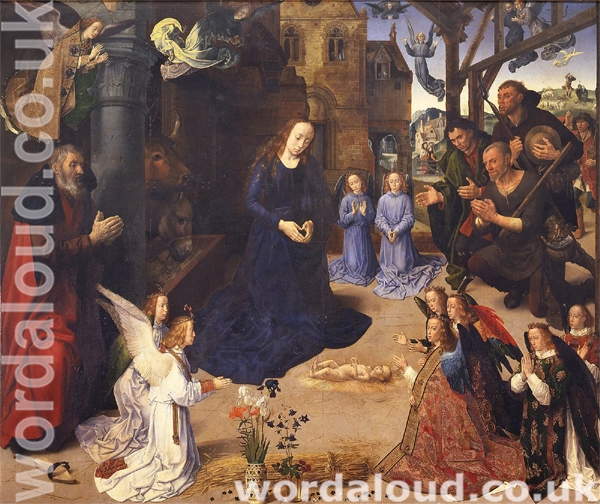
Christian Art | Nativity Of Jesus Christ | Adoration Of The Shepherds
Office Of Readings | Week 29, Monday, Ordinary Time | A Reading From The Letter Of Saint Augustine To Proba | Let Us Turn Our Mind To The Task Of Prayer At Appointed Hours
‘Let us turn our mind to the task of prayer at appointed hours.’
Saint Augustine continues his reflection on prayer, turning from its inner meaning to its outward rhythm and practice. Desire for God, he says, must be maintained through regular acts of prayer, for human attention is fragile. Involvement in daily affairs dulls the spiritual focus, and unless desire is repeatedly stirred, it fades into indifference. Prayer at appointed times therefore serves not to inform God but to recall the praying person to the direction of that desire.
For Augustine, prayer has both an interior and an exterior dimension. Interiorly, it is the constant orientation of the will towards God; exteriorly, it takes form in the deliberate setting aside of time to recollect that movement. The two belong together. Without desire, prayer becomes empty speech; without prayer, desire loses strength. This rhythm marks the discipline of the Christian life — contemplation and action, silence and word, recollection and labour.
Augustine distinguishes between length and verbosity. To pray for a long time is not to multiply words but to persevere in attention. Prolonged talk risks scattering the mind; sustained desire gathers it. The purpose of prayer is not to persuade God by argument, but to keep the heart steadfast in the act of seeking him. Thus, ‘to spend much time in prayer’ is to persist before God with a steady and undistracted longing, even when this expresses itself only in silence, tears, or sighs. God receives such wordless prayer, for he who made the heart understands what the heart utters.
Augustine refers to the monks of Egypt, whose brief and frequent prayers symbolise this balance: brevity preserving vigilance, frequency sustaining warmth. The lesson is that prayer should neither be diluted by distraction nor wearied by excess. Attention must be kept alive — neither shortened by haste nor extinguished by fatigue.
In this way, prayer becomes the renewal of desire within the pattern of time. It recalls the soul to its true end, turning it again and again toward the light it seeks. The act of praying thus restores the interior flame of longing, so that the life of faith is kept from growing cold.

A Reading From The Letter Of Saint Augustine To Proba | Let Us Turn Our Mind To The Task Of Prayer At Appointed Hours
Let us always desire the happy life from the Lord God and always pray for it. But for this very reason we turn our mind to the task of prayer at appointed hours, since that desire grows lukewarm, so to speak, from our involvement in other concerns and occupations. We remind ourselves through the words of prayer to focus our attention on the object of our desire; otherwise, the desire that began to grow lukewarm may grow chill altogether and may be totally extinguished unless it is repeatedly stirred into flame.
Therefore, when the Apostle says: Let your petitions become known before God, this should not be taken in the sense that they are in fact becoming known to God who certainly knew them even before they were made, but that they are becoming known before men through boasting.
Since this is the case, it is not wrong or useless to pray even for a long time when there is the opportunity. I mean when it does not keep us from performing the other good and necessary actions we are obliged to do. But even in these actions, as I have said, we must always pray with that desire. To pray for a longer time is not the same as to pray by multiplying words, as some people suppose. Lengthy talk is one thing, a prayerful disposition which lasts a long time is another. For it is even written in reference to the Lord himself that he spent the night in prayer and that he prayed at great length. Was he not giving us an example by this? In time, he prays when it is appropriate; and in eternity, he hears our prayers with the Father.
The monks in Egypt are said to offer frequent prayers, but these are very short and hurled like swift javelins. Otherwise their watchful attention, a very necessary quality for anyone at prayer, could be dulled and could disappear through protracted delays. They also clearly demonstrate through this practice that a person must not quickly divert such attention if it lasts, just as one must not allow it to be blunted if it cannot last.
Excessive talking should be kept out of prayer but that does not mean that one should not spend much time in prayer so long as fervent attitude continues to accompany his prayer. To talk at length in prayer is to perform a necessary action with an excess of words. To spend much time in prayer is to knock with a persistent and holy fervor at the door of the one whom we beseech. This task is generally accomplished more through sighs than words, more through weeping than speech. He places our tears in his sight, and our sighs are not hidden from him, for he has established all things through his Word and does not seek human words.
Christian Prayer With Jesus
Lord, you who know our need before we speak,
teach us to return to you in the quiet rhythm of the hours.
When our hearts grow dull through labour and distraction,
rekindle in us the flame of desire.
Let our words be few and our longing steadfast;
let our silence speak the prayer you have placed within us.
May our tears be counted before you,
our sighs received as praise,
and our whole life become a single act of turning toward your light.
Through Christ our Lord. Amen.
Glossary Of Christian Terms
Desire — The movement of the soul toward God, which prayer both expresses and strengthens.
Attention — The focused stillness of mind required in prayer; vigilance of heart rather than effort of speech.
Verbosity — The use of many words without depth of meaning; Augustine contrasts this with sustained, silent longing.
Discipline of prayer — The ordered pattern of times and gestures that preserve desire in the midst of daily life.
Monks of Egypt — Early Christian hermits whose short, frequent prayers exemplified simplicity and attentiveness.
Sighs and tears — Expressions of prayer beyond words; signs of inward desire made known to God.
Recollection — The act of gathering the mind back from distraction to awareness of God’s presence.
Persistence — The steady endurance of prayer over time, which keeps desire alive before the divine.




Saint Ephraem’s homily on the Cross is shaped by the paradox at the heart of the Paschal mystery: that death is undone by death. Jesus Christ, the Son of God, takes on flesh so that he might enter into death, not as a victim, but as a conqueror. Ephraem does not reason this out philosophically, nor does he dwell on emotional pathos. Instead, he draws out the inner structure of salvation as something enacted by God in the flesh, and received by us in faith [ … ]
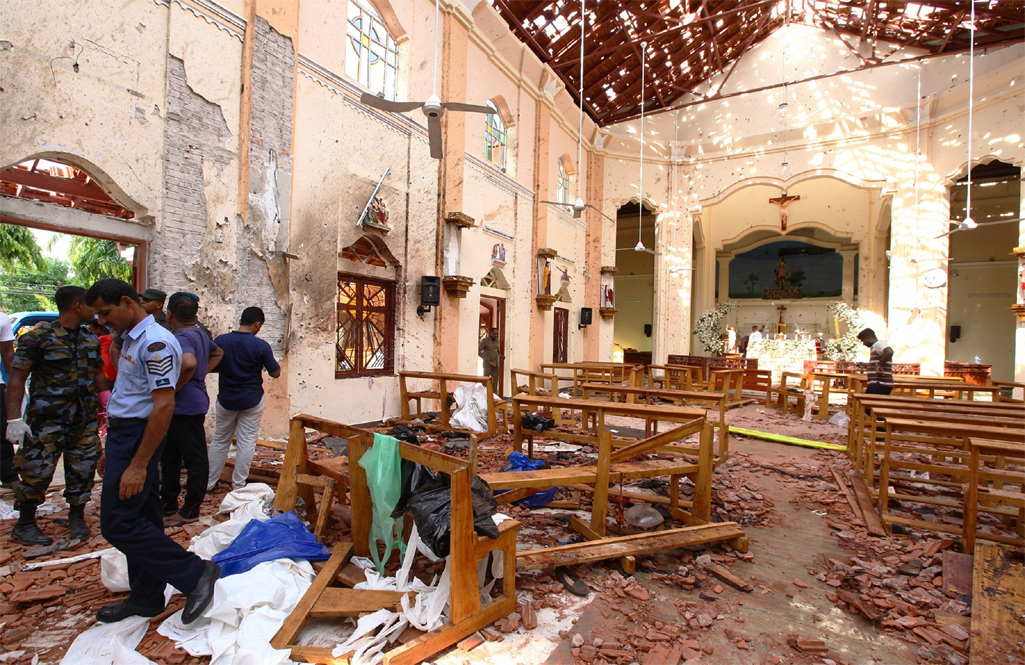
Jesus teaches us to be bold and to have faith and confidence in the light of persecutions. His listeners are told that, when they are accused, the Spirit will be with them, guiding their words such that they become a living testimony to Jesus. The Christians’ accusers will be unable to answer their words then – the force of their witness will be irresistible [ … ]
The poem contemplates the nature of spiritual growth and the relationship between the soul and the body in a Christian context. It begins with a recognition of the ‘narrow way and little gate’, referencing a biblical metaphor for the difficult path of righteousness (Matthew 7:13-14). The poet reflects on his early spiritual awakening (‘on my infancy / Thou didst lay hold’) and the idea that God preemptively initiated his faith before he could fully comprehend it (‘antedate my faith in me’). This expresses the belief that faith is a gift from God, implanted at an early stage [ … ]