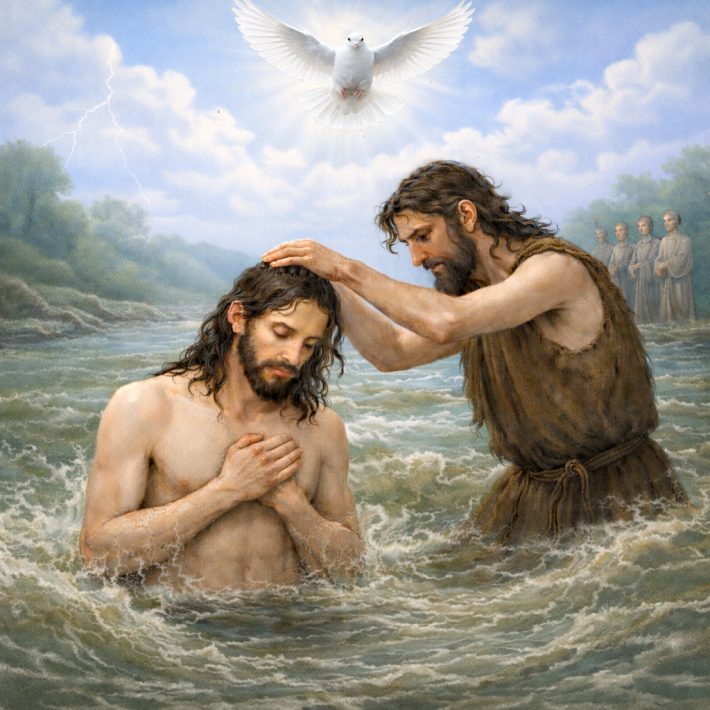
Christian Art | |Jesus Is Baptized
Office Of Readings | Wednesday, Week 6, Ordinary Time | A Reading From A Commentary On The Book Of Proverbs By Saint Procopius Of Gaza | Wisdom And Foolishness
‘The Wisdom of God has mingled wine and spread a table for us.’
This passage from Procopius of Gaza presents an extended allegorical reading of the Book of Proverbs, particularly the figure of Wisdom as host and builder. It integrates themes of creation, anthropology, the Incarnation, and sacramental life into a unified theological vision. The method is characteristically patristic: scriptural imagery is not treated in isolation but read in light of the whole economy of salvation.
The opening assertion—’Wisdom has built herself a house’—is interpreted cosmologically and anthropologically. Wisdom, identified with the divine Power of the Father, is understood to dwell both in the created order and in the human person. Creation itself becomes a kind of habitation of divine activity, while humanity, made in the image of God, is described as a composite reality, both visible and invisible. This duality is significant. It prepares for the later theme of ‘mingling’, suggesting that the structure of human nature already reflects a capacity for union between the material and the spiritual.
The reference to the ‘seven pillars’ is read in terms of the gifts of the Holy Spirit. Procopius presents these gifts not as static endowments but as principles of growth. They enable the ‘spiritual man’ to advance towards maturity, understood as conformity to Christ. The exposition here is systematic: each gift contributes to a rightly ordered life, integrating knowledge, moral action, and discernment. The relationship between knowledge and virtue is reciprocal—knowledge informs action, and action, in turn, deepens understanding. This reflects a classical Christian anthropology in which intellectual and moral formation are inseparable.
The central metaphor of the passage—the mingling of wine—introduces a Christological dimension. Human nature is described as a ‘bowl’ in which spiritual and physical elements are combined. This prepares for the fuller claim that in the Incarnation, the Jesus Christ unites divine and human natures. The imagery is carefully maintained: as wine intoxicates, so the knowledge of God affects the human mind, not by confusion but by transformation. The ‘inebriation’ is a figure for the surpassing character of divine truth, which exceeds ordinary modes of understanding.
Procopius then develops the image of the banquet. Wisdom not only prepares nourishment but invites participation. This is interpreted in explicitly ecclesial and apostolic terms. The ‘servants’ are the apostles, sent to proclaim the Gospel and summon all to the feast. The universality of the invitation is emphasised: even those described as ‘foolish’ are called to turn and receive wisdom. The movement from ignorance to faith is thus central to the text’s soteriology.
A further development concerns the nature of the law. The Gospel is said to transcend both natural and written law, not by abolishing them but by fulfilling and surpassing them. This reflects a familiar patristic distinction: earlier forms of revelation are preparatory, while the coming of Christ brings a fuller disclosure. The Incarnation is again central. In Christ, the ‘mingling’ of divine and human is realised in a definitive way, yet without confusion of natures. This careful balance reflects the doctrinal concerns of the period, particularly the need to affirm both unity and distinction in Christ.
The concluding section turns explicitly to sacramental language. The invitation to ‘eat my bread and drink the wine’ is interpreted as participation in Christ’s body and blood. The Eucharistic dimension is clear: Christ is both the host and the substance of the feast. Nourishment is not merely symbolic but transformative, enabling growth in virtue and knowledge. The language of divinisation is implicit. Through this participation, the believer is drawn into the life of God.
In sum, Procopius offers a richly layered interpretation in which Wisdom, creation, Christ, and the Church are brought into relation. The passage moves from the structure of the world and the human person to the Incarnation and sacramental life, presenting a coherent vision of divine generosity and human response. Wisdom is not only to be sought but received, not only understood but participated in.
A Reading From A Commentary On The Book Of Proverbs By Saint Procopius Of Gaza | Wisdom And Foolishness
Wisdom has built herself a house. God the Father’s Power, himself a person, has fashioned as his dwelling-place the whole world in which he lives by his activity, and also man who, created to resemble God’s own image and likeness, has a nature which is partly seen and partly hidden from our eyes.
And she has set up seven pillars. To man who was made in the image of Christ when the rest of creation was completed, Wisdom gave the seven gifts of the Spirit to enable him to believe in Christ and to keep his commandments. By means of these gifts the spiritual man grows and develops until, through firm faith and the supernatural graces he received, he finally reaches maturity. Knowledge stimulates virtue and virtue reflects knowledge. The fear of the Lord, understanding and knowledge gave the true orientation to his natural wisdom. Power makes him eager to seek understanding of the will of God as revealed in the laws by which the entire creation is governed. Counsel distinguishes these most sacred and eternal laws of God from anything opposed to them; for these laws are meant for man to ponder, to proclaim, and to fulfill. Insight disposes man to embrace these expressions of God’s will and to reject whatever contravenes them.
She has mingled her wine in a bowl and spread her table. Because the Word of God has mingled in man, as in a bowl, a spiritual and a physical nature, and has given him a knowledge both of creation and of himself as the Creator, it is natural for the things of God to have on man’s mind the inebriating effect of wine. Christ himself, the bread from heaven, is his nourishment enabling him to grow in virtue, and it is Christ who quenches his thirst and gladdens him with his teaching. For all who desire to share in it, he has prepared this rich banquet, this spiritual feast.
She has sent forth her servants with the sublime message that all are to come to the bowl and drink. Christ has sent forth his apostles, the servants with the sublime message that all are to come to the bowl and drink. Christ has sent forth his apostles, the servants of his divine will, to proclaim the message of the Gospel which, since it is spiritual, transcends both the natural and the written law. By this he calls us to himself in whom as in a bowl there was brought about by the mystery of the incarnation a marvelous mingling of the divine and human natures, although each still remains distinct. And through the apostles he cries out: Is anyone foolish? Let him turn to me. If anyone is so foolish as to think in his heart that there is no God, let him renounce his disbelief and turn to me by faith. Let him know that I am the maker of all things and their Lord.
And to those who lack wisdom he says: Come, eat my bread and drink the wine that I have prepared for you. To those who still lack the works of faith and the higher knowledge which inspires them he says; ‘Come, eat my body, the bread that is the nourishment of virtue, and drink my blood, the wine that cheers you with the joy of true knowledge and makes you divine. For in a wonderful way I have mingled my divinity with my blood for your salvation.’
Christian Prayer With Jesus Christ
O God,
source of all wisdom,
who have prepared for us a rich and living banquet
in your Son, Jesus Christ,
grant that we may come to your table with faith and humility.
Pour into us the gifts of your Spirit,
that we may grow in understanding and in virtue,
and be conformed more fully to your likeness.
Teach us to receive the bread of life
and the cup of salvation with reverence,
that, nourished by your Word and sustained by your grace,
we may be strengthened in holiness.
Draw us ever closer to the mystery of your wisdom,
where the divine and human are joined for our salvation,
and bring us at last to the fullness of life in you.
Through Christ our Lord.
Amen
Glossary Of Christian Terms
Wisdom (Divine Wisdom)
A title often applied to the Son of God, expressing his role in creation, revelation, and salvation.
Word of God (Logos)
The eternal Son, through whom all things were made and who became incarnate in Jesus Christ.
Incarnation
The mystery by which the Son of God took on human nature while remaining fully divine.
Image and Likeness of God
The belief that humanity reflects God’s nature, especially in intellect and will, and is called to grow into that likeness.
Seven Gifts of the Holy Spirit
Traditional gifts (wisdom, understanding, counsel, fortitude, knowledge, piety, and fear of the Lord) that perfect the soul and guide it in divine truth.
Holy Spirit
The third Person of the Trinity, who bestows grace and sanctifies believers.
Virtue
A habitual disposition to act in accordance with truth and goodness, strengthened by grace.
Grace
The free and transforming gift of God that enables participation in divine life.
Gospel
The good news of salvation proclaimed by Christ and his apostles.
Apostles
Those sent by Christ to proclaim his message, such as the early disciples.
Eucharist
The sacrament in which bread and wine become the body and blood of Christ, a participation in the divine life.
Bread of Life
A title for Christ, indicating that he is the source of spiritual nourishment and eternal life.
Faith
Trust in God and acceptance of his revelation, especially in Christ.
Divinisation (Theosis)
The process by which human beings are made to share in the divine life through grace.
Mystery
A divine reality that surpasses human understanding but is revealed and participated in through faith.



The fourth commandment, ‘Honour your father and mother,’ instructs Christians to show respect, love, and obedience to their parents. This commandment is important because it reflects the natural order of the family and promotes harmony within the family unit. It is a way for Christians to fulfil their responsibilities and duties as children, and to show gratitude for the love and care that their parents have provided for them [ … ]
Psalm 114 recounts the Israelites’ journey out of Egypt, focusing on God’s power over natural elements. Psalm 114 describes the sea fleeing, the Jordan River reversing its course, and mountains and hills moving, all in response to God’s presence. These images serve as metaphors for divine intervention during the Exodus. The psalm is traditionally linked with significant events in Jewish history, and its vivid imagery reflects a theme of liberation and divine guidance [ … ]

Elizabeth – Mary’s cousin – and Zechariah are of noble ancestry. They have spiritual nobility also, following in all of the commandments and ordinances of the old Law in such a way that they are righteous before God. Zechariah is a priest, moreover. He serves God in the Temple, at the centre of Jewish society and faith. His son John the Baptist will go out to the wilderness to preach, but his journey starts here [ … ]