
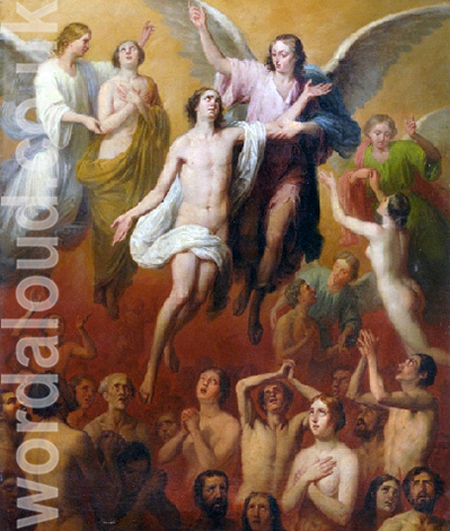
Christian Art | Prayer For All Christian Souls | Purgatory | Love Revealed By Jesus Christ
Office Of Readings | Week 32, Tuesday, Ordinary Time | A Reading From A Homily Of A Second-Century Author | Repentance Of Sin From A Sincere Heart
‘Repentance of sin from a sincere heart.’
The second-century homily develops early Christian theology of repentance that is both moral and eschatological. It presents repentance not as a fleeting emotion but as a transformative act that reshapes the believer’s life before the final judgment. The homilist combines vivid imagery with ethical exhortation, expressing the conviction that human freedom and divine mercy must meet in time if salvation is to be realised.
The central metaphor is drawn from craftsmanship: the potter and the clay. This image, inherited from the Hebrew Scriptures (cf. Jeremiah 18:1–6), represents God’s creative and redemptive sovereignty. As long as the clay is still moist—in other words, while human life endures—it can be reformed and made sound. Once hardened in the kiln, however, it cannot be remoulded. The analogy conveys a serious theological point: repentance belongs to the temporal order. The present life is the arena of conversion; after death, the possibility of change ceases. The tone is pastoral yet insistent—human life must be lived as a time for restoration.
The homilist links repentance directly with obedience to divine command and purity of life. The believer must keep the ‘seal of baptism undefiled’, a phrase implying both moral integrity and fidelity to one’s Christian identity. Baptism marks the beginning of new life; repentance sustains it. Faithfulness in small matters, as the Gospel says, is a test of faithfulness in greater ones. This insistence on the moral coherence of daily life reflects an early Christian understanding of salvation as embodied and continuous, not merely future or abstract.
A significant section of the text defends the resurrection of the body. Against tendencies to spiritualise salvation, the preacher affirms that it is in the body that one is saved, healed, and sanctified; therefore, it is in the body that one will also be judged and rewarded. The body is not a disposable vessel but a temple of God, called to share in resurrection glory. This balanced anthropology—neither rejecting the flesh nor exalting it apart from spirit—shows continuity with the Incarnation: since Christ became flesh, humanity’s bodily life is capable of redemption.
The homily concludes with a turn toward charity and interior sincerity. Repentance, if genuine, manifests itself in love for others and in a heart made transparent before God. Divine mercy is portrayed in personal terms: God is the physician, repentance is the patient’s cooperation, and sorrow for sin is the offering of gratitude. Praise must therefore arise from both heart and lips; outward confession must correspond to inward truth. The promise follows naturally: those who do the Father’s will become members of Christ’s own family.
In its moral simplicity and theological clarity, this text expresses the essence of early Christian pastoral teaching: repentance is the remaking of the human person by divine grace, achieved through obedience, purity, and love, within the limited time of earthly life.

A Reading From A Homily Of A Second-Century Author | Repentance Of Sin From A Sincere Heart
We should repent of our sins while we are still on earth. When a potter is making a vessel and it becomes misshapen or breaks in his hands, he shapes it again; but once placed in the oven, it is beyond repair. Now the clay in the craftsman’s hands is an image of ourselves, and it teaches us that, while still in this world, we must wholeheartedly repent of sins committed in the body and make it possible for the Lord to save us while there is time. When we have left this world, we shall no longer be able to repent and confess our sins. We must do the will of the Father, keep our bodies pure, and observe the commandments of the Lord, for this is the way to obtain eternal life. The Lord says in the gospel: If you have not been observant in small matters, who will entrust you with anything important? For I tell you that the man who is faithful in the smallest things is faithful in the greatest things as well. In other words, in order to obtain eternal life, we must remain pure and keep the seal of our baptism undefiled.
Nor must any of you say that our bodies will not share in the judgment, nor rise again. In what were you saved? In what did you receive your sight? Think for a moment. Was it not in this very body? Our bodies are the temple of God, and as such we must guard them, for even as we were called in the body, so shall we also be judged in the body. Since Christ, our Lord and Savior, who in the beginning was spirit, became flesh and in this way called us, it is in this flesh of ours that we shall also receive our reward.
Therefore, let us love one another, so that we may all attain to the kingdom of God. While we can still be healed, let us surrender ourselves into the hands of our divine physician and give him his recompense – the recompense of true sorrow for our sins. Since he who knows all things sees what is in our hearts, let us praise him with our hearts as well as our lips. He will then receive us as his sons. The Lord himself has said: Those who do my Father’s will are my brothers.
Christian Prayer With Jesus Christ
O Lord,
you are the potter and we are the clay.
While we live, shape us anew;
while there is time, reform what is misshapen.
Grant us sincere repentance,
that we may turn from sin and return to your will.
Keep undefiled within us the seal of our baptism,
and teach us to love one another in the purity of heart.
When our course is finished,
receive us as your sons and daughters,
healed by your mercy and made whole in Christ our Saviour,
who lives and reigns with you and the Holy Spirit,
one God, now and for ever.
Amen.
Glossary Of Christian Terms
Baptismal seal – The indelible spiritual mark signifying belonging to Christ, received at baptism and preserved through moral fidelity.
Eschatological – Relating to the final events of human history and the ultimate destiny of the soul.
Incarnation – The Christian doctrine that the Word of God took human flesh in Jesus Christ.
Judgment (final) – The divine evaluation of each person’s life at the end of time, including both soul and body.
Metanoia (repentance) – A Greek term meaning change of mind or turning of life toward God; not mere regret but moral transformation.
Obedience – Alignment of human will with the will of God, expressed through moral conduct.
Purity – Integrity of body and intention; the condition of being undivided in one’s devotion to God.
Resurrection of the body – The belief that the dead will rise, body and soul reunited, at the end of time.
Seal – A sign of authenticity and protection; in Christian usage, a symbol of God’s claim upon the believer.
Temporal – Belonging to time or earthly life, in contrast with the eternal or divine realm.
Temple of God – A biblical image describing the human body as the dwelling place of the divine Spirit.
Theophany – Manifestation or visible appearance of God; implied here in the divine act of calling humanity to life in the body.
Transfiguration – Transformation of the human condition by grace; the moral analogue of resurrection.




The poem expresses a living relationship between light and darkness, both real and symbolic. The change from night to day stands for a shifting disposition from ignorance to knowledge. This mirrors a human quest for understanding [ … ]
For the first Christian communities, almost all of them Jewish, the Benedictus would have been a song of joy, thanking God for His fulfilment of the promise of ages: God has visited his people and redeemed them. The faith of those early Christians is strong as they look back along the road they have travelled since Abraham, and forward to a time of peace, light, salvation [ … ]

Saint Gregory of Nyssa, a 4th-century Cappadocian Father and key architect of early Christian theology, offers in this Eastertide reading a profound and poetic meditation on the transformative power of the Resurrection. Rooted in the joy of Easter, the sermon explores the cosmic and personal implications of Christ’s rising from the dead. Gregory’s theology is deeply mystical, sacramental, and steeped in scriptural imagery, and this piece reveals the vast scope of the Christian vision of renewal [ … ]
