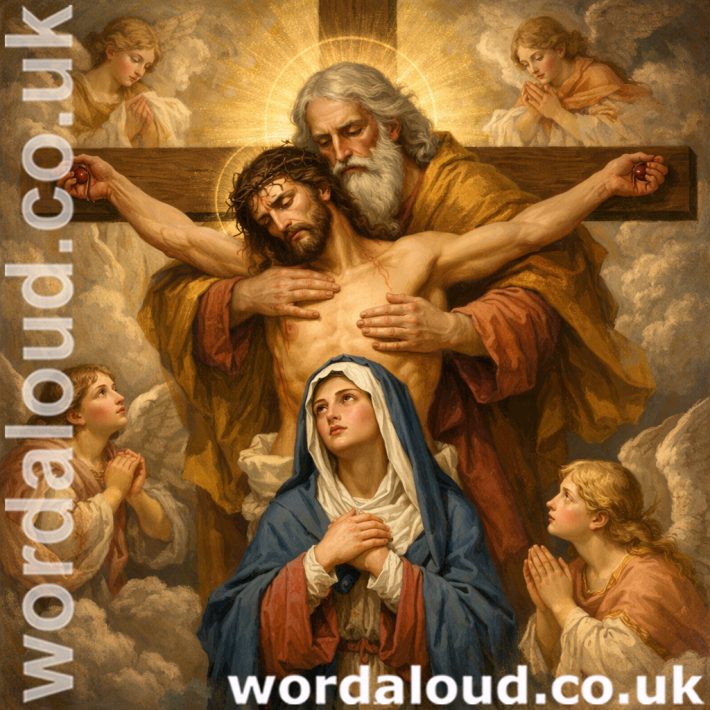
Christian Art | The Cross | God The Father, God The Son, And Mary
Office Of Readings | Week 1, Wednesday, Ordinary Time | A Reading From The Treatise Of Saint Iranaeus Against The Heresies | Knowledge Of The Father Is The Manifestation Of The Son
‘Knowledge of the Father consists in the self-revelation of the Son.’
In this reading from Against the Heresies, Saint Irenaeus sets out a central conviction of early Christian theology: knowledge of God the Father is possible only through the Son, the Word of God. This is not a matter of intellectual effort or philosophical ascent, but of divine self-disclosure.
Irenaeus begins by stressing the ordered relationship between Father and Son. The Father sends; the Son is sent. The Father remains beyond direct human sight and comprehension, while the Son makes him known. This is not because the Father is absent or distant, but because God chooses to be known in a particular way: through the Word. Knowledge of God, therefore, is always received, never seized.
When Irenaeus says that ‘knowledge of the Father consists in the self-revelation of the Son’, he means that the Son does not merely speak about the Father. Rather, in revealing himself, the Son reveals the Father. To encounter the Son is already to be drawn into knowledge of the Father, because the Son is from the Father and acts entirely in accordance with the Father’s will.
Irenaeus is careful to insist that this revelation is not limited to the incarnation alone. The Word has always been at work. Through creation, the Word reveals God as Creator; through the law and the prophets, the Word reveals God’s purpose; through becoming visible and tangible, the Word reveals the Father in a new and direct way. The difference across history is not the presence or absence of revelation, but the manner in which it is given and received.
At several points, Irenaeus notes that revelation does not automatically result in belief. All may hear the same message, yet not all respond in the same way. Knowledge of God involves obedience as well as understanding: ‘To believe in Him means to do his will.’ Revelation calls for a lived response, not simply assent.
The unity of God’s work is a further emphasis. Irenaeus speaks of one Father, one Son, one Spirit, and one salvation. The Son’s ministry, from beginning to end, serves the Father’s purpose. There is no division between creation, history, and redemption; all are held together in the work of the Word.
In this way, Irenaeus offers a vision of faith that is both deeply theological and pastoral. God is not hidden out of reluctance, but known through his own initiative. The Son stands at the centre of this knowledge, making the invisible Father known and drawing humanity into communion with God.
A Reading From The Treatise Of Saint Iranaeus Against The Heresies | Knowledge Of The Father Is The Manifestation Of The Son
No one can know the Father apart from God’s Word, that is, unless the Son reveals him, and no one can know the Son unless the Father so wills. Now the Son fulfils the Father’s good pleasure: the Father sends, the Son is sent, and he comes. The Father is beyond our sight and comprehension; but he is known by his Word, who tells us of him who surpasses all telling. In turn, the Father alone has knowledge of his Word. And the Lord has revealed both truths. Therefore, the Son reveals the knowledge of the Father by his revelation of himself. Knowledge of the Father consists in the self-revelation of the Son, for all is revealed through the Word.
The Father’s purpose in revealing the Son was to make himself known to us all and so to welcome into eternal rest those who believe in him, establishing them in justice, preserving them from death. To believe in him means to do his will.
Through creation itself the Word reveals God the Creator. Through the world he reveals the Lord who made the world. Through all that is fashioned he reveals the craftsman who fashioned it all. Through the Son the Word reveals the Father who begot him as Son. All speak of these things in the same language, but they do not believe them in the same way. Through the law and the prophets the Word revealed himself and his Father in the same way, and though all the people equally heard the message not all equally believed it. Through the Word, made visible and palpable, the Father was revealed, though not all equally believed in him. But all saw the Father in the Son, for the Father of the Son cannot be seen, but the Son of the Father can be seen. The Son performs everything as a ministry to the Father, from beginning to end, and without the Son no one can know God. The way to know the Father is the Son. Knowledge of the Son is in the Father, and is revealed through the Son. For this reason the Lord said: No one knows the Son except the Father; and no one knows the Father except the Son, and those to whom the Son has revealed him. The word ‘revealed’ refers not only to the future – as though the Word began to reveal the Father only when he was born of Mary; it refers equally to all time. From the beginning the Son is present to creation, reveals the Father to all, to those the Father chooses, when the Father chooses, and as the Father chooses. So, there is in all and through all one God the Father, one Word and Son, and one Spirit, and one salvation for all who believe in him.
Christian Prayer With Jesus Christ
Father of all,
You are beyond our sight and understanding,
yet you have chosen to make yourself known.
Through your Word,
you have spoken from the beginning
and revealed yourself in your Son.
Grant us faith to receive what you reveal,
obedience to do your will,
and humility to accept knowledge as your gift.
Lead us through your Son
into the rest and life you promise,
through the one Spirit
by whom you save all who believe.
Amen
Glossary Of Christian Terms
The Word | The Son of God, through whom the Father reveals himself and through whom all things were made.
The Father | The source of all being, known through the revelation given by the Son.
The Son | The Word of God, sent by the Father to reveal him and accomplish his will.
Self-revelation | God’s act of making himself known by his own initiative.
Knowledge of God | Understanding and communion with God made possible through the Son.
Revelation | God’s disclosure of himself in creation, history, and the Son.
Creation | The work through which the Word reveals God as Creator.
Law and prophets | The means by which the Word revealed God’s purpose before the incarnation.
Incarnation | The Word becoming visible and tangible by being born of Mary.
Belief | Trust in God that includes obedience to his will.
Obedience | Living in accordance with what God reveals and commands.
Salvation | Deliverance from death and establishment in justice through the Son.
Eternal rest | The promised fulfilment given to those who believe.
Ministry of the Son | The Son’s work of revealing the Father and carrying out his purpose.
Visibility | The way the Son makes the unseen Father known.
Faith | The response by which revelation is received.
Spirit | The one Spirit through whom God’s saving work is applied.
Unity of God | The oneness of Father, Son, and Spirit in revelation and salvation.
Divine will | The purpose of the Father, fulfilled by the Son.
Knowledge as gift | The understanding of God received through revelation, not human effort.




We are asked to become as a child to enter the Kingdom of Heaven [ … ]
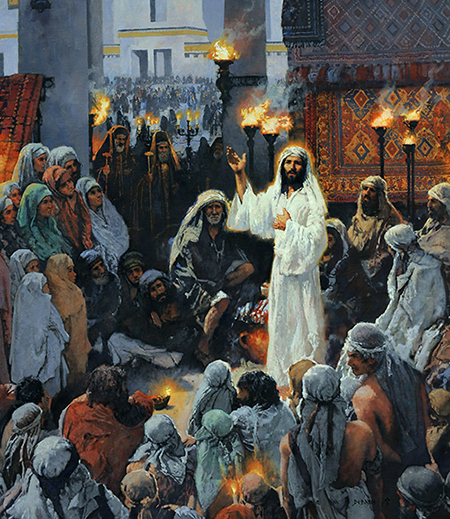
John’s teaching of the journeys Jesus makes is more complete than the other Gospels. According to the other Gospels, Jesus travels only once to Jerusalem, when he goes to be crucified. According to John, Jesus travels at least two or three times to Jerusalem for the Feast of the Passover. This gives us the approximation of the duration of Jesus’ public life as being three years [ … ]
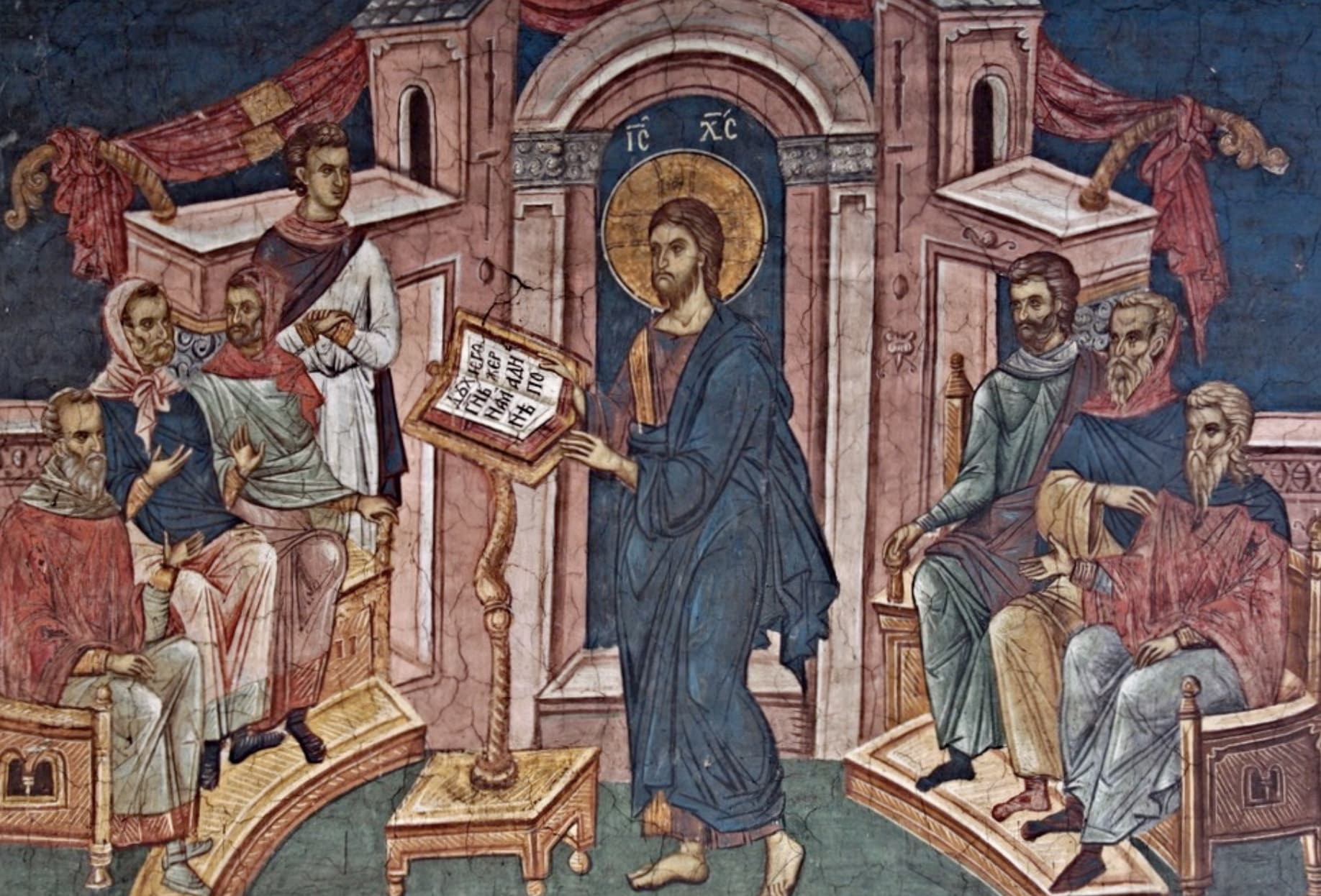
The image of children in these Bible verses is curious. We could read the lines as suggesting childishness, with one group of children expecting to amuse another and reacting peevishly when those others do not move according to the music they play. We could more broadly read these verses as suggesting a disconnect between various children, a failure of communication, recognition, response, which is emblematic of Christ and his followers and those who reject him …