
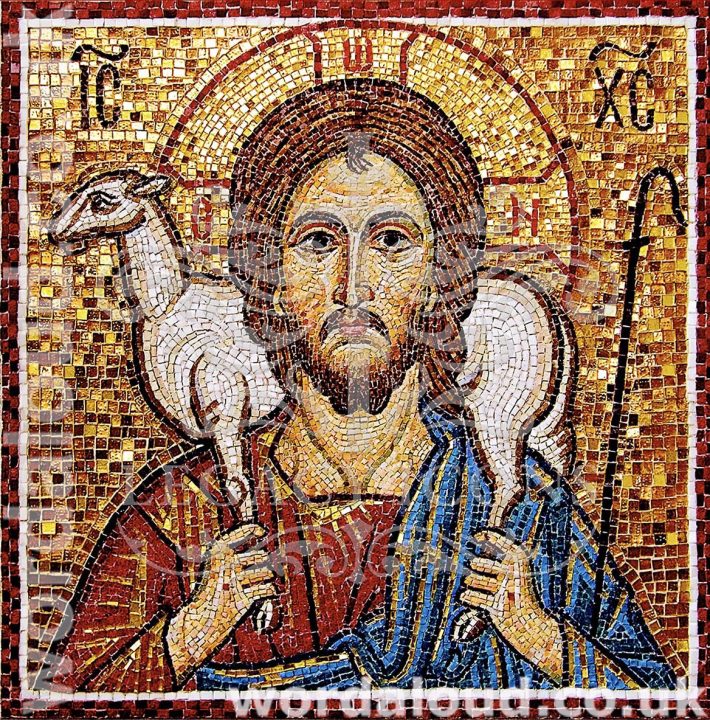
Christian Art | Jesus Christ The Good Shepherd
Office Of Readings | Week 24, Friday, Ordinary Time | From The Sermon Of Saint Augustine On The Shepherds | Prepare Your Soul For Temptation
‘Prepare your soul for temptation.’
Saint Augustine continues his critique of negligent shepherds by focusing on what they fail to provide for the flock. The concern here is not only with material exploitation, but with a more fundamental dereliction: the refusal to prepare believers for the trials that accompany the Christian life.
Augustine draws upon the imagery of Ezekiel’s prophetic indictment of false shepherds (Ezekiel 34:4) to catalogue the failures of pastoral care: the weak remain unstrengthened, the sick uncared for, the injured unbound, the straying uncalled, and the lost unsearched. To these he adds the destruction of the strong, which occurs when those with firm faith are unsettled by misleading teaching or bad example.
The central theme is the necessity of preparing believers for temptation. The negligent pastor fails to instruct the weak with the exhortation: ‘My son, come to the service of God … prepare your soul for temptation’ (a reference to Sirach 2:1). Without this preparation, Christians risk being corrupted by prosperity or crushed by adversity. Augustine here contrasts two foundations for faith, following Matthew 7:24–27: the sand of worldly security, and the rock which is Christ. Only those built upon Christ’s example of suffering and endurance will stand firm.
The reference to Christ’s passion highlights the formative role of his suffering: he endured humiliation, accusation and crucifixion not for his own sake, but for humanity’s strengthening. By meditating upon his endurance, the believer finds a pattern for perseverance. The shepherd’s responsibility is therefore to direct attention away from promises of worldly ease and toward the reality of discipleship marked by suffering.
Augustine warns against those who, fearing to offend, promise the faithful a life of worldly happiness. Such teaching, he argues, not only departs from Scripture but contradicts the apostolic witness: ‘All who desire to live a holy life in Christ will suffer persecution.’ (2 Timothy 3:12) To teach otherwise is to construct faith on fragile ground, leaving it exposed to collapse when difficulties arise.
For Augustine, hardship and discipline are not signs of abandonment but of divine recognition, echoing Hebrews 12:6: ‘He chastises every son whom he acknowledges.’ The Christian must therefore interpret trials not as punishment but as confirmation of sonship. The pastor’s task is to ensure the flock understands this, so that when adversity comes they are neither scandalised nor shaken but confirmed in their union with Christ.

From The Sermon Of Saint Augustine On The Shepherds | Prepare Your Soul For Temptation
You have already been told about the wicked things shepherds desire. Let us now consider what they neglect. You have failed to strengthen what was weak, to heal what was sick and to bind up what was injured, that is, what was broken. You did not call back the straying sheep, nor seek out the lost. What was strong you have destroyed. Yes, you have cut it down and killed it. The sheep is weak, and so, incautious and unprepared, it may give in to temptations.
The negligent shepherd fails to say to the believer: My son, come to the service of God, stand fast in fear and in righteousness, and prepare your soul for temptation. A shepherd who does say this strengthens the one who is weak and makes him strong. Such a believer will then not hope for the prosperity of this world. For if he has been taught to hope for worldly gain, he will be corrupted by prosperity. When adversity comes, he will be wounded or perhaps destroyed.
The builder who builds in such manner is not building the believer on a rock but upon sand. But the rock was Christ. Christians must imitate Christ’s sufferings, not set their hearts on pleasures. He who is weak will be strengthened when told: ‘Yes, expect the temptations of this world, but the Lord will deliver you from them all if your heart has not abandoned him. For it was to strengthen your heart that he came to suffer and die, came to be spit upon and crowned with thorns, came to be accused of shameful things, yes, came to be fastened to the wood of the cross. All these things he did for you, and you did nothing. He did them not for himself, but for you.’
But what sort of shepherds are they who for rear of giving offense not only fait to prepare the sheep for the temptations that threaten, but even promise them worldly happiness? God himself made no such promise to this world. On the contrary, God foretold hardship upon hardship in this world until the end of time. And you want the Christian to be exempt from these troubles? Precisely because he is a Christian, he is destined to suffer more in this world.
For the Apostle says: All who desire to live a holy life in Christ will suffer persecution. But you, shepherd, seek what is yours and not what is Christ’s, you disregard what the Apostle says: All who want to live a holy life in Christ will suffer persecution. You say instead: ‘If you live a holy life in Christ, all good things will be yours in abundance. If you do not have children, you will embrace and nourish all men, and none of them shall die.’ Is this the way you build up the believer? Take note of what you are doing and where you are placing him. you have built him on sand. The rains will come, the river will overflow and rush in, the winds will blow, and the elements will dash against that house of yours. It will fall, and its ruin will be great.
Lift him up from the sand and put him on the rock. Let him be in Christ, if you wish him to be a Christian. Let him turn his thoughts to sufferings, however unworthy they may be in comparison to Christ’s. Let him center his attention on Christ, who was without sin, and yet made restitution for what he had not done. Let him consider Scripture, which says to him: He chastises every son whom he acknowledges. Let him prepare to be chastised, or else not seek to be acknowledged as a son.
Christian Prayer With Jesus Christ
Lord Jesus,
you endured suffering and shame for the sake of your people.
Strengthen us in weakness,
heal us in our wounds,
and prepare us for the trials of this life.
Keep our feet firm upon your rock,
that in adversity we may not fall,
and in prosperity we may not be corrupted.
Teach your Church to speak truth with courage,
that your people may be built up in faith,
and share in the hope of your kingdom,
where you live and reign with the Father and the Holy Spirit,
one God, now and for ever.
Amen.
Glossary Of Christian Terms
Ezekiel 34:4 – A prophetic denunciation of Israel’s false shepherds who neglected and exploited the flock. Augustine repeatedly draws on this chapter in On Pastors.
Sirach 2:1 – ‘My child, if you come to serve the Lord, prepare yourself for testing.’ A key text for Augustine’s argument about preparing Christians for temptation.
Rock / Sand (Matthew 7:24–27) – The parable of the wise and foolish builders, contrasting faith founded on Christ with that based on worldly securities.
2 Timothy 3:12 – Paul’s warning that all who desire to live a godly life in Christ will suffer persecution.
Hebrews 12:6 – ‘The Lord disciplines those whom he loves, and chastises every son whom he acknowledges.’ Used to frame adversity as divine discipline.
Pastoral negligence – For Augustine, the failure not only to feed or protect the flock materially, but also to teach and prepare them spiritually for the trials of faith.




The reading from Gaudium et Spes, meaning ‘love and hope’, a key document of the Second Vatican Council, examines contradictions within modern society and the human condition. The world is marked by both power and fragility, progress and conflict, unity and division. Humanity has awakened forces that can serve or dominate, and the responsibility for their direction falls on human choice. Beneath these external tensions lies a deeper struggle within the human person, who experiences both limitation and an unlimited desire for something greater [ … ]

Saint Catherine of Siena was born in 1347 in the Italian city of Siena. She was the twenty-third child of Jacopo and Lapa Benincasa, a family of tradespeople. From her earliest years she showed a deep love for God. At the age of six she said she saw Christ in vision, clothed in papal robes and blessing her. This sense of the nearness of God shaped her whole life [ … ]

Saint Clement’s reflection on divine fidelity presents an early instance of Christian reasoning that links observation of the natural order with trust in the promise of resurrection. The structure of the argument proceeds by analogy: the visible alternation of night and day, the decay and renewal of seed, the continuous pattern of the seasons, all provide evidence that death does not end a process but belongs within it. The ordered rhythm of nature is treated not as mere metaphor but as a form of testimony, available to perception and open to interpretation by faith [ … ]