
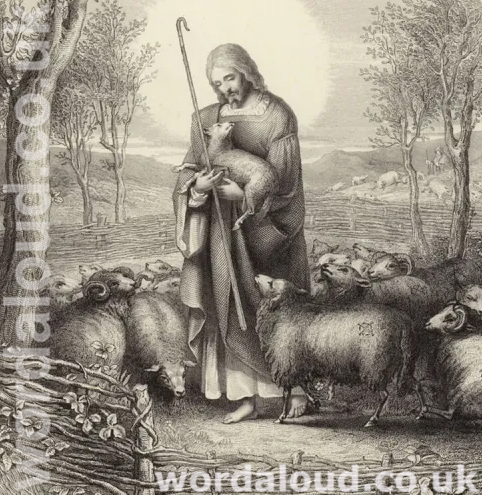
Christian Art | Jesus Christ Is The True Shepherd
Office Of Readings | Week 25, Friday, Ordinary Time | From The Sermon Of Saint Augustine On The Shepherds | All Good Shepherds Are One In The One True Shepherd
‘All good shepherds are one in the one shepherd.’
Saint Augustine reflects on Christ’s words: ‘My sheep hear my voice and follow me.’ From this, he draws the principle that all true shepherds are united in Christ, the one true shepherd. Individual pastors do not act independently, for their voice is authentic only when it is the voice of Christ speaking through them. Unity is therefore essential: the many who share in Christ’s ministry form one in him, since division would contradict the reality of the one flock.
Augustine points to the commissioning of Peter in John’s Gospel, where Christ asks three times: ‘Do you love me?’ and then entrusts him with the command: ‘Feed my sheep.’ This repetition underlines that shepherding is inseparable from love of Christ. The act of entrusting the flock to Peter demonstrates both personal responsibility and the unity of the Church. Christ remains the head and bridegroom, while Peter represents the body and bride; they are two in one, inseparably joined. Thus, when Peter feeds Christ’s sheep, it is Christ himself who is feeding them.
This principle extends to all pastors. Good shepherds are not shepherds for themselves, but shepherds in Christ. They serve Christ’s flock on his behalf, speaking with his voice rather than their own. In this sense, all true shepherds are one with the one shepherd. Their authority is real, yet it is wholly dependent on Christ’s love and voice working through them.
Augustine also insists that unity of voice is a safeguard for the flock. Divisions, schisms and heresies introduce multiple and conflicting voices, which confuse the sheep. The call is for the Church to speak with a single voice in Christ, so that the flock may recognise and follow the one shepherd who leads them to life.

From The Sermon Of Saint Augustine On The Shepherds | All Good Shepherds Are One In The One Shepherd
Christ is your shepherd and judge; he judges between his own sheep and other sheep. My sheep, he says, hear my voice and follow me.
In this statement I find that all good shepherds are one in the one shepherd. It is not that good shepherds are lacking; they are there in the one shepherd. When we speak of ‘many’ we refer to those who are divided from each other. Here only one is spoken of, because in this passage unity is commended. The reason why shepherds are not mentioned here, but only one shepherd, is not because the Lord has failed to find anyone to whom to entrust his sheep; he entrusted the sheep to Peter because he had found Peter. Indeed, in the case of Peter he also commended the unity of the flock. there were many apostles, and yet to one only did he say: Feed my sheep. Do not imagine that there will be no more good shepherds, or that we shall find them lacking, or that the Lord’s mercy will not produce and establish them.
Certainly, if there are good sheep there are also good shepherds; good sheep give rise to good shepherds. But all good shepherds are one in the one good shepherd; they form a unity. If only they feed the sheep, Christ is feeding the sheep. The friends of the bridegroom do not speak with their own voice, but they take great joy in listening to the bridegroom’s voice. Christ himself is the shepherd when they act as shepherds. ‘I feed them,’ he says, because his voice is in their voice, his love in their love.
When he entrusted his sheep to Peter as one person to another, Christ chose to make Peter one with himself. He wanted to entrust him with the sheep in such a way that he himself might be the head and Peter might represent the body, that is, the Church. As bridegroom and bride, Christ and the Church were to be two in one flesh.
Accordingly, what does he say before he entrusts the sheep to Peter as to someone who is not separate from himself? Peter, do you love me? He answered: I love you. And again: Do you love me? He answered: I love you. And a third time: Do you love me? He answered: I love you. He receives an assurance of love in order to establish unity. Christ is the one shepherd who is one with the other shepherds, and in whom they themselves are one.
Shepherds are not mentioned, but they are not passed over. Shepherds have cause for pride, but if anyone boasts it should be in the Lord. This means that Christ should be the shepherd, that they should be shepherds for Christ, shepherds in Christ, not shepherds for themselves, apart from Christ. When the prophet said: I will feed my sheep, it was not because of a lack of shepherds, as though he were foretelling those evil times to come and saying: ‘I have no one to whom I can entrust my sheep.’ At a time when Peter himself, and the apostles too, were alive in the body, Christ, the one in whom alone all are one, said this: I have other sheep that are not of this sheepfold; I must bring them in as well, so that there may be one flock and one shepherd.
All shepherds should therefore be one in the one good shepherd. All should speak with the one voice of the one shepherd, so that the sheep may hear and follow their shepherd; not this or that shepherd, but the one shepherd. All should speak with on e voice in Christ, not with different voices. Brethren, I beg all of you to say the same thing, and to have no dissensions among you. the sheep should hear this voice, a voice purified from all schism, freed from all heresy, and so follow their shepherd, who says: My sheep hear my voice and follow me.
Christian Prayer With Jesus Christ
Lord Jesus Christ,
you are the one shepherd who calls your sheep by name.
You entrusted Peter with your flock,
and through him you made known the unity of your Church.
Strengthen all pastors to speak with your voice,
to love you above all, and to serve your people faithfully.
Keep your flock from the voices of division,
and gather us into one fold,
that we may follow you in love and truth,
for you live and reign forever and ever. Amen.
Glossary Of Christian Terms
One shepherd – Christ himself, in whom all good pastors are united and through whom they exercise their ministry.
Feed my sheep – Christ’s command to Peter, showing that pastoral care is entrusted personally, yet rooted in love for Christ.
Bridegroom and bride – A biblical image for Christ and the Church, united as head and body, or as husband and wife in one flesh.
Shepherds in Christ – Pastors who act not for their own sake but as instruments of Christ’s care for the flock.
Unity of voice – The call for the Church to speak with one voice in Christ, avoiding schism or heresy that would divide the flock.



Today’s Bible verses flow from John the Baptist’s beautiful words, as he explains, speaking of Jesus, that ‘he must increase, but I must decrease’. John the Baptist reminds his disciples that he has told them he is not the Christ, but rather the one who was sent before to prepare the way of Christ. John the Baptist now rejoices that Christ’s time is come, that his own purpose is complete and it is time to relinquish to Christ the ministry that brings salvation. There is no competition between John the Baptist and Jesus. Rather, through faith and love, he is overjoyed that people are flocking to Jesus to be baptized by him [ … ]

Christ’s journey from Galilee to Jerusalem is an ascent, literally, that occupies the central third of Luke’s Gospel. When the journey begins, it is made explicit that this is a journey toward the cross: ‘And it came to pass, when the time was come that he should be received up, he stedfastly set his face to go to Jerusalem…’ (Luke 9: 51) Christ’s teachings as he and his disciples travel are cued to the sense of steady, deliberate movement toward the Passion [ … ]

Saint Aelred was a 12th-century Cistercian abbot who lived within a spiritual tradition that emphasised both community life and the inner journey to God. His reflections on friendship are deeply shaped by Cistercian ideals of caritas—a love that is disinterested, holy and rooted in the life of Christ. Unlike worldly friendships based on advantage or pleasure, spiritual friendship seeks what is good for the other in God. It is a school of charity, a training ground for grace [ … ]
