
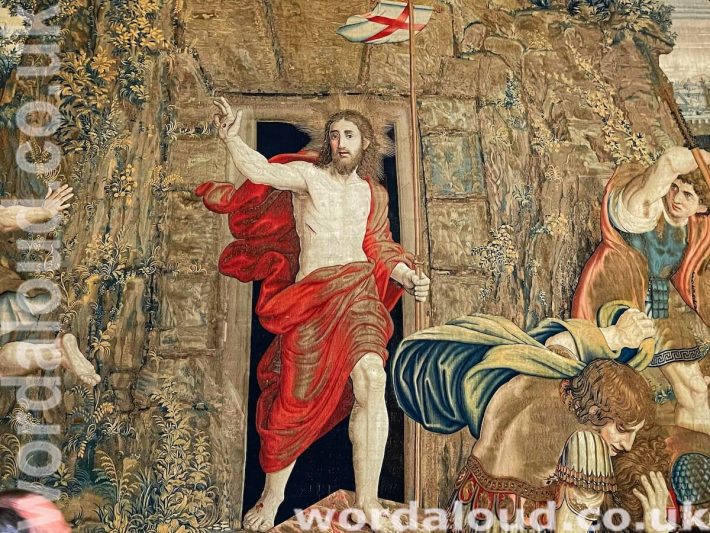
Christian Art | Jesus Christ Resurrection | Jesus Is Alive
Office Of Readings | Week 28, Saturday, Ordinary Time | A Reading From The Constitution Of The Second Vatican Council On The Church In The Modern World | City Of God | I Am Alpha And Omega
‘I am Alpha and Omega, the first and the last.’
This reading reflects the vision of the Second Vatican Council concerning the Church’s relationship with the modern world. It presents human history as the meeting place of divine purpose and human freedom. The ‘earthly’ and ‘heavenly’ cities – terms drawn from Augustine – are not separate realities but interwoven. Their relationship can only be discerned through faith, because human progress remains marked by sin and imperfection until the final revelation of God’s glory.
The Church’s mission is both spiritual and human. In communicating divine life through word and sacrament, she also radiates its light across human society. Her service includes defending the dignity of the person, promoting justice, and deepening the meaning of human work and culture. The document situates these efforts not as social activism alone, but as expressions of the Church’s sacramental nature: she is the ‘universal sacrament of salvation’, a visible sign and instrument of God’s saving love in history.
This mutual relationship between Church and world is dynamic. The Church contributes to the moral and spiritual enrichment of human life, while also receiving from the world insights, experiences, and cultural forms that aid her mission. Yet her ultimate purpose remains fixed: to serve the coming of God’s kingdom and the salvation of all humanity. Every genuine good in human progress finds its source and fulfilment in this divine plan.
The text then directs attention to Christ, the centre of all history. The eternal Word, through whom all things were made, entered creation to restore unity and reconcile all things. In his resurrection and exaltation, Christ becomes the end toward which all human striving tends – ‘the joy of all hearts and the fulfilment of their desires’. The meaning of civilisation and the destiny of the human race converge in him.
This reading concludes with the words of the risen Lord from the Book of Revelation: ‘I am Alpha and Omega, the first and the last.’ These titles express the totality of divine sovereignty: Christ is both origin and end, the one in whom time and eternity are reconciled. The Christian vision of history therefore holds together the temporal and the eternal — human progress and divine completion — within the unity of God’s purpose to make all things one in Christ.
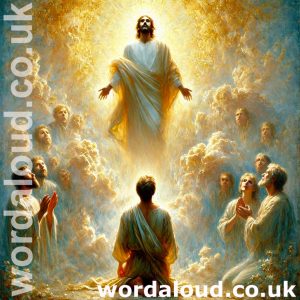
A Reading From The Constitution Of The Second Vatican Council On The Church In The Modern World | City Of God | I Am Alpha And Omega
The way in which the earthly and the heavenly city interpenetrate each other can be recognized only by faith; of a history always troubled by sin until the glory of the sons of God is fully revealed.
As she pursues her appointed goal of bringing salvation to men, the Church not only communicates the divine life to mankind but also in some measure reflects the light of that life over the whole world. She does this especially through her work of restoring and enhancing the dignity of the human person, of strengthening the fabric of human society, and of enriching the daily activity of men with a deeper meaning and importance. The Church believes that in this way she can make a great contribution, through individual members and the community as a whole, toward bringing a greater humanity to the family of man and to its history.
While the Church helps the world and herself receives much from the world, she has one object in view: the coming of God’s kingdom and the salvation of the whole human race. Every good that the people of God in the course of its earthly pilgrimage can confer on the family of men derives from the fact that the Church is the universal sacrament of salvation, revealing, and at the same time bringing into operation, the mystery of God’s love for man.
The Word of God, through whom all things were made, was himself made flesh so that as perfect man he might save all men and bring all things into unity. The Lord is the final end of human history, the point toward which the aspirations of history and civilization are moving, the focus of the human race, the joy of all hearts and the fulfilment of their desires. He it is whom the Father raised from the dead, lifted up on high and set at his right hand, appointing him judge of the living and the dead. In his Spirit we have been brought to life and gathered into unity, and so make our pilgrim way toward the goal of human history, a goal in complete harmony with the loving plan of God to make all things one in Christ, the things in heaven and the things on earth.
The Lord himself says: See, I am coming soon; I bring my recompense with me, to give to everyone what his deeds deserve. I am Alpha and Omega, the first and the last, the beginning and the end.
Christian Prayer With Jesus
Lord Jesus Christ,
Alpha and Omega,
the beginning and the end of all things,
grant that your Church may reflect your light in the world.
Strengthen her service of truth and justice,
and guide all human work towards your kingdom
city of God.
Unite all peoples in the peace of your Spirit,
that creation may be brought to its fulfilment in you,
who live and reign with the Father and the Holy Spirit,
God for ever and ever.
Amen.
Glossary Of Christian Terms
Earthly and Heavenly Cities – Terms drawn from Augustine’s City of God, describing the tension between human society and the divine community being formed in history.
Universal Sacrament of Salvation – A phrase used by Vatican II to describe the Church as both sign and means of communion between God and humanity.
Alpha and Omega – The first and last letters of the Greek alphabet, used in Revelation to symbolise Christ as the beginning and end of all things.
The Word (Logos) – The eternal Son of God, through whom all things were made and who became incarnate in Jesus Christ.
Kingdom of God – The reign of God’s justice and peace, present in Christ and moving towards completion in the renewal of all creation.
Human Dignity – The inherent worth of every person, affirmed by the Church as grounded in the image of God and redeemed in Christ.



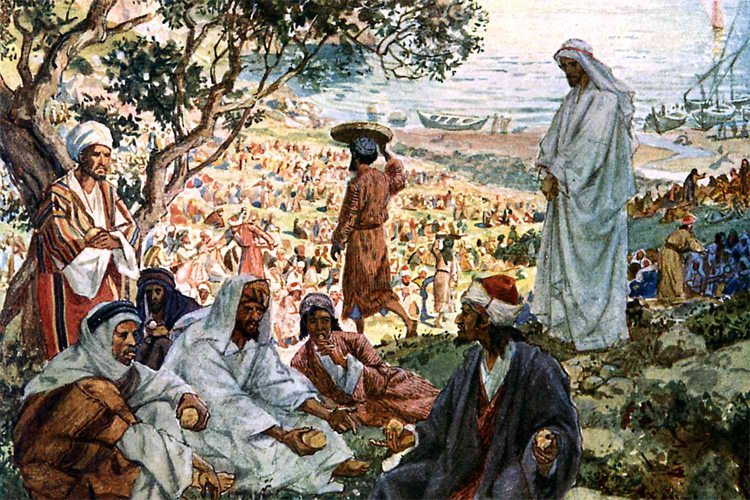
Jesus has performed the second miracle of the loaves and fishes, following which the Pharisees have come to him, demanding to see a sign from heaven to prove that he is the Messiah. Jesus rejects and departs from the Pharisees, and now warns his disciples to be wary of them [ … ]
Psalm 32 is a contemplative poem expressing themes of forgiveness, repentance and blessings that arise from acknowledging one’s sins before the Lord. The psalm reflects on the power of confession and upon the joy found in the assurance of divine pardon [ … ]
Psalm 59 is attributed to King David. The psalm resonates with themes of seeking protection from enemies, finding refuge in God, and grappling with the challenges of a troubled world. The psalm embodies a deep sense of trust and reliance on the divine, portraying God as the ultimate source of strength, defence, and justice in the face of adversity [ … ]
