
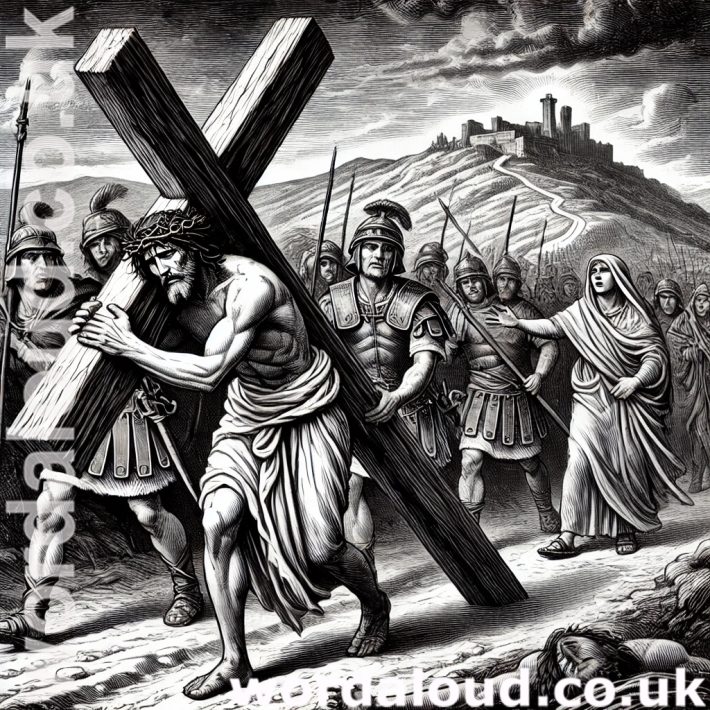
Christian Art | Our Path Through Lent Towards Easter | Jesus Carries The Cross
Office Of Readings | Week 5, Monday, Ordinary Time | A Reading From The Breviloquium Of Saint Bonaventure | He Who Knows Jesus Christ Can Understand All Sacred Scripture
‘He who knows Jesus Christ can understand all sacred Scripture.’
In this reading, Saint Bonaventure sets out a theological vision of Scripture that is centred on Christ and grounded in faith. He insists that the understanding of sacred Scripture does not begin with human study alone, but with divine revelation and the interior work of God.
Bonaventure begins by tracing the origin of Scripture to the Father of Light. Revelation flows from the Father, through the Son, and reaches human hearts through the Holy Spirit. This movement is important: Scripture is not simply information communicated from God, but part of a living relationship. Through the Spirit, faith is given, and through faith Christ comes to dwell within the believer. Knowledge of Christ, therefore, is not external but personal and interior.
This knowledge of Christ becomes the key to understanding Scripture. Bonaventure argues that without faith in Christ, Scripture cannot be fully grasped in its truth. Faith is described as the foundation and doorway of all supernatural understanding. Wisdom grows in proportion to faith, not intellectual achievement alone. For this reason, Bonaventure warns against pride in learning and urges humility in assessing one’s own understanding.
Bonaventure then turns to the purpose of Scripture. Its goal is not merely belief, but eternal life. Scripture points beyond itself to a future fulfilment in which understanding will be complete, love will be perfect, and desire fully satisfied. The present reading and study of Scripture are therefore preparatory, guiding the believer towards a final state of communion with God.
Yet this future fulfilment does not remove the need for careful study in the present. Bonaventure emphasises the importance of reading, teaching, and listening to Scripture attentively. Scripture provides the path of virtue that leads to eternal happiness, but to follow this path one must begin rightly, with pure faith and prayer.
The reading concludes by returning to its starting point. True understanding requires asking God for knowledge and love of Christ through the Holy Spirit. When faith and love are firmly rooted, Scripture opens itself in its full depth and coherence. Ultimately, this knowledge leads not to Scripture itself, but to the Trinity, in whom all truth and goodness find their completion.
A Reading From The Breviloquium Of Saint Bonaventure | He Who Knows Jesus Christ Can Understand All Sacred Scripture
The source of sacred Scripture was not human research but divine revelation. This revelation comes from the Father of Light from whom the whole concept of fatherhood in heaven and on earth derives. From him, through Jesus Christ his Son, the Holy Spirit enters into us. Then, through the Holy Spirit who allots and apportions his gifts to each person as he wishes, we receive the gift of faith, and through faith Christ lives in our hearts. So we come to know Christ and this knowledge becomes the main source of a firm understanding of the truth of all sacred Scripture. It is impossible, therefore, for anyone to achieve this understanding unless he first received the gift of faith in Christ. This faith is the firm basis of all supernatural enlightenment, the light guiding us to it, and the doorway through which we enter upon it. What is more, the extent of our faith is the measure of the wisdom which God has given us. Thus, no one should overestimate his wisdom; instead, he should soberly make his assessment according to the extent of the faith which God has given him.
The outcome or the fruit of reading holy Scripture is by no means negligible: it is the fullness of eternal happiness. For these are the books which tell us of eternal life, which were written not only that we might believe but also that we might have everlasting life. When we do live that life we shall understand fully, we shall love completely, and our desires will be totally satisfied. Then, with all our needs fulfilled, we shall truly know the love that surpasses understanding and so be filled with the fullness of God. The purpose of the Scriptures, which come to us from God, is to lead us to this fullness according to the truths contained in those sayings of the Apostles to which I have referred. In order to achieve this, we must study holy Scripture carefully, and teach it and listen to it in the same way.
If we are to attain the ultimate goal of eternal happiness by the path of virtue described in the Scriptures, we have to begin at the very beginning. We must come with a pure faith to the Father of Light and acknowledge him in our hearts. We must ask him to give us, through his Son and in the Holy Spirit, a true knowledge of Jesus Christ, and along with that knowledge a love of him. Knowing and loving him in this way, confirmed in our faith and grounded in our love, we can know the length and breadth and height and depth of his sacred Scripture. Through that knowledge we can come at last to know perfectly and love completely the most blessed Trinity, whom the saints desire to know and love and in whom all that is good and true finds its meaning and fulfilment.
Christian Prayer With Jesus Christ
Father of Light,
from you comes every good gift
and all true understanding.
Grant us the gift of faith,
that your Son may dwell in our hearts.
Through the Holy Spirit,
teach us to know and love Jesus Christ
more deeply each day.
Open our minds as we read the Scriptures,
that we may seek not knowledge alone
but the life to which they lead us.
Keep us humble in our learning
and faithful in our desire for truth.
Lead us through your word
towards the fullness of life with you,
where we may know and love you completely.
Through Jesus Christ our Lord.
Amen.
Glossary Of Christian Terms
Divine revelation | God’s self-disclosure, given freely rather than discovered by human effort
Father of Light | A title for God as the source of truth and wisdom
Holy Spirit | God’s Spirit, who gives faith and understanding
Faith | Trust in God that opens the mind and heart to divine truth
Christ dwelling in our hearts | The presence of Christ within believers through faith
Supernatural enlightenment | Understanding given by God beyond natural reasoning
Wisdom | Insight into divine truth shaped by faith
Sacred Scripture | The books of the Bible inspired by God
Eternal life | Full communion with God beyond this life
Virtue | A pattern of life shaped by goodness and faithfulness
Trinity | The one God as Father, Son, and Holy Spirit
Fulness of God | Complete participation in God’s life and love



Saint Teresa wrote during a period of profound spiritual and political upheaval in 16th-century Spain, amidst the Counter-Reformation and a Church in crisis. Her audience included not only cloistered nuns but a wider ecclesial community in need of reform and renewal. Her insight into prayer as intimate conversation with God stemmed from her personal experience of spiritual desolation, ecstatic union, and eventual peace in God. The call for the Kingdom to come ‘in us’ is not abstract: it is grounded in Teresa’s urgent desire that each soul be transformed into a sanctuary where God may reign [ … ]
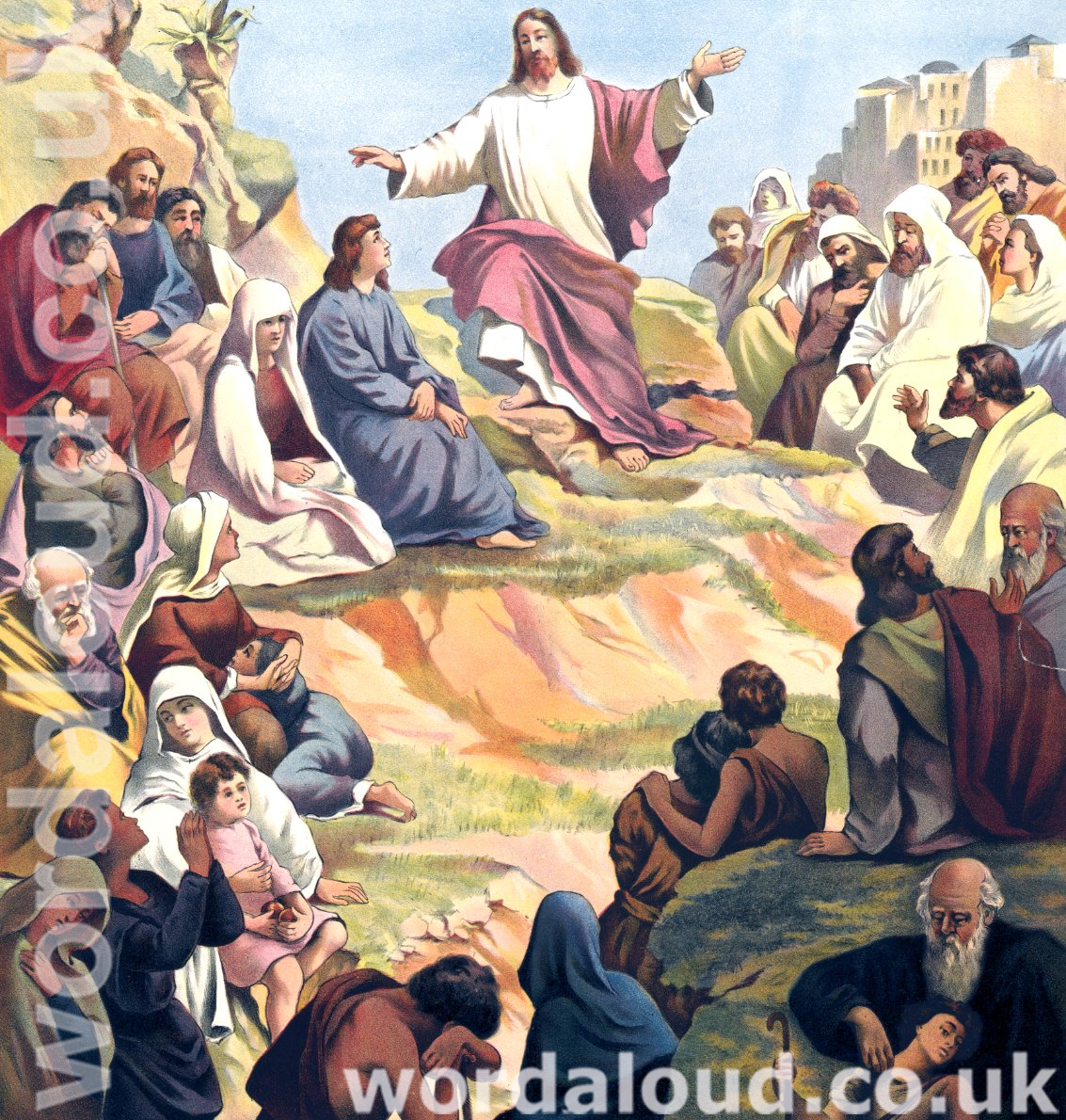
Pope Saint Leo the Great’s exposition of the first Beatitude, ‘Blessed are the poor in spirit, for theirs is the kingdom of heaven,’ (Matthew 5:3) sets poverty of spirit in relation to both material poverty and spiritual detachment. His reflection is situated within the wider Christian tradition that viewed the Beatitudes as the programme of the Christian life, and particularly as an introduction to the Sermon on the Mount [ … ]
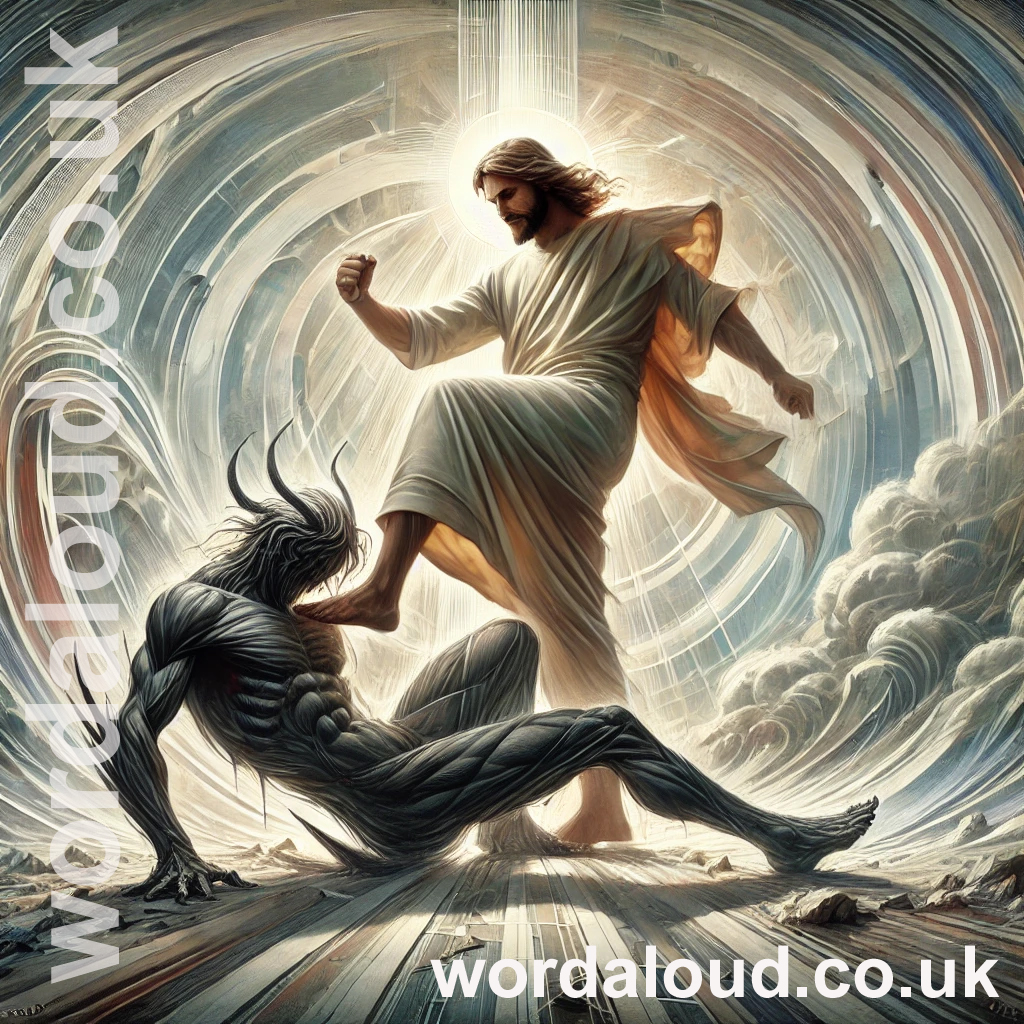
The Bible offers us different accounts of Christ’s first miracle, each suited to the particular needs of the audiences to whom the Gospel evangelists are speaking. In John’s Gospel, the first miracle is that of the wedding feast at Cana. For Luke, it is Jesus freeing himself when those around him, of Nazareth, seek to kill him. Matthew speaks of the healing of a large number of the sick and possessed, most particularly a leper. Here, Mark tells us of the casting out of a devil. In highly compressed form, we are told of how Christ frees us from the fear of evil. He has power over devils. To a people living in fear, this is a most remarkable and wonderful message [ … ]
