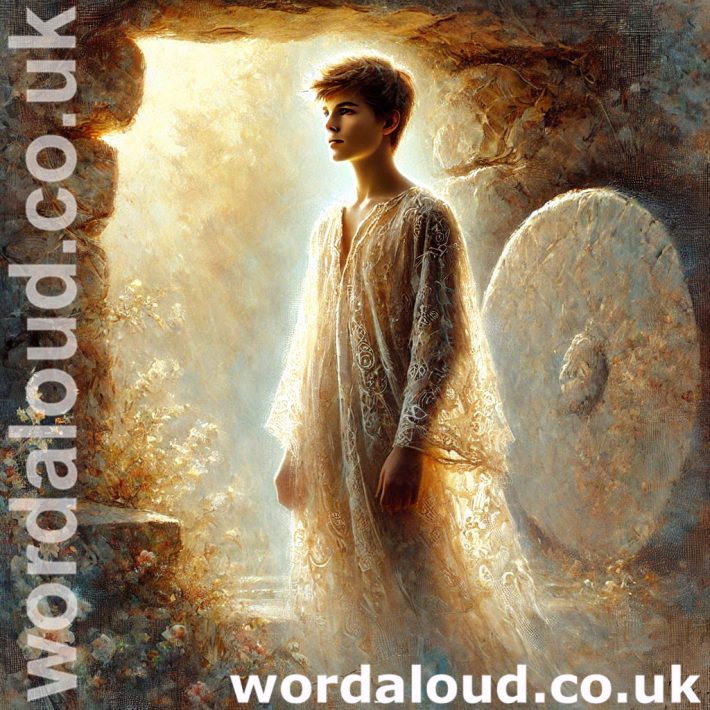
Christian Art | Resurrection | A New Baptism In Faith Of Jesus Christ
Office Of Readings | Easter Monday | A Reading From The Homily Of Melito Of Sardis On The Pasch | Praise Of Jesus Christ
‘The Easter praise of Jesus Christ.’
Easter Praise Of Christ
Melito of Sardis, writing in the second century, gives us one of the earliest and most powerful reflections on the mystery of Easter. His homily, poetic and theological, offers not just a celebration of the resurrection but a sweeping vision of salvation history fulfilled in Jesus Christ. The tone is triumphant and exultant—fitting for the season of Easter—but the substance is rich with meaning. At its heart, the homily proclaims a profound truth: that in Christ, death is not the end, but the beginning of new and eternal life.
A Mystery That Is Both Old And New
Melito opens with a striking paradox: the paschal mystery is ‘old and new, transitory and eternal, corruptible and incorruptible, mortal and immortal’. This rhythmic list is not simply rhetorical flourish; it captures a central theme in early Christian theology. The story of Easter didn’t appear out of nowhere. It is deeply rooted in the history of God’s people—in the Passover of the Jews, in the Law of Moses, and in the rituals of the old covenant.
But now, in the death and resurrection of Christ, all those earlier symbols have found their fulfilment. The lamb of the old Passover, slain to spare the Israelites, prefigures Christ, the Lamb of God, who dies to save all humanity. The ‘old’ was a shadow; the ‘new’ is reality. Melito’s early Christian audience would have heard these words as both a declaration of faith and a dramatic unveiling of divine mystery. Christ is not just part of the story; he is the center and climax of it.
Christ As Fulfilment Of The Law And The Word
A key line in the homily reads: ‘The sacrifice of the lamb, the celebration of the Passover, and the prescriptions of the Law have been fulfilled in Jesus Christ.’ This reveals Melito’s understanding of continuity between Judaism and Christianity—not one replacing the other, but one leading to fulfillment in the person of Jesus. The lamb, the Law, and the feast were signposts, and now the destination has been reached.
This approach is known as typology, where figures from the Old Testament are understood as foreshadowing Christ. It was a common and powerful way for early Christians to interpret Scripture, and Melito uses it masterfully. The old covenant, in all its beauty and limitation, was pointing toward something greater—the living reality of Christ.
Christ The Lamb And The God Who Rises
One of the most profound tensions in this homily is found in how Melito describes Christ: ‘He was slain as a lamb; he rose again as God.’ This statement captures the scandal and the glory of the cross. Jesus suffers as a lamb—silent, meek, obedient—but his resurrection reveals his divinity. He is not merely a tragic figure; he is the victorious Lord.
This paradox—that the one who suffers is also the one who saves—lies at the heart of Christian faith. Melito emphasizes that Jesus is more than symbol; he is substance. The lamb gives way to the Son, the sacrifice gives way to the Saviour. It’s not just a lamb we’re dealing with anymore. It is God himself, entering into human suffering, embracing death, and then breaking its power from the inside out.
‘I Am The Christ’ | A Victory Proclaimed
The homily crescendos into a triumphant declaration spoken in the voice of Christ himself: ‘I have destroyed death, triumphed over the enemy, trampled hell underfoot, bound the strong one, and taken men up to the heights of heaven.’ This is Christ as victor, the one who has descended into the depths and risen in glory. It echoes the ‘Christus Victor’ image found in early Christian writings, where Jesus is portrayed not only as the suffering servant but as the conquering King.
The phrase ‘I am the Christ’ becomes a rallying cry. It is not only a personal claim—it’s a cosmic one. In Jesus, death no longer holds dominion. In Jesus, sin is defeated. And in Jesus, we are raised—not only morally, but physically and eternally.
A Call To The Nations | Universal Scope Of Easter
Finally, Melito opens the gates wide with the invitation: ‘Come, then, all you nations of men, receive forgiveness for the sins that defile you.’ The resurrection is not a private event. It is not for a select few. It is for all people, for all time. Easter is the moment when the doors of heaven are thrown open, and the invitation is extended to the entire world.
This echoes the words of the risen Jesus in the Gospels—’Go and make disciples of all nations’ (Matthew 28:19)—and it reminds us that the resurrection is not just a historical moment, but a living and ongoing reality. Christ is alive, and he offers new life to everyone.
Voice Of The Risen One
What Melito offers is not merely theology—it is liturgy, poetry, and proclamation. His homily is a window into how the early Church understood Easter: not just as a celebration of an empty tomb, but as the dawn of a new creation. Every contrast he draws—old and new, mortal and immortal, lamb and God—is meant to deepen our understanding of the mystery we celebrate.
In Melito’s voice, we hear the echo of the risen Christ: ‘I am your forgiveness… your life… your resurrection… your king.’ These words are as true now as they were then. In Christ, we are raised. In Christ, death is defeated. And in Christ, we are called into the fullness of life.
A Reading From The Homily Of Melito Of Sardis On The Pasch
We should understand, beloved, that the paschal mystery is at once old and new, transitory and eternal, corruptible and incorruptible, mortal and immortal. In terms of the Law it is old, in terms of the Word it is new. In its figure it is passing, in its grace it is eternal. It is corruptible in the sacrifice of the lamb, incorruptible in the eternal life of the Lord. It is mortal in his burial in the earth, immortal in his resurrection from the dead.
The Law indeed is old, but the Word is new. The type is transitory, but grace is eternal. The lamb was corruptible, but the Lord is incorruptible. He was slain as a lamb; he rose again as God. He was led like a sheep to the slaughter, yet he was not a sheep. He was silent as a lamb, yet he was not a lamb. The type has passed away; the reality has come. The lamb gives place to God, the sheep gives place to a man, and the man is Christ, who fills the whole of creation. The sacrifice of the lamb, the celebration of the Passover, and the prescriptions of the Law have been fulfilled in Jesus Christ. Under the old Law, and still more under the new dispensation, everything pointed towards him.
Both the Law and the Word came forth from Zion and Jerusalem, but now the Law has given place to the Word, the old to the new. The commandment has become grace, the type a reality. The lamb has become a Son, the sheep a man, and man, God.
The Lord, though he was God, became man. He suffered for the sake of those who suffer, he was bound for those in bonds, condemned for the guilty, buried for those who lie in the grave; but he rose from the dead, and cried aloud: Who will contend with me? Let him confront me. I have freed the condemned, brought the dead back to life, raised men from their graves. Who has anything to say against me? I, he said, am the Christ; I have destroyed death, triumphed over the enemy, trampled hell underfoot, bound the strong one, and taken men up to the heights of heaven: I am the Christ.
Come, then, all you nations of men, receive forgiveness for the sins that defile you. I am your forgiveness. I am the Passover that brings salvation. I am the lamb who was immolated for you. I am your ransom, your life, your resurrection, your light, I am your salvation and your king. I will bring you to the heights of heaven. With my own right hand I will raise you up, and I will show you the eternal Father.


Psalm 50 is a profound exploration of God’s authority, the meaning of true worship, and the imperative of righteous living. The psalm condemns empty rituals and hypocrisy while calling for genuine, heart-centred relationship with God. The psalm balances warnings of judgment with the promise of deliverance and salvation for those who seek God with sincerity and integrity [ … ]

The text from Saint Irenaeus, read on Thursday of the third week of Eastertide in the Office of Readings, is a profound theological meditation on the relationship between the Eucharist and the resurrection of the body. It stands not merely as an apologetic against heresy, but as a luminous witness to the Church’s sacramental and eschatological faith—rooted in the Incarnation, expressed through liturgy, and fulfilled in the resurrection [ … ]
YouTube: Ash Wednesday | T.S. Eliot | Audio Christian Poetry | Word Aloud Ash Wednesday, one of T.S. Eliot’s most profound and enigmatic poems, marks a significant transition in his life and work. Written in 1930, it is the first long poem Eliot composed after his conversion to Anglicanism in 1927. The poem, often considered one of Eliot’s masterpieces, delves into themes of faith, redemption, and spiritual struggle. It reflects the poet’s personal journey towards spiritual enlightenment and serves as a testament to his newfound religious beliefs. A reading of Ash Wednesday is an exploration of the poem’s religious, literary, and personal contexts, as of the poem’s complex structure and themes. Religious Context And Symbolism Ash Wednesday is deeply embedded in Christian symbolism and tradition. The title refers to the first day of Lent in the Christian liturgical calendar, a day marked by penance, fasting, and prayer. Ash Wednesday is a time for reflection on mortality and repentance, themes that are intricately woven throughout the poem. Eliot’s conversion to Anglicanism profoundly influenced his writing; ‘Ash Wednesday’ is an expression of spiritual awakening and quest for redemption. The poem is replete with religious imagery and references, drawing on Christian doctrine and scripture. The use of liturgical language, biblical allusions, and references to saints and spiritual figures creates a tapestry of faith that invites readers to contemplate deep spiritual truths with which Eliot is grappling. The repetitive and prayer-like quality of the verses echoes meditative practices of the faithful, in part enabling the contemplative nature of the poem. Literary Influences And Techniques T.S. Eliot was a master of literary allusion and technique, and Ash Wednesday expresses Eliot’s ability to blend various influences into a cohesive whole. The poem reflects the influence of Dante, particularly The Divine Comedy, which Eliot admired for its exploration of spiritual ascent and redemption. Dante’s journey through Hell, Purgatory and Heaven parallels Eliot’s own spiritual journey, and the structure of Ash Wednesday can be seen as a reflection of this pilgrimage. Eliot’s use of fragmented narrative, a hallmark of his earlier work such as The Waste Land, is also present in Ash Wednesday. However, in this poem, the fragmentation serves a different purpose. Instead of depicting the disintegration of modern society, it mirrors the fragmented and often painful process of spiritual rebirth. The disjointed structure reflects the internal struggle of the speaker, who is torn between the pull of worldly desires and the aspiration for divine grace. The poem’s language is rich and varied, combining the lyrical and the obscure, the personal and the universal. Eliot employs a range of poetic forms and devices, including free verse, rhyme and meter, to convey the tumultuous journey of faith. The shifting tone and style reflect the complexities and contradictions inherent in the spiritual quest, capturing moments of doubt, despair, hope, and transcendence. Personal Significance Ash Wednesday is a deeply personal work. Eliot’s conversion to Anglicanism marked a profound shift in his life, providing a sense of purpose and direction that had been missing. The poem can be read as a reflection of Eliot’s own struggles with faith and his efforts to reconcile his intellectual skepticism with his desire for spiritual certainty. Eliot’s personal experiences, including his troubled marriage and professional pressures, also inform the poem. Themes of renunciation and acceptance, sin and redemption, are not merely abstract concepts but lived realities for the poet. This personal dimension adds a layer of intimacy and urgency to the poem, which thereby resonates with readers who have faced their own spiritual crises. Thematic Exploration At its core, Ash Wednesday is a meditation on the possibility of spiritual renewal in a world that often seems devoid of meaning. The poem grapples with the tension between faith and doubt, reflecting the existential struggles of modernity. The poem acknowledges the difficulties of maintaining belief in an age of skepticism but ultimately affirms the possibility of redemption and grace. The central theme of renunciation is explored through imagery of ascension and purification. The speaker’s journey is marked by a series of renunciations, symbolizing the shedding of earthly attachments in pursuit of spiritual truth. This process is neither straightforward nor easy; it involves moments of intense struggle and introspection. Yet, through this arduous journey, the speaker moves closer to a state of spiritual clarity and acceptance. Ash Wednesday | T. S. Eliot Because I do not hope to turn again Because I do not hope Because I do not hope to turn Desiring this man’s gift and that man’s scope I no longer strive to strive towards such things (Why should the agèd eagle stretch its wings?) Why should I mourn The vanished power of the usual reign? Because I do not hope to know The infirm glory of the positive hour Because I do not think Because I know I shall not know The one veritable transitory power Because I cannot drink There, where trees flower, and springs flow, for there is nothing again Because I know that time is always time And place is always and only place And what is actual is actual only for one time And only for one place I rejoice that things are as they are and I renounce the blessèd face And renounce the voice Because I cannot hope to turn again Consequently I rejoice, having to construct something Upon which to rejoice And pray to God to have mercy upon us And pray that I may forget These matters that with myself I too much discuss Too much explain Because I do not hope to turn again Let these words answer For what is done, not to be done again May the judgement not be too heavy upon us Because these wings are no longer wings to fly But merely vans to beat the air The air which is now thoroughly small and dry Smaller and dryer than the will Teach us to care and not to care Teach us to sit still. Pray for us sinners now […]