
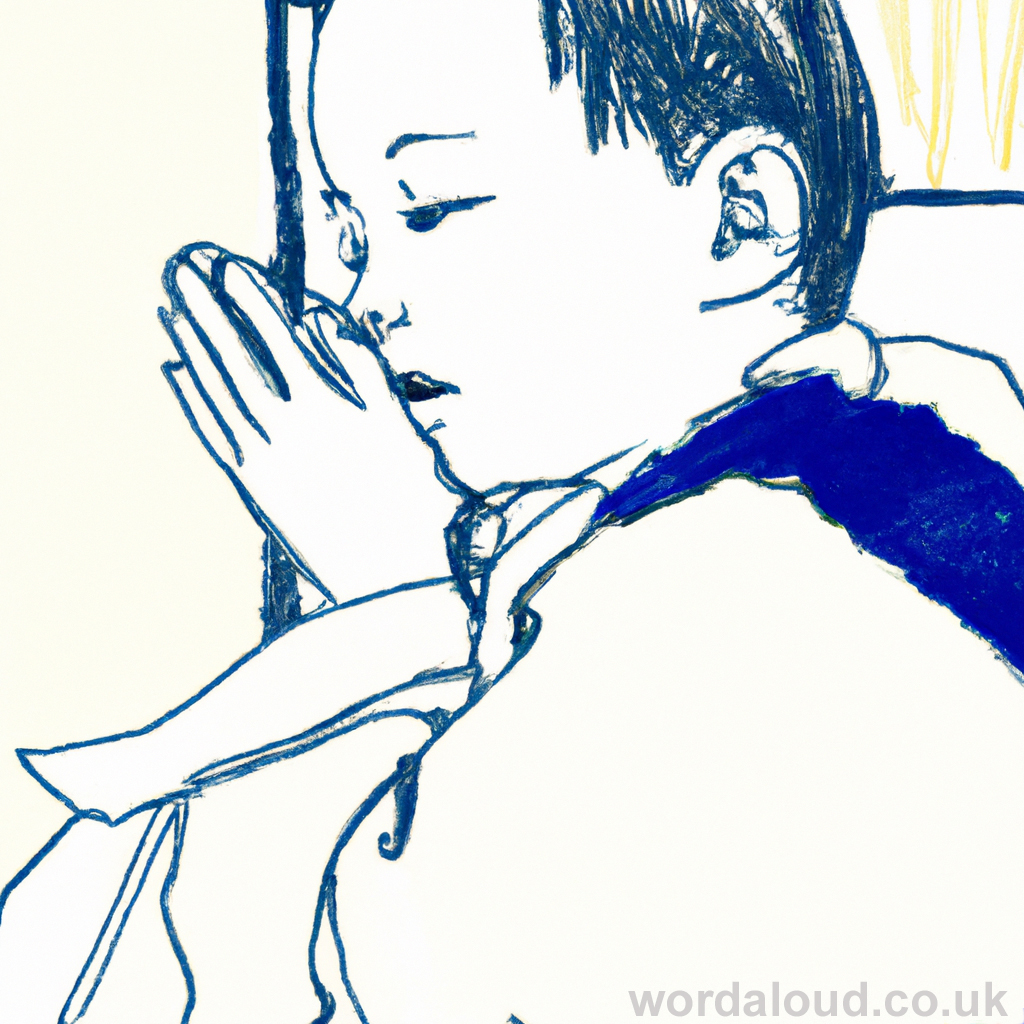
Christian Art | A Boy At Prayer With Jesus And The Trinity In The Eucharist
Office Of Readings | Eastertide Week 4, Wednesday | A Reading From The Treatise Of Saint Hilary Of Poitiers On The Trinity | Jesus And The Trinity In The Eucharist
‘The natural unity of the faithful in God through the incarnation of the Word and the sacrament of the eucharist.’
Historical Context | Saint Hilary And The Arian Controversy
Saint Hilary of Poitiers (c. 310–367) was a bishop and doctor of the Church known primarily for his role in defending the Nicene faith against Arianism. This heresy denied the full divinity of Christ and therefore threatened the entire theological foundation of the Incarnation, Trinity, and Eucharist. In his principal theological work, De Trinitate (‘On the Trinity’), Hilary argues forcefully for the unity of the divine and human in Christ. The Eucharistic theology expressed in this passage reflects and supports that Christological argument.
In Hilary’s logic, the Eucharist becomes the concrete expression and continuation of the Incarnation: the eternal Word, having assumed human flesh, remains bodily present in the sacrament of his Body and Blood. Through our reception of that sacrament, we are united with him not merely symbolically or spiritually, but organically and substantially.
Theological Structure | Eucharistic Incarnation And Indwelling
Hilary’s main claim is that our unity with Christ is not merely moral or intellectual, but natural—a participation in his very being, made possible through the sacrament of the Eucharist. He writes:
‘If the Word has truly been made flesh and we in very truth receive the Word made flesh as food from the Lord, are we not bound to believe that he abides in us naturally?’
This statement hinges on the premise of the Incarnation: if the eternal Word truly took on human nature, and if that human nature is truly received in the Eucharist, then we genuinely participate in the divine-human life of Christ. The term ‘naturally’ (naturaliter) here does not mean physically in a biological sense but refers to a real ontological union—a joining of being.
Hilary argues that this union is not only real but reciprocal: ‘He himself is in us through the flesh and we in him, and because we are united with him, our own being is in God.’ This reflects a classical patristic pattern of thought: the divine condescension (God becoming man) enables human exaltation (man sharing in divine life). This is the core of what Eastern theology calls theosis, and what Hilary, in Latin terms, expresses as indwelling and participation.
Eucharist As Fulfilment Of Christ’s Words
Hilary supports his theology by quoting Christ’s promise in John 14:
‘On that day you will understand that I am in my Father and you in me and I in you.’
Hilary takes this not as a metaphorical statement about shared moral aims or mutual love, but as a theological statement about ontological unity—our being joined to Christ in the same real way that Christ is united to the Father.
This understanding culminates in John 6:56:
‘He who eats my flesh and drinks my blood lives in me and I live in him.’
Hilary is adamant that these words must be taken seriously: the Eucharist is not a symbol of Christ’s presence, but the means by which Christ remains present in us and we in him. This is why Hilary insists that Christ ‘abides in us naturally’—a union made possible only because of the hypostatic union (Christ’s full divinity and full humanity) and sacramentally communicated in the Eucharist.
Theological Implications | The Nature Of Unity
Hilary’s thought suggests a vertical chain of communion:
- Christ is in the Father by nature (as the eternal Son),
- We are in Christ by sacramental incorporation,
- Therefore, we are also united to the Father through Christ.
This ‘mediated unity’ does not dilute our relationship with God but secures it: because we receive Christ’s own humanity—permanently united to his divinity—we are drawn into the divine life. This is why Hilary argues that Christ’s statement is not reducible to a mere unity of will. If it were only about shared intentions or beliefs, the detailed progression Christ outlines (‘I in the Father, you in me, I in you’) would be unnecessary.
Hilary reaffirms this unity through another key Johannine text:
‘As I, who am sent by the living Father, draw life from the Father, so whoever eats me will draw life from me.’
This creates a theological analogy: just as the Son receives life eternally from the Father (not created but begotten), we receive life from the Son by eating his Body and drinking his Blood. This is not mere imitation, but participation—our life is sustained by his indwelling presence.
Spiritual And Ecclesial Dimensions
For Hilary, this union is not only individual but ecclesial: all who share in the one Body are united with Christ and with each other. The Eucharist is the source of both personal sanctification and ecclesial unity. This early vision of the Church as the Body of Christ, united by the real presence of Christ in the sacrament, anticipates much later dogmatic theology, including the teachings of the Council of Trent and Vatican II.
The implication is that Christian life is not primarily about abstract belief, but about being transformed through sacramental participation in Christ’s divine-human life. It is a mystagogical reality—something into which we are initiated and continually nourished.
Faith, Flesh, And Communion
Saint Hilary’s commentary reminds us that faith in Christ is not merely an intellectual assent but a physical and spiritual union, made possible by the Incarnation and enacted through the Eucharist. To eat the Body of Christ is to be taken into the divine communion shared between the Son and the Father. Hilary’s thought prefigures many later theological developments and remains one of the earliest and clearest expressions of the real presence of Christ in the Eucharist.
In a world that often spiritualizes or reduces religion to moral teaching, Hilary’s theology calls us back to the radical mystery of the Word made flesh, and the astonishing claim that through receiving him in the sacrament, we are transformed and divinized.

A Reading From The Treatise Of Saint Hilary Of Poitiers On The Trinity
If the Word has truly been made flesh and we in very truth receive the Word made flesh as food from the Lord, are we not bound to believe that he abides in us naturally? Born as a man, he assumed the nature of our flesh so that now it is inseparable from himself, and conjoined the nature of his own flesh to the nature of the eternal Godhead in the sacrament by which his flesh is communicated to us. Accordingly we are all one, because the Father is in Christ and Christ in us. He himself is in us through the flesh and we in him, and because we are united with him, our own being is in God.
He himself testifies that we are in him through the sacrament of the flesh and blood bestowed upon us: In a short time the world will no longer see me; but you will see me, because I live and you will live. On that day you will understand that I am in my Father and you in me and I in you. If he wanted to indicate a mere unity of will, why did He set forth a kind of gradation and sequence in the completion of that unity? It can only be that, since he was in the Father through the nature of Deity, and we on the contrary in him through his birth in the body, he wishes us to believe that he is in us through the mystery of the sacraments. From this we can learn the perfect unity through a Mediator; for we abide in him and he abides in the Father, and while abiding in the Father he abides in us as well – so that we attain unity with the Father. For while Christ is in the Father naturally according to his birth, we too are in Christ naturally, since he abides in us naturally.
He himself has told us how natural this unity is: He who eats my flesh and drinks my blood lives in me and I live in him. No one can be in Christ unless Christ is in him, because the only flesh which he has taken to himself is the flesh of those who have taken his.
He had earlier revealed to us the sacrament of this perfect unity: As I, who am sent by the living Father, myself draw life from the Father, so whoever eats me will draw life from me. He lives because of the Father, and as he lives because of the Father so we live because of his flesh.
Every comparison is chosen to shape our understanding, so that we may grasp the subject concerned by help of the analogy set before us. To summarise, this is what gives us life: that we have Christ dwelling within our carnal selves through the flesh, and we shall live because of him in the same manner as he lives because of the Father.
Glossary Of Terms
Incarnation
The Christian belief that the eternal Son of God (the Word) became human in the person of Jesus Christ, fully God and fully man. This is foundational to understanding Christ’s presence in the Eucharist.
Eucharist
The sacrament in which Christians receive the Body and Blood of Christ under the forms of bread and wine. Saint Hilary insists this is not symbolic but real and substantial.
Ontological
Relating to the nature of being. When Hilary speaks of a ‘natural’ union with Christ, he means a real union at the level of our very being, not just emotional or intellectual agreement.
Real Presence
A term used especially in Catholic theology to affirm that Christ is truly, substantially present in the Eucharist—not just symbolically or figuratively, but in reality.
Hypostatic Union
A theological term describing the union of Christ’s divine and human natures in one Person. This union makes it possible for Christ’s humanity to be a vehicle of divine life to us.
Arianism
A 4th-century heresy that denied the full divinity of Jesus Christ. Hilary opposed it forcefully in his writings, especially De Trinitate.
De Trinitate
Latin for ‘On the Trinity,’ this is Hilary’s major theological work, defending the full divinity of the Son and the unity of the Trinity.
Theosis
A Greek term meaning ‘divinization’ or participation in the divine nature. Hilary expresses a similar idea in Latin by speaking of our natural union with God through Christ.
Mediated Unity
The idea that we come into union with God the Father through our union with Christ the Son, who is himself united to the Father. Christ acts as the bridge between God and humanity.
Mystagogical
Related to initiation into mysteries. In Christian theology, it refers to deepening understanding of the sacraments, especially the Eucharist, through reflection and participation.
Ecclesial
Pertaining to the Church. Hilary’s teaching also implies that the Eucharist unites believers not just with Christ, but with each other in the Church.


Psalm 44 is an expression of tension between faith and adversity. It wrestles with the question of why suffering exists despite unwavering devotion to God. It is a poignant reminder that faith does not exempt individuals from trials and tribulations but rather serves as an anchor during these challenging times, keeping hope alive in the midst of uncertainty [ … ]

‘Behold the Lamb of God.’ Throughout the Bible, we are called to know and to develop our relationship with the Lamb. It is in Genesis the Lamb is first mentioned, provided by God as a sacrifice to take the place of Isaac. Through the history of Jewish ritual, a lamb is offered in sacrifice, for expiation, reparation, sanctification. The prophets speak of a meek, tame lamb, sheared without opening its mouth. In the Book of Revelation, or Apocalypse, the full meaning of the Lamb will be revealed, as the king, the Spouse, the lamp, the temple, the place of our eternal dwelling. The Lamb spans all history. And John the Baptist has already, in John’s Gospel, recognised and declared Christ as the Lamb of God who will take away the sins of the world [ … ]
In his sermon, Saint Augustine turns again to the responsibilities of Christian pastors, drawing his example from the Apostle Paul. The passage is shaped by Paul’s words in his letter to the Philippians (Philippians 4:10–20), written from prison, in which he acknowledges the gifts sent by the community. Augustine highlights Paul’s dual emphasis: while grateful for material help, Paul’s deeper joy lies in the spiritual fruit shown by the generosity of the Philippians [ … ]