

Christian Art | Palm Sunday | Jesus Enters Jerusalem On A Donkey
Office Of Readings | Week 21, Thursday, Ordinary Time | A Reading From The Instructions Of Saint Columban | You Are All Things To Us, O God
‘You, O God, are everything to us.’
Saint Columban continues his meditation on Christ as the fountain of life, drawing together biblical imagery from the prophets, the Psalms, and the Gospel of John. The text highlights the central Christian conviction that God is the source of all that sustains life, both physical and spiritual.
The imagery of the fountain has multiple resonances. It recalls Jeremiah 2:13, where God laments that his people have forsaken him, the fountain of living water, to dig broken cisterns that cannot hold water. It also echoes Jesus’ words to the Samaritan woman in John 4:14, promising ‘living water’ that wells up to eternal life. By identifying Christ as the fountain not only of life but also of light, Columban unites Johannine imagery: Christ as living water (John 4, 7) and as the true light (John 1:9, 8:12).
Columban exhorts his hearers to seek this fountain by leaving behind worldly concerns. His language of ‘despising what we see’ and ‘dwelling in the highest heavens’ reflects the ascetic and monastic perspective, where spiritual longing requires detachment from transient realities. At the same time, he draws upon natural imagery—fish drinking water—to communicate that this desire for divine life is part of humanity’s true rational nature.
The prayer section of the text reveals Columban’s theology of Christ as total sufficiency. Christ is described as ‘our life, our light, our salvation, our food and our drink, our God’. This comprehensive identification recalls biblical passages where God is the sole source of sustenance: Psalm 27[26]:1 (‘The Lord is my light and my salvation’), Psalm 36[35]:9 (‘with you is the fountain of life; in your light we see light’), and John 6, where Jesus identifies himself as the bread of life. For Columban, Christ not only gives gifts but gives himself, which he considers the greatest possible gift.
The striking imagery of being ‘wounded by love’ also has biblical and patristic roots. It echoes the Song of Songs 2:5 and 5:8, texts frequently read allegorically in monastic spirituality as the soul wounded with divine desire. The paradox of a ‘healing wound’ highlights the transformative effect of divine love: longing is itself part of the healing process, drawing the soul into deeper union with Christ.
Finally, Columban names Christ as the ‘good and saving physician’, an image already present in early Christian writings (e.g., Ignatius of Antioch, Clement of Alexandria). Here it completes the paradox: Christ both wounds with desire and heals through love. The reading thus circles back to its beginning—Christ as source of wisdom, life, and light—framing the whole spiritual journey as a continual deepening of thirst that is never fully satisfied, because the source is inexhaustible.
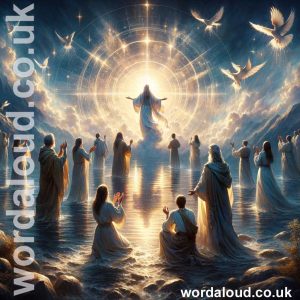
A Reading From The Instructions Of Saint Columban | You Are All Things To Us, O God
Brethren, let us follow that vocation by which we are called from life to the fountain of life. He is the fountain, not only of living water but of eternal life. He is the fountain of light and spiritual illumination; for from him come all these things: wisdom, life and eternal light. The author of life is the fountain of life; the creator of light is the fountain of spiritual illumination. Therefore, let us seek the fountain of light and life and the living water by despising what we see, by leaving the world and by dwelling in the highest heavens. Let us seek these things, and like rational and shrewd fish may we drink the living water which wells up to eternal life.
Merciful God, good Lord, I wish that you would unite me to that fountain, that there I may drink of the living spring of the water of life with those others who thirst after you. There in that heavenly region may I ever dwell, delighted with abundant sweetness, and say: ‘How sweet is the fountain of living water which never fails, the water welling up to eternal life.’
O God, you are yourself that fountain ever and again to be desired, ever and again to be consumed. Lord Christ, always give us this water to be for us the source of the living water which wells up to eternal life. I ask you for your great benefits. Who does not know it? You, King of glory, know how to give great gifts, and you have promised them; there is nothing greater than you, and you bestowed yourself upon us; you gave yourself for us.
Therefore, we ask that we may know what we love, since we ask nothing other than that you give us yourself. For you are our all: our life, our light, our salvation, our food and our drink, our God. Inspire our hearts, I ask you, Jesus, with that breath of your Spirit; wound our souls with your love, so that the soul of each and every one of us may say in truth: Show me my soul’s desire, for I am wounded by your love.
These are the wounds I wish for, Lord. Blessed is the soul so wounded by love. Such a soul seeks the fountain of eternal life and drinks from it, although it continues to thirst and its thirst grows ever greater even as it drinks. Therefore, the more the soul loves, the more it desires to love, and the greater its suffering, the greater its healing. In this same way may our God and Lord Jesus Christ, the good and saving physician, wound the depths of our souls with a healing wound – the same Jesus Christ who reigns in unity with the Father and the Holy Spirit, for ever and ever. Amen.
Christian Prayer With Jesus Christ
O Christ, fountain of life and light,
draw us to yourself, that we may drink of the living water that never fails.
You are our food and our drink, our salvation and our God.
Wound our hearts with your love, and heal us with your mercy.
Grant that our longing for you may never cease,
but grow ever deeper until we rest in your eternal presence,
who live and reign with the Father and the Holy Spirit,
for ever and ever. Amen.
Glossary Of Christian Terms
Fountain of life – A biblical image for God as the source of spiritual vitality and eternal life (cf. Psalm 36:9; John 4:14).
Living water – The gift of the Spirit and eternal life promised by Christ (John 4:14, John 7:37–39).
Light – In biblical tradition, a symbol of divine presence, truth, and guidance; Christ is described as the ‘light of the world’ (John 8:12).
Despising what we see – A monastic expression for detachment from earthly goods and temporary realities in order to seek eternal things.
Fish imagery – Columban likens Christians to fish who seek and drink from the fountain, an image reflecting both natural behaviour and baptismal symbolism (the fish being an ancient symbol of Christ).
Wounded by love – A spiritual expression drawn from the Song of Songs (2:5; 5:8), used by early Christian writers to describe the soul pierced with longing for God.
Healing wound – The paradox that divine love both causes desire and brings wholeness, leading to deeper communion with Christ.
Physician – An early Christian image for Christ as healer of souls (cf. Mark 2:17; writings of Ignatius of Antioch and Clement of Alexandria).



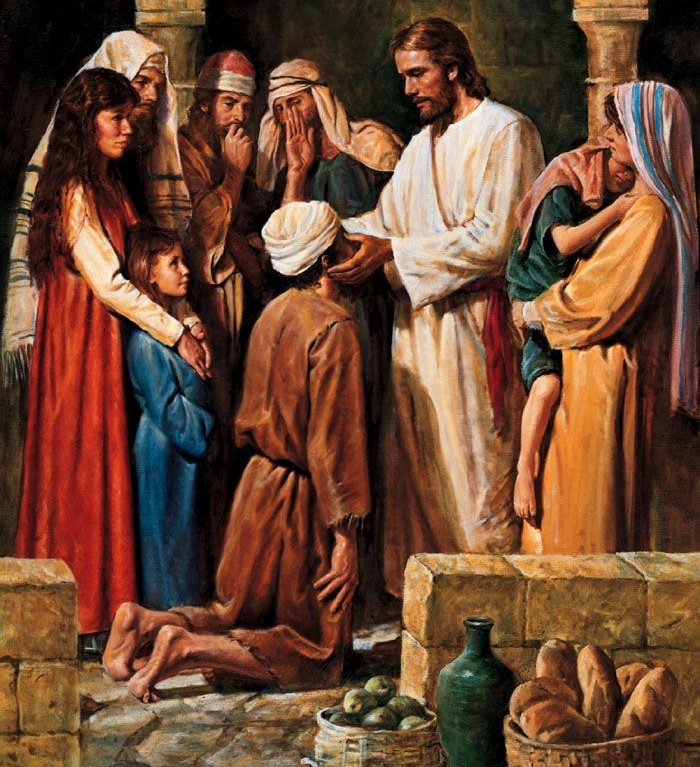
Blessed Isaac of Stella reflects on the close unity between Christ and the Church, especially in relation to the forgiveness of sins. He begins by affirming that two things belong to God alone: the right to receive confession and the power to forgive. Yet, he immediately links this divine prerogative with the mystery of Christ’s union with his bride, the Church [ … ]

The meditation on the love of Jesus Christ on Palm Sunday is struck by the imagery of Jesus’ triumphal entry into Jerusalem, though on a donkey. Crowds of people gathered around Jesus, laying down their cloaks and palm branches before Jesus, shouting ‘Hosanna to the Son of David! Blessed is he who comes in the name of the Lord! Hosanna in the highest!’ (Matthew 21:9, KJV) [ … ]
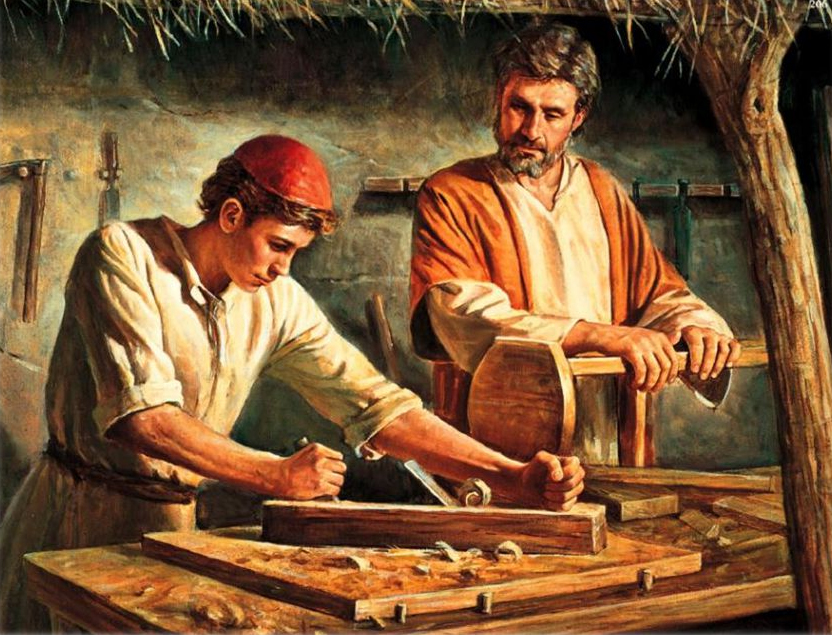
On Tuesday, His Grace turns to the theme of Jesus’ hidden years. His Grace asks the students to consider questions concerning what really happened: ‘Who, for instance, was Joseph? Was he indeed a carpenter, or has Joseph’s true role in the society in which he lived been misconstrued and forgotten to us? Though it be a beautiful, simplifying image to grasp, which offers to us much that is of value in Catholic faith… ‘A wise elder, which carpenter could mean, or a great engineer, an architekton, which in the Greek does not mean carpenter. But carpenter in the Hebrew could mean a wise man…’ His Grace turns the pages of his Bible back and forth, as if to itemize the paucity of information. Then he says: ‘What I think I can say to you with confidence is that it is of profound significance that we simply don’t know what Jesus was doing for most of his earthly life. There are some very different possibilities. One idea cherished by the Church is that Jesus worked with his father Joseph as a carpenter. Another possibility is that Jesus lived and prayed and studied closely with John the Baptist. They were cousins, and very close, almost the same, in age. Luke’s Gospel tells us clearly that Jesus and John knew each other from within the womb before they were born. So there may have been something quite important happening there. You see, we don’t know – it is an impossible mystery to us – just how much Jesus had to learn. This is because, if Jesus knew everything, humanly speaking, even as a tiny baby, then how can we say he is fully human? We simply can’t probe too far into this mystery, but we can draw extraordinary truth and healing from this thought, which becomes of immense relevance in our own lives. Jesus came to know and to understand himself not merely as a son of God, but as God the Son, and so as self-identical with his Father. It is not an adoptive relationship. Jesus is God. Now so much is hidden here. But this is a great gift. If you think about it, how do we come to know that we are loved by God, that we have our relationship with God? What are we born with in here’ – his chest – ‘and what do we have to learn? This is to say, what is gifted to us by other Christians at our baptism? ‘Jesus must have studied, and experienced profound revelation about who and what he truly was, and, so it seems to be, these studies cannot have been confined to the Semitic world. But this is the important point: there is a hiddenness about all of this. No matter which schools and which sects our Lord might have encountered all these years, this to us is as a desert space. What this means is that we can enter into the hidden life of Jesus, and there we can discover our own being with God, our own sonship. Our own particular being loved by God can come to us, if we can enter within this great unknown – into this desert space, where we are loved by Jesus. I firmly believe that there may be a great Lenten mystery in this period of our Lord’s life.’ A Bishop’s Lenten Homily | Extracted From The Gospel According To Tomàs | Faith And Hope And Love And Sexuality | Part 1 A Bishop’s Lenten Homily | Extracted From The Gospel According To Tomàs | Faith And Hope And Love And Sexuality | Part 2 A Bishop’s Lenten Homily | Extracted From The Gospel According To Tomàs | Faith And Hope And Love And Sexuality | Part 3 A Bishop’s Lenten Homily | Extracted From The Gospel According To Tomàs | Faith And Hope And Love And Sexuality | Part 4 | King James Audio Bible | KJV A Bishop’s Lenten Homily | Extracted From The Gospel According To Tomàs | Faith And Hope And Love And Sexuality | Part 5 A Bishop’s Lenten Homily | Holy Week | Extracted From The Gospel According To Tomàs | Faith And Hope And Love And Sexuality | Part 6
