
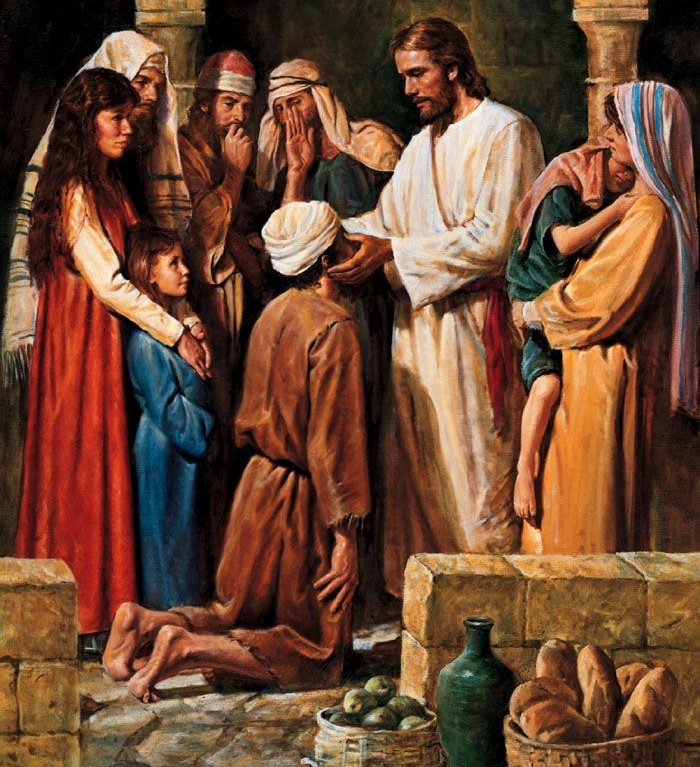
Christian Art | Healing Prayer With Jesus | Jesus Heals
Office Of Readings | Week 23, Friday, Ordinary Time | A Reading From The Sermons Of Blessed Isaac Of Stella | Without The Church, Jesus Christ Will Not Forgive
‘It is not Christ’s will to forgive without the Church.’
Blessed Isaac of Stella reflects on the close unity between Christ and the Church, especially in relation to the forgiveness of sins. He begins by affirming that two things belong to God alone: the right to receive confession and the power to forgive. Yet, he immediately links this divine prerogative with the mystery of Christ’s union with his bride, the Church.
Isaac draws on biblical nuptial imagery: Christ, the Bridegroom, has taken the Church, the lowly servant, and raised her to his side, as Eve was formed from Adam’s side (Genesis 2:21–23). The allusion to Christ’s wounded side on the cross (John 19:34) emphasises that the Church is born from the self-giving love of Christ, particularly in the sacraments of baptism and Eucharist, which flow from water and blood.
The heart of Isaac’s teaching is the exchange between Christ and the Church:
- He takes away her sins, bearing them on the cross.
- He assumes her humanity.
- He confers upon her what is divine.
This mirrors the broader patristic theme of admirabile commercium (the ‘wonderful exchange’): Christ becomes what we are, so that we may become what he is.
From this union flows the sacramental economy. The Church exercises the ministry of forgiveness not apart from Christ but in communion with him, hence the words: ‘Go, show yourself to the priest.’ (Luke 5:14) Confession is directed to God, yet carried out in and through the Church, which Christ has made one with himself. Isaac insists on reciprocity: the Church cannot forgive without Christ, and Christ wills not to forgive without the Church.
This unity guards against separating Christ from his body. To divide Christ from the Church would be to destroy the wholeness of salvation. As Paul teaches, the mystery of marriage points to Christ and the Church (Ephesians 5:32). Thus, sacramental confession is not a merely human act but a participation in the union of Christ and his bride, through which divine forgiveness is made present.

A Reading From The Sermons Of Blessed Isaac Of Stella | Without The Church, Jesus Christ Will Not Forgive
There are two things that are God’s and God’s alone: the honour of receiving confession and the power of granting forgiveness. Confession is what we must make to him, and forgiveness is what we must hope to receive from him. The power to forgive sins belongs only to God, and this is why we must confess them to him.
But God has taken a bride. The Almighty has taken the feeble one, the Most High has taken the lowly one – out of a servant he has made a queen. She was behind and beneath him and he raised her to be at his side. From out of his wounded side she came, and he took her to be his bride.
Just as all that the Father has is the Son’s, so too what the Son has is the Father’s, since they share the same undivided nature. In just the same way the bridegroom gave all that was his to the bride and shared all that she had, making her one with himself and the Father. Hear the Son making his plea to the Father for his bride: I desire that just as you and I are one, so these should be one with us.
The bridegroom is one with the Father and one with his bride. Whatever in her was foreign to her nature he took away from her and nailed to the cross. He carried her sins with him onto the tree and by the tree he took them away from her. Whatever was natural and proper to her he took on and clothed himself in it. Whatever was divine and proper to him, he bestowed on her. He took away what was diabolical, took on what was human, conferred what was divine, so that all that the bride possessed should be the bridegroom’s also. Thus it is that he who has committed no sin, on whose lips is no deceit, can say Take pity on me, Lord, for I am weak – for he who shares in his bride’s weakness must share in her lament, and thus all that is the bridegroom’s is the bride’s also. Here is where the honour of confession comes from, and the power of forgiveness, so that it can truly be said: Go and show yourself to the priest!
The Church can forgive nothing without Christ, and it is Christ’s will to forgive nothing except with the Church. The Church can forgive no-one except the penitent – that is, one who has been touched by Christ – and Christ does not wish to forgive anyone who does not value the Church. What God has united, man must not divide, says Christ, and Paul adds, I am saying that this great mystery applies to Christ and the Church.
Do not sever the head from the body so that Christ is whole no longer. For Christ is not whole without the Church, nor is the Church whole without Christ. This is why he says No-one has gone up to heaven except the Son of Man who is in heaven. He is the only man who can forgive sins.
Christian Prayer With Jesus
Lord Jesus Christ,
you have made the Church your bride
and united her inseparably to yourself.
Grant that we, confessing our sins with humility,
may receive your mercy through the ministry of your Church.
May we never be separated from your body,
but remain in your love,
you who live and reign with the Father and the Holy Spirit,
one God, forever and ever. Amen.
Glossary Of Christian Terms
Confession – The act of admitting sins before God, in the Church, with the hope of forgiveness.
Bride/Bridegroom imagery – Biblical language describing the covenant relationship between Christ (the Bridegroom) and the Church (the Bride).
Wounded side of Christ – Refers to John 19:34, where blood and water flow from Christ’s side; traditionally seen as the origin of the Church’s sacramental life.
Admirabile commercium – Latin for ‘wonderful exchange,’ the theological idea that Christ takes on human nature so that humanity may share in the divine.
Sacramental economy – The way Christ’s saving work is made present in the Church through the sacraments.
‘Go, show yourself to the priest’ – From Luke 5:14, where Jesus directs a healed leper to the priest; understood as prefiguring sacramental confession.
Mystery of Christ and the Church – From Ephesians 5:32, where the union of husband and wife is seen as a sign of the union between Christ and his Church.
Head and body – A Pauline image (e.g., Colossians 1:18), expressing the inseparable unity of Christ (head) and the Church (body).




In our Gospel verses this Thursday and Friday, and also Sunday (B), Jesus develops on the parable of the vine and the branches with an injunction for us to be at one with each other, as with Jesus and the Father, through love. The love to which we are called is of a special quality. It is divinely inspired and a reflection of Jesus’ love for us, itself a reflection of the love between the Son and the Father. This is the new commandment [ … ]
Psalm 69, attributed to King David, is a heartfelt and poignant expression of suffering and an earnest plea for deliverance. Unlike some of the more celebratory Psalms, this composition delves into the depths of despair and serves as a raw and unfiltered account of distress. The psalmist cries out for salvation in the face of adversity and persecution, making it a relatable and comforting text for those grappling with their own trials [ … ]
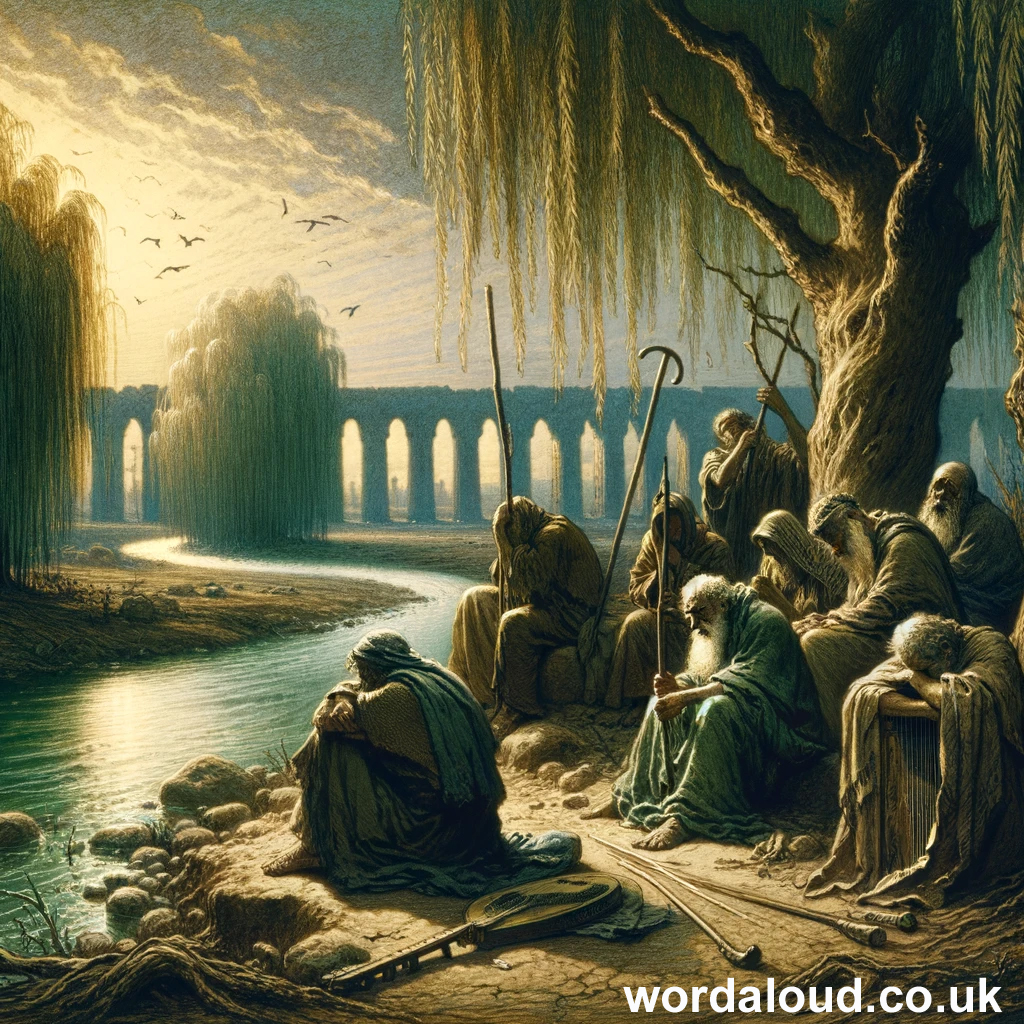
Psalm 137 expresses complexities of exile and displacement. The psalm’s candid expression of sorrow, defiance, and longing for justice offer insights into an enduring human struggle to maintain identity and to seek justice in the face of overwhelming odds [ … ]
