
Christian Art: 1200 BC
Judges 1: 1-36
Was There An Historical King David? | What Can We Know?
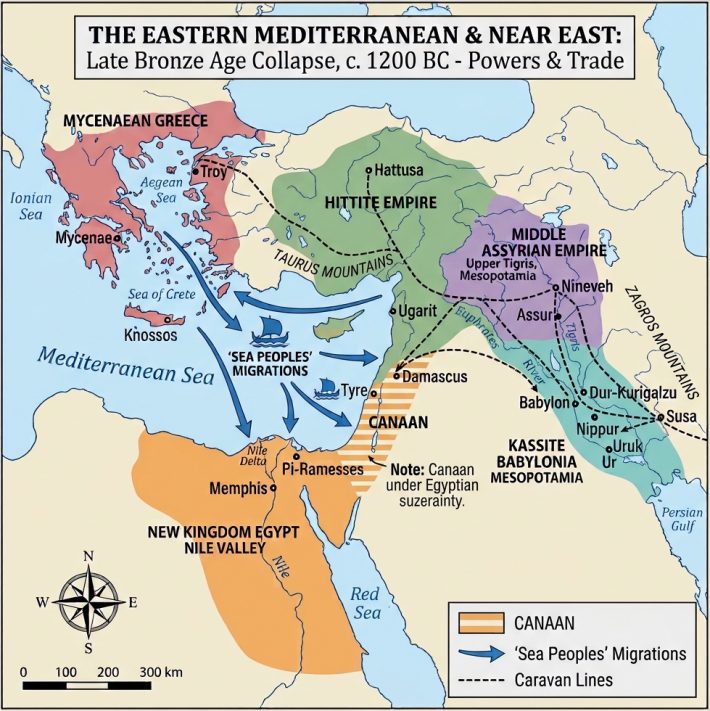
The world described in the earliest books of the Bible did not arise in isolation. Canaan (the southern Levant, broadly corresponding to present-day Israel, the Palestinian territories and adjoining parts of Lebanon, Syria and Jordan) had already been inhabited for millennia when Israel appears in the surviving historical record. Its towns and villages belonged to a region linked by trade, warfare, diplomacy and imperial government to Egypt (in northeastern Africa, centred on the Nile Valley), Anatolia (the peninsula comprising most of present-day Turkey), Syria (on the eastern Mediterranean coast and its inland hinterland, within and around modern Syria), Cyprus (the island in the eastern Mediterranean, south of present-day Turkey) and the Aegean (the sea and surrounding lands between present-day Greece and western Turkey). During the centuries around 1200 BC, much of that political world changed. Some kingdoms disappeared; others survived in reduced form; new settlements and communities became visible. The transition is conventionally called the Bronze Age Collapse.
The biblical books also belong to a world with an older history of written law, religious narrative and political thought. Long before the surviving biblical texts took their present forms, scribes in Mesopotamia (the Tigris–Euphrates region, chiefly in present-day Iraq and parts of Syria and Turkey) had recorded laws, accounts of creation and flood, royal inscriptions, prayers and wisdom literature. Some of these writings survive in copies made centuries apart, so the date of a surviving tablet must be distinguished from the age of the tradition it transmits. Israel’s literature did not emerge in a cultural vacuum. Its writers used forms of expression and addressed questions already familiar across the ancient Near East, even where their answers differed.
The commandments provide an example. The collection known as the Code of Hammurabi, inscribed in Babylon (in southern Mesopotamia, near present-day Hillah in Iraq) in the eighteenth century BC, addresses theft, false accusation, injury, family relations, debt and the responsibilities of judges. Earlier Mesopotamian law collections, including those associated with Ur-Nammu (king of Ur, an ancient city in southern Mesopotamia, in present-day southern Iraq) and Lipit-Ishtar (king of Isin, a city in southern Mesopotamia, in present-day Iraq), show that the writing down of legal rules was not Hammurabi’s invention. Exodus 20 and Deuteronomy 5 contain prohibitions of murder, adultery, theft and false witness, alongside commands concerning the worship of the Lord, the Sabbath and duties towards parents. The overlap demonstrates that some concerns of biblical law were shared with older societies. Hammurabi’s laws commonly describe a particular case and its penalty; the Decalogue largely presents direct commands. Biblical legal collections beyond the Ten Commandments, notably Exodus 21–23, offer further and sometimes closer comparisons with the case-law traditions of the region.
Narrative parallels are equally instructive. The Akkadian Atrahasis story and the flood account incorporated into Tablet XI of the Epic of Gilgamesh tell of a devastating flood, a survivor who builds a vessel, the preservation of life and the release of birds. These features invite comparison with Genesis 6–9. The narratives differ in their depiction of divine motives, human conduct and what follows the flood. The Babylonian creation composition Enuma Elish and Genesis 1 both address the ordering of the cosmos, but their accounts of divine agency are different. A shared subject or narrative motif is evidence of a wider literary environment.
The date of the events described in the Pentateuch may be distinguished from the dates at which its books were written and edited. Traditions concerning Moses and Israel’s origins were transmitted and developed over centuries. Many students of the Bible associate an earlier form of Deuteronomy with the religious reforms of King Josiah in the late seventh century BC, while identifying further composition and editing during the Babylonian Exile in the sixth century BC. Jerusalem fell to Babylon in 586 BC, and the loss of the kingdom and Temple gave new urgency to questions of covenant, land and obedience. The Pentateuch as a collection may not have reached something close to its received form until the Persian period, after the exile. These dates and stages remain subjects of debate. It is self-evident that a narrative set in the age of Moses cannot of necessity be treated as a document written in that age. Nor does the presence of an older Mesopotamian parallel establish when a biblical writer first encountered the tradition.
The biblical idea of a covenant between the Lord and Israel has parallels in the political agreements of older Near Eastern kingdoms. Hittite kings, ruling from central Anatolia (in present-day Turkey) during the second millennium BC, made treaties with subordinate rulers. These agreements could recount the benefits the king had conferred, require loyalty and obedience, and prescribe consequences for breaking the agreement. Deuteronomy contains comparable features. Moses recalls the Lord’s deliverance of Israel, commands obedience to his laws, and declares the blessings and curses associated with keeping or breaking the covenant (Deuteronomy 28). Similarities have also been identified with treaties of the Assyrian kings, particularly the seventh-century BC succession treaties of Esarhaddon. These comparisons help explain the literary and political traditions available to the biblical writers.
The biblical accounts of Israel’s origins, settlement and early political history were written and edited long after many of the events they describe. The destruction of the Late Bronze Age kingdoms and the changes that followed can be investigated through archaeology, inscriptions and contemporary documents. Such sources help establish the historical circumstances in which Israel emerged in Canaan.
The Eastern Mediterranean Before The Collapse
In the thirteenth century BC, the eastern Mediterranean contained states whose rulers corresponded with one another across considerable distances. Egypt controlled the Nile valley and maintained authority over parts of Canaan. The Hittite king governed a large empire from central Anatolia. Mycenaean (the Late Bronze Age Greek palace civilisation centred on mainland Greece) palaces exercised authority in parts of mainland Greece. Ugarit (at Ras Shamra on the Mediterranean coast of modern Syria, near Latakia), on the Syrian coast, served as a trading and diplomatic centre. Cyprus supplied copper and stood at the intersection of maritime routes connecting the Levant, Anatolia and the Aegean.
This was not a single economic or political system directed from one capital. Each kingdom possessed its own institutions, interests and internal divisions. Yet their affairs were interconnected. Correspondence of Late Bronze Age courts records exchanges of gifts, requests for materials, diplomatic marriages, disputes over territory and the movement of merchants. International relations were sustained by recognised conventions and by the practical need to obtain goods that were not available everywhere.
The alloy bronze in itself illustrates both the reach and the limitations of these connections. Its principal ingredients, copper and tin, did not necessarily come from the same places. Copper from Cyprus travelled widely; tin reached Mediterranean workshops through longer and less securely understood routes. Metals moved alongside textiles, pottery, foodstuffs and luxury objects. A disruption at one port could inconvenience merchants and rulers elsewhere, although no single trade route was indispensable to every community.
In terms of the geography of this network, the Hittite heartland lay inland, across the Anatolian plateau, while its rulers depended upon access to northern Syria and the routes connecting the Euphrates with the Mediterranean; Ugarit stood near the Syrian coast, with its harbour at Minet el-Beida; Egypt approached Canaan from the southwest, through the Sinai and along routes that linked its frontier fortresses to Gaza (on the Mediterranean coast of the present-day Gaza Strip) and the cities farther north; Cyprus, known in many Late Bronze Age documents as Alashiya (a Late Bronze Age polity generally identified with Cyprus, in the eastern Mediterranean), lay between these spheres. These places were not interchangeable parts of an empire. Their position determined which supplies, military threats and diplomatic obligations mattered to their rulers.
Distance between these centres helps explain their different interests. Hattusa, at Boğazkale northeast of Ankara in central Turkey, lay inland on the Anatolian plateau, far from the sea; Ugarit occupied the Syrian coast, with access to the harbour at Minet el-Beida; Cyprus stood between the Aegean and Levantine shores. Egypt’s route towards Canaan ran through the north-eastern frontier and the southern coastal plain. Goods could travel by sea along the coast or cross inland routes towards the Euphrates. A shipment that was routine for a coastal merchant might require difficult overland transport before it reached a capital such as Hattusa. The geography makes it misleading to speak of a single supply system that failed everywhere in the same way.
The Amarna correspondence, discovered in Egypt and dating mainly to the fourteenth century BC, gives unusually direct evidence of the language of international politics. Major kings addressed one another as ‘brother’, while subordinate rulers appealed to the Egyptian king as their lord. Letters from Canaan report disputes among local rulers, accusations of disloyalty and requests for troops. They show how much royal authority depended upon messages, intermediaries and local cooperation. They also caution against treating the region as an undifferentiated Egyptian possession. The pharaoh claimed overlordship, but his ability to intervene depended upon changing circumstances and the conduct of Canaanite rulers themselves.
The Amarna archive makes the language of dependence audible. In letter EA 90, Rib-Addi of Byblos (the ancient port at modern Jbeil on the Lebanese coast, north of Beirut) addresses the Egyptian king as his lord and sun god, presenting himself as a servant who falls at the king’s feet ‘seven times and seven times’. He complains that hostile forces have taken his towns, leaving Byblos exposed, and asks for Egyptian assistance. This is not a modern diplomatic memorandum: ritual language emphasises inequality, while the complaint reveals a ruler attempting to obtain practical protection. Such letters show that Egyptian overlordship depended upon local cooperation, information and the dispatch of men when requested. The Amarna letters date mainly to the fourteenth century BC, earlier than the collapse; their value here is to reveal how the older political order worked.
Egyptian and Hittite relations illustrate the scale of Late Bronze Age diplomacy. Their conflict at Kadesh (on the Orontes River near modern Tell Nebi Mend in western Syria), usually dated to the thirteenth century BC under Ramesses II and Hattusili’s predecessor Muwatalli II, was followed by a treaty between Ramesses II and Hattusili III. Versions of its terms survive in Egyptian and Hittite records. The agreement concerned peace, mutual assistance and the return of fugitives; it did not abolish competition, but it demonstrates that rulers could establish durable arrangements across imperial frontiers. When the Hittite imperial court disappeared, the loss extended beyond one capital. A participant in this diplomatic order had ceased to function.
The archaeological visibility of ordinary households differs sharply from that of courts. Administrative tablets survive because buildings burned and clay records were preserved; ordinary transactions written on perishable materials have largely vanished. The documents are consequently rich in the concerns of institutions and poor in direct testimony from those who cultivated fields or transported goods. A historian who follows only royal correspondence risks mistaking the fortunes of kings for the fortunes of entire societies.
The great palaces also organised production within their territories. Linear B tablets from Mycenaean Greece record allocations of labour, livestock, grain and materials. Such documents reveal an administrative world in which royal households and officials could direct resources on a considerable scale. They tell us much less about the thoughts of ordinary cultivators, whose labour sustained the system. A palace’s destruction could end its archive and administrative machinery while leaving many inhabitants alive and at work.
A Linear B tablet was normally an administrative record, not a literary account. Tablets from Pylos (the Mycenaean palace site at Ano Englianos in southwestern Greece, in the Peloponnese) and Knossos (on Crete, the Greek island south of the Aegean mainland, near Heraklion) enumerate workers, animals, wool, grain, vessels and allocations to named places or groups. Imagine the administrative sequence behind a record of wool assigned to textile workers: flocks had to be managed, wool collected, quantities assessed, workers supplied and finished goods accounted for. The tablet preserves a small part of that sequence, not the experience of the shepherd or weaver. The end of the tablets mark the disappearance of a recording institution, rather than that sheep ceased to be kept or cloth ceased to be made.
Canaan occupied a different position. Its Late Bronze Age towns were frequently ruled by local authorities subject to Egyptian influence. The Amarna letters, written earlier in the fourteenth century BC, show Canaanite rulers petitioning the Egyptian court, accusing rivals and seeking military assistance. The correspondence cannot be treated as a complete map of political life, but it establishes that the region already possessed cities, competing rulers and a long history of contact with Egypt. Israel did not enter an historical vacuum.
The End Of Palaces And Kingdoms
Around the end of the thirteenth century and into the twelfth, several centres of power ceased to function as they had before. The scale and timing of the changes varied. A convenient date such as 1200 BC is a marker for a period of upheaval.
The Hittite imperial capital at Hattusa was abandoned as a centre of government. The empire’s disappearance has sometimes been described as the destruction of the Hittites themselves, but that confuses an imperial institution with the people and traditions associated with it. At Carchemish (on the Euphrates at the modern Turkey–Syria border, near Karkamış and Jarabulus) and in other parts of northern Syria and southeastern Anatolia, political and cultural continuities survived into the Iron Age. The Hittite imperial court vanished; the wider inheritance did not.
Carchemish, on the Euphrates, provides the counter-example to imperial disappearance. A dynasty there continued to use Hittite royal traditions after the central court at Hattusa had ceased to function. The city’s later monuments and inscriptions belong to the world commonly called the Neo-Hittite or Syro-Hittite states. These kingdoms were not merely fragments waiting to be reunited: they developed their own histories while retaining elements of older political and artistic practice. Their existence means that the phrase ‘the Hittites disappeared’ needs qualification. A capital and its imperial command structure vanished, while a political inheritance remained active elsewhere.
In Greece, the destruction or abandonment of Mycenaean palaces brought the Linear B administrative system to an end. Pylos supplies a particularly revealing example because its tablets preserve the workings of a palace shortly before its destruction. The disappearance of written administration does not mean that Greek-speaking people vanished, or that settlements were abandoned. Some places contracted; others continued; new patterns of settlement emerged. What ended most decisively was a form of concentrated political authority.
Hattusa was a fortified imperial centre with monumental gates, temples, archives and a complex urban topography. Its surviving buildings and cuneiform records reveal a court that administered territories extending far beyond the city. The end of the capital might not be reconstructed as one certain assault. Archaeological interpretations distinguish abandonment, localised burning and later disturbance, and some areas may have been vacated before destruction. Disappearance of the imperial administration is clear; a precise sequence of its final days is not. Collapse of a government need not begin with an enemy breaching its walls.
The Mycenaean evidence is similarly precise in one respect and limited in another. Linear B is a form of Greek written in a syllabic script, used mainly for palace administration. Its tablets list personnel, allocations and commodities; they were not composed as histories of the kingdom. At Pylos, records concerning coastal watchers and military preparations have attracted attention because the palace was destroyed not long afterwards. Their interpretation remains disputed, and the tablets do not name the force that destroyed Pylos. What is clear is that the administrative system ceased to operate, and the writing tradition disappeared from use in Greece for centuries.
The Pylos ‘o-ka’ tablets are evocative because they concern the deployment of men in coastal districts. One begins with a formula commonly translated as describing how guards defend the coast, then names commanders, places and groups of men, sometimes in tens or fifties. The document has been interpreted as an arrangement for coastal defence, perhaps during a period of danger. Terminology and purpose of some entries are debated. Nothing on the tablet identifies a particular invading people or states that an attack was imminent. Its value lies in the specificity of the administration: named officers and counted personnel were being organised shortly before the palace system disappeared.
Aegean settlement after the palace destructions followed multiple patterns. Some communities contracted, others moved, and places such as Tiryns (in the Argolid of northeastern Peloponnese, Greece) remained inhabited. The archaeological record includes changing pottery styles, burial practices and forms of domestic architecture. The scale of the palatial system was not restored. Describing this period as a ‘dark age’ can obscure what archaeologists can actually observe: altered settlement patterns, fewer written records and new social arrangements rather than an absence of history.
Ugarit’s archive makes the problem of historical reconstruction unusually tangible. One letter, conventionally associated with the final crisis, reports enemy ships and damage to settlements while the king’s troops and ships were away. The text conveys the vulnerability of a coastal kingdom, but neither its precise place in the sequence of events nor the identity of the attackers can be fixed beyond dispute. The same archives preserve letters about grain and international obligations. Together they reveal pressures that a ruler might face, not a chronological diary leading inevitably to destruction.
Cyprus further complicates the map of catastrophe. At sites including Enkomi (in eastern Cyprus, near modern Famagusta) and Kition (at modern Larnaca on the southern coast of Cyprus), destruction, rebuilding and changes in material culture belong to a period of transformation, but their chronology and interpretation differ. The island’s role in copper production did not simply end with the Late Bronze Age. Connections with the Aegean became more visible in some contexts, while local traditions continued.
At Enkomi in eastern Cyprus, excavation reveals a substantial Late Bronze Age town with planned streets, buildings and evidence for metalworking. Destruction and rebuilding occurred in successive phases, and changes in pottery and architecture accompanied transition to the Iron Age. Cyprus remained a centre of copper production and cultural exchange; the island was not rendered uninhabited by one catastrophe. Material associated with Aegean traditions became prominent in some contexts, but it appeared alongside local practices. Enkomi helps illustrate a history of adaptation, movement and rebuilding that differs from the abrupt disappearance of a palace archive.
The archaeological settlement at Hisarlik, the archaeological mound near the Dardanelles in northwestern Turkey, contains successive cities conventionally distinguished by numbered phases. Troy VI ended in major destruction, for which earthquake damage has been proposed; Troy VIIa is associated with a later destruction and has been discussed in relation to warfare. Precise dates and causes remain debated. Homer’s Iliad, composed centuries later, presents a story of heroes, quarrels and siege. Archaeology can establish that a substantial settlement occupied the site and experienced upheaval. It cannot identify Achilles or Hector in a destruction layer, nor convert the poem’s narrative into contemporary report.
Ugarit offers a different kind of evidence. Excavations at Ras Shamra have recovered archives containing diplomatic correspondence, commercial records and texts of religious and literary interest. Letters from the kingdom’s final period speak of danger from hostile ships and of a ruler’s difficulties in defending his territory. They bring the reader close to the anxieties of a court facing military danger. The city was destroyed.
A letter attributed to Ammurapi, king of Ugarit, addressed to the ruler of Alashiya, reports enemy ships and damage to towns. The king says that his troops and chariots are in Hatti and his ships in Lukka (a region associated with southwestern Anatolia, in present-day Turkey), leaving his own country without adequate defence. Another letter from Alashiya warns of enemy ships whose whereabouts were uncertain. These are not accounts composed after the catastrophe; they are correspondence about immediate danger. They also demonstrate the hazards of an interconnected political world: a king could have obligations or deployments abroad while his own coast was threatened.
The destruction of these centres was not uniform. Some buildings burned; some sites were abandoned without a comparable destruction layer; elsewhere, occupation continued despite political change. Archaeological dates carry margins of uncertainty. A sequence that looks simultaneous on a broad historical chart may conceal events separated by years or decades.
Egypt demonstrates the danger of speaking of total collapse. Its monarchy survived, as did its religious and administrative institutions. Egypt’s position in Canaan and the wider eastern Mediterranean changed and its rulers confronted military threats. Survival at the centre could coexist with diminished influence abroad.
Egypt, The Sea Peoples And The Philistines
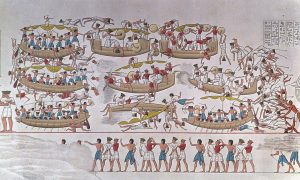
The reign of Ramesses III supplies the best-known ancient representations of conflict during the early twelfth century BC. At Medinet Habu (the mortuary temple complex on the west bank of the Nile at Luxor, in southern Egypt), inscriptions and reliefs commemorate Egyptian victories over enemies arriving by land and sea. Among the groups named are the Peleset, commonly associated with the Philistines. Modern historians group several of the peoples named in Egyptian records under the modern expression ‘Sea Peoples’.
Neither can the groups named by Egypt be assigned responsibility for all the destroyed cities of the period. Warfare was real, and the Egyptian accounts deserve close attention, but the distance between a commemorative inscription and a comprehensive explanation of regional collapse remains considerable. Some people may have moved as armed groups, others as families, migrants or settlers.
Reliefs of Ramesses III’s mortuary temple at Medinet Habu portray combat on land and water. Ships crowd together; archers shoot from decks; men fall into the water or are taken captive. Other scenes present prisoners before the victorious pharaoh. The inscriptions name several groups, among them the Peleset, Tjeker, Shekelesh, Denyen and Weshesh. Such scenes are unusually rich evidence for how an Egyptian court wished to represent the enemy and the king’s victory. Their composition is also deliberate royal propaganda.
Ramesses III’s inscriptions belong to a long Egyptian tradition in which the king defeats foreign enemies and restores order. The monument presents victory as an achievement sanctioned by the gods. Its claims can be compared with the archaeology of Egypt and the Levant rather than accepted as a neutral account. Egypt’s continued existence after the campaigns is beyond doubt. So too is the longer-term weakening of its influence in parts of Canaan, although the timing and causes of that retreat varied from place to place.
The association between the Peleset of Egyptian records and the biblical Philistines is widely accepted. Excavations at Philistine centres have revealed pottery with Aegean connections, alongside cooking practices and other features that changed as communities interacted with local populations. Ancient DNA from early Iron Age burials at Ashkelon (on the Mediterranean coast of present-day southern Israel) has been interpreted as evidence for a transient European-related genetic component in some individuals, subsequently diluted in later populations.
Early Iron Age pottery at Ashdod (on the southern coastal plain of present-day Israel) and Ekron (at Tel Miqne in the southern coastal plain of present-day Israel) includes vessels conventionally called Mycenaean IIIC-style, that is bowls and other forms whose shapes and painted decoration have close parallels in the Aegean and Cyprus. Scientific analysis of pottery fabrics has shown that many such vessels were made locally rather than imported ready-made. This shifts the historical question from imported goods to local production and cultural transmission. The finds do not merely show that merchants carried Greek pots to Canaan; they suggest that local potters were producing vessels in a style associated with wider eastern Mediterranean traditions. Subsequent Philistine pottery developed further, combining and modifying features within the southern Levant.
The biblical five-city grouping comprises Gaza, Ashkelon, Ashdod, Ekron and Gath (usually identified with Tell es-Safi in the Shephelah, west of the Judean highlands in present-day Israel). Gaza and Ashkelon occupied coastal approaches, Ashdod lay farther north on the coastal plain, while Ekron and Gath connected the coastal zone to the inland lowlands. Their positions mattered because movement between the coast and the central highlands passed through valleys and foothills rather than across an abstract boundary. Excavations at Tel Miqne-Ekron and Tell es-Safi/Gath show the scale and changing fortunes of these centres. The biblical expression ‘lords of the Philistines’ does not mean that all five cities possessed identical interests or institutions at every period.
A 2019 study analysed genome-wide data from ten individuals buried at Ashkelon in Bronze and Iron Age contexts. The early Iron Age individuals showed a European-related genetic component not detected in the preceding sampled population; it was no longer detectable in the later Iron Age samples examined. The result is consistent with some movement of people into Ashkelon during the period when its material culture changed.
In Judges and Samuel, Philistines appear as neighbours and adversaries of Israel. Narratives of Samson, Samuel, Saul and David presuppose a political landscape in which Philistine cities possess military power and regional interests.
Drought, Warfare And The Fragility Of Government
Why did so many centres of authority change or disappear? No explanation accounts equally well for all of the evidence. Environmental pressures, military conflict, political instability and interruptions to exchange are all relevant.
Agriculture supported the palaces and armies of the Late Bronze Age. Grain sustained households and specialist workers; livestock, vineyards and olive groves supplied food and commodities for exchange. Poor harvests could damage a ruler’s ability to feed dependants, reward supporters and maintain troops. Some environmental studies indicate periods of dryness in parts of the eastern Mediterranean, and evidence from Anatolia has been used to identify an episode of exceptionally severe drought around the turn of the twelfth century BC.
A tree normally adds a growth ring each year. Under appropriate conditions, narrow rings can indicate moisture stress; chemical measurements can provide an independent check. Researchers studying ancient juniper timbers from Gordion, near modern Yassıhöyük west of Ankara in central Turkey combined ring widths with carbon-isotope measurements and identified an exceptionally dry interval around 1198–1196 BC, allowing for dating uncertainty. This evidence identifies environmental conditions within a narrow span of years. It does not record a Hittite harvest ledger, the abandonment of Hattusa or a king’s political decisions. The historical inference depends on connecting local environmental stress to the demands of an inland empire whose capital required dependable supplies.
Water systems also differed. The Nile depended upon the annual inundation and conditions far beyond the Mediterranean coast. Rain-fed farming in Anatolia and parts of the Levant was exposed to different risks. A drought that devastated one district might have had a different effect in a region supplied by irrigation or imports. The broad claim that ‘climate caused the collapse’ hides these geographical distinctions and assumes a political consequence that climate data alone cannot establish.
The logistics of food supply are visible in surviving correspondence. Ugarit and other courts had to consider the transport of grain, the needs of dependants and obligations imposed by stronger neighbours. Ships could move large quantities of goods, but maritime transport was vulnerable to military danger and seasonal constraints. If a kingdom lost access to imports at the same time that local harvests failed, its difficulties would be greater than either problem alone.
The Late Bronze Age archives include correspondence concerning shipments of grain and the need to provision cities and courts. Such documents deserve to be read as practical transactions: someone required food, someone else controlled a supply, and transport had to be arranged. A request for grain does not automatically prove general famine. It may reflect shortage, a royal obligation or a temporary interruption in normal supply. In the case of Ugarit, grain correspondence is especially instructive because the kingdom combined local agriculture with maritime exchange and obligations to stronger powers.
The frequently proposed idea of ‘systems collapse’ has explanatory value when its parts are specified. For a Mycenaean palace, the failure of a central bureaucracy might end the collection and redistribution of commodities. For Ugarit, attacks on shipping could interrupt exchange and diplomatic communication. For Hattusa, failures in provisioning or provincial loyalty could undermine imperial control.
Archaeologists establish sequences from stratigraphy, pottery and, where available, radiocarbon dates or inscriptions. Even a securely dated destruction layer may not reveal whether the cause was war, accidental fire or abandonment followed by burning. Sites destroyed within a century of one another should not be placed in a single campaign.
Archaeologists considering an earthquake look for patterns such as walls displaced or tilted in related directions, collapsed masonry, deformation of floors and damage that fits a seismic mechanism. A fire may follow an earthquake, but burning alone cannot establish one. Troy VI has long figured in discussions of possible earthquake destruction, although the explanation is not immune from challenge. Elsewhere, ruined walls may result from warfare, neglect, deliberate demolition or later disturbance. An earthquake hypothesis might explain the particular damage more convincingly than alternatives.
Military conflict contributes a further dimension. Warfare could kill inhabitants, destroy stores, interrupt routes and drive people from their homes. Surviving sources attest military danger, but they do not identify one invading force that moved systematically from Greece to Anatolia, Syria and Canaan. Internal struggles for authority may also have weakened some kingdoms. Direct testimony for the motives of those involved is scarce.
We might consider a hypothetical inland palace that has suffered two poor harvests. Its stores must support administrators, soldiers, specialist workers and animals, while provincial communities are asked to deliver grain they can scarcely spare. If routes become unsafe, imported supplies arrive late; if the ruler sends troops away, local security weakens. Officials may struggle to collect dues, and subordinate leaders may retain resources rather than send them to the centre. This sequence illustrates how several pressures could reinforce one another. This illustration makes concrete the mechanisms hidden by the phrase ‘systems collapse’.
Human consequences are harder to recover than the political. Royal archives disappear when palaces fall, but ordinary people rarely leave written accounts of their experience. Some must have suffered violence, hunger and displacement; others adapted to altered circumstances. Archaeology records changes in houses, settlements, tools and burial practices, yet it seldom tells us how an individual understood the loss of a king or the arrival of a new neighbour. We should not mistake the silence of the sources for the absence of human lives.
Canaan Before Israel
The biblical question comes into sharper focus in Canaan. During the Late Bronze Age, the southern Levant consisted of established urban centres, villages and agricultural districts, with local rulers operating under varying degrees of Egyptian authority. Its population possessed religious and cultural traditions long before the period conventionally associated with Israel’s settlement.
Egyptian control did not disappear overnight. The retreat or reduction of imperial authority unfolded unevenly, and Egyptian activity continued in parts of the region into the twelfth century BC. Even so, the long-term weakening of Egyptian oversight changed the opportunities available to local rulers and communities. New settlements could develop beyond the immediate reach of the older urban centres, while coastal cities followed different paths.
Canaanite urban society had deep roots. Late Bronze Age centres such as Megiddo (at Tel Megiddo overlooking the Jezreel Valley in northern present-day Israel), Hazor (at Tel Hazor in Upper Galilee, in northern present-day Israel), Lachish (at Tel Lachish in the Shephelah of southern present-day Israel) and Beth Shean (in the northern Jordan Valley of present-day Israel, southeast of the Jezreel Valley) occupied different places in networks of agriculture, regional exchange and Egyptian power. Excavations at Beth Shean have uncovered evidence of Egyptian presence, while Egyptian inscriptions and objects elsewhere in the region attest royal claims and administrative contacts. Such finds do not imply that every village was occupied by Egyptian soldiers. Imperial authority operated through a combination of garrisons, local rulers, obligations and negotiation.
Beth Shean, at the eastern end of the Jezreel Valley, a broad inland valley in northern present-day Israel, near the Jordan River, supplies material evidence of Egypt’s Late Bronze Age presence in Canaan. Egyptian-style monuments, inscriptions and architectural remains attest official activity there, although their interpretation belongs to particular phases of occupation. The site was strategically placed on routes linking inland valleys and the Jordan corridor. A garrison or administrative establishment at such a location could support communication, military movement and oversight of local affairs.
Late Bronze Age Hazor was a major urban centre in northern Canaan, with a monumental ceremonial palace and an extensive lower city. Excavators have documented severe burning in the final Late Bronze Age destruction of important buildings. Joshua 11:10–11 describes Joshua taking Hazor and burning it. The biblical narrative and the excavated destruction concern the same city. Explanations involving Israelite attack, internal upheaval or other conflict have been advanced.
The Merneptah Stele deserves careful reading because it is so frequently made to bear more weight than it can support. It is a royal victory inscription from Egypt, not an Israelite account of origins. The text names Ashkelon, Gezer (at Tel Gezer between the coastal plain and the Judean foothills, in present-day Israel) and Yanoam (an ancient Canaanite place whose precise location remains uncertain, probably in the northern Levant) among the places or peoples subdued and includes Israel in the same sequence. In Egyptian writing, the determinative associated with Israel is commonly interpreted as indicating a population group rather than a city-state. The inscription establishes the use of the name at the end of the thirteenth century BC. It says nothing about Moses, Joshua, tribal organisation or the location of Israel’s settlements.
The final victory lines of Merneptah’s inscription name Ashkelon, Gezer and Yanoam, then Israel. In one familiar translation, the boast concerning Israel reads: ‘Israel is laid waste, his seed is no more.’ This is the language of royal triumph, not a reliable census of the dead. Egyptian scribes used unpronounced determinative signs to classify names: the signs accompanying Israel are generally read as referring to a people, while those accompanying the neighbouring names indicate places or cities. The distinction is the basis for identifying Israel as a population known in Canaan by about 1208 BC.
Its value becomes clearer when the inscription is placed alongside the chronology of the collapse. Merneptah’s victory monument belongs to the late thirteenth century BC, before the final disappearance of several Late Bronze Age courts. Egypt could still campaign in Canaan, and an entity called Israel was already sufficiently recognisable to be named among the campaign’s subjects. The name’s presence is more secure than any reconstruction of the community behind it. The inscription does not identify an Israelite capital, king, migration route or religious practice. It is a fixed point in the history of the name ‘Israel’, not an independent version of Exodus or Joshua. It also makes it difficult to explain Israel’s very first appearance solely as a consequence of the political vacuum left by Egypt’s later retreat.
The highland settlement evidence is substantial but not self-interpreting. Surveys in the central hill country have identified an increase in small rural sites during Iron Age I, conventionally dated approximately 1200–1000 BC. Many were modest agricultural communities rather than fortified cities. Their material culture shares much with the surrounding Canaanite world. Four-room houses and collared-rim storage jars have been discussed as markers of early Israelite settlement, but neither feature is an infallible ethnic test. Objects can spread between groups, and cultural identities need not correspond neatly to one type of pottery or architecture.
An early Iron Age highland settlement was more likely to contain modest houses, courtyards, storage jars and installations for domestic work than a royal palace. Families needed places to keep grain, tend animals, prepare food and repair tools. Archaeologists reconstruct such activities from building plans, hearths, pottery, botanical remains and animal bones. Four-room house plans and collared-rim jars appear frequently in discussions of early Israel. This was no ethnic passport. A household could share construction techniques with neighbours while participating in a distinct community or religious tradition.
Animal remains permit more precise questions than broad claims about ‘Israelite culture’. Excavators count bones by species and context, while considering whether the deposits reflect meals, butchery, disposal or other activities. Pig remains are scarce in many highland assemblages and more prominent in some Philistine contexts. That pattern may reflect ecology, economy, habit or social boundaries, and its meaning can change by place and date. There is correlation with the final written form of Levitical dietary law.
Several historical explanations of Israel’s emergence have been proposed. Older conquest models emphasised the arrival of an external population. Other approaches have stressed gradual settlement, pastoral groups establishing permanent villages, internal social change or the development of a new identity among people already living in Canaan. The evidence points towards continuity with Canaanite society alongside the formation of a recognisable Israelite identity.
The accounts in Joshua and Judges warrant comparison. Joshua 11:10–11 describes Hazor’s destruction, while Judges 1 records cities and districts where Canaanite populations remained. Judges 1:27 states that Manasseh did not drive out the inhabitants of Beth Shean and several other places. These texts are not identical accounts of an evenly completed conquest. They preserve different emphases and literary arrangements, and Judges places the continuing presence of other peoples within a theological account of Israel’s conduct. An historical reading should not force such passages into a military timetable.
Ugaritic literature offers another kind of background. Texts recovered at Ras Shamra contain myths and rituals involving deities such as Baal and El – El being a name of God as in the word Israel – and their language shares features with the wider Northwest Semitic world. Comparisons with biblical poetry and divine titles can illuminate the religious vocabulary available in the Levant. They require care: Ugarit was destroyed before much of the biblical literature reached its surviving form, and its texts describe a particular kingdom, not a universal Canaanite religion.
Biblical emphasis upon covenant, worship of the Lord and resistance to other gods is set against a world in which religious traditions were closely connected with households, cities and kingship. Archaeological evidence can show temples, cult objects and inscriptions, howsoever the interpretation of individual practices remains contested. Understanding this background helps the reader grasp why questions of worship and allegiance are inseparable from questions of political identity in Judges and Samuel.
The biblical books of Joshua and Judges present conquest, settlement, tribal relationships, conflict and recurring failures of fidelity to the Lord. Their narratives make theological claims about covenant, land, obedience and judgement. They also preserve memories and traditions associated with the peoples and places of Canaan. Reading them historically requires attention both to the circumstances they describe and to the later formation of the texts in which those accounts survive.
A reader might resist two opposite shortcuts. One is to treat the biblical account as a contemporary administrative record of the events it narrates. The other is to assume that archaeological uncertainty renders the biblical traditions historically meaningless. Neither follows from evidence. The task is to ask what each source can establish, what it leaves open and where different kinds of testimony may be compared.
From The Bronze Age To The World Of Judges And Samuel
The transition to the Iron Age did not consist of a sudden technological revolution. Iron was known before 1200 BC, while bronze remained in use long afterwards. Over time, ironworking became more widespread, and patterns of manufacture, exchange and military equipment changed. The names ‘Bronze Age’ and ‘Iron Age’ describe broad archaeological periods, not an instant replacement of one metal by another.
Political change was equally gradual. The great Hittite imperial administration did not reappear, but successor kingdoms preserved elements of its traditions. Phoenician cities continued maritime activity and developed new commercial networks. Aramaean kingdoms emerged in Syria. Along the southern coast, Philistine cities consolidated their place in regional affairs. In the highlands of Canaan, communities that would become associated with Israel developed within this altered landscape.
The books of Judges and Samuel belong to a world of local strongholds, shifting alliances, raids, rival peoples and contested authority. Their narratives ought not to be converted into a precise chronological map of the early Iron Age without independent evidence. Yet the broad setting they presuppose is intelligible in light of the changes visible after the Late Bronze Age: weakened imperial control, regional competition and the formation of new political identities.
Chronology requires care. Events conventionally grouped under the Bronze Age Collapse cluster around the late thirteenth and twelfth centuries BC. The emergence of established kingdoms in Israel and Judah belongs to later years, especially concerning the tenth and ninth centuries BC. The interval is not an empty space to be crossed by a sentence concerning ‘the rise of monarchy’. It includes generations of settlement, local conflict and institutional development. The archaeological and textual evidence for these centuries is uneven, and claims about a unified kingdom under David and Solomon may be myth, legend, fiction as much as history.
The geographical contrast between coast and highlands helps explain the world of the narratives. Philistine centres occupied routes and agricultural territories along the southern coastal plain and its approaches. Highland settlements were generally smaller and more dispersed. The Shephelah (the low hills between the Mediterranean coastal plain and the highlands of Judah, in present-day Israel), the lowland zone between the coastal plain and the hill country, became a region of contact and conflict. Biblical accounts involving the Philistines, including the stories of Saul and David, repeatedly make use of this landscape. Such depiction of geography can make a narrative credible.
The Valley of Elah, southwest of Jerusalem in present-day Israel, lies in the Shephelah, the belt of low hills between the southern coastal plain and the highlands of Judah. Routes through this landscape connected different ecological and political zones. In 1 Samuel 17, the Philistines and Israelites occupy opposing positions in a valley setting, with Socoh (a biblical town generally identified in the Valley of Elah area, southwest of Jerusalem) and Azekah (at Tel Azekah overlooking the Valley of Elah in the Judean foothills) named in the account. The topography makes the narrative’s concern with access and military position intelligible: control of a route could matter to communities on either side of the hills. Geography cannot establish that the encounter between David and Goliath occurred exactly as written. It can show why this region was a plausible setting for conflict between coastal and highland powers.
The books of Samuel also depict a transition from local and charismatic leadership to kingship. Discussions of monarchy are not merely descriptive. In 1 Samuel 8, the demand for a king is accompanied by a warning about royal power: ‘he will take your sons’ and ‘he will take your daughters’ (1 Samuel 8:11, 13). This criticism of the demands of kingship has an historical resonance in a region where earlier palace governments had depended upon labour, tribute and military service. The passage concerns a longer history of the relationship between rulers and subjects, rather than eyewitness account of Bronze Age Collapse.
The Exodus narrative makes Israel’s residence in Egypt, its enslavement and its departure under Moses central to Israel’s identity. There is no presently known archaeological evidence or contemporary Egyptian document that establishes that the Israelites, as a people, lived in Egypt and departed in the Exodus as described in the Bible. No securely identified Egyptian record documents the enslavement and release of a population called Israel, or the journey and events related in Exodus. The biblical narrative is itself evidence for Israel’s later understanding and transmission of its origins, but it is not independent corroboration of the events it recounts.
Egyptian sources do establish that people from the Levant lived in Egypt at different periods, including as workers, servants and enslaved persons. Such evidence shows that movement between Canaan and Egypt was historically possible and sometimes documented; it does not identify these people as the biblical Israelites. Conversely, Egyptian inscriptions and archaeological remains attest Egypt’s political and military presence in Canaan, but Egyptian rule over Canaan is not evidence that Israel first resided in Egypt and then escaped from it. The two propositions ought not be confused. The Merneptah Stele, dating to about 1208 BC, places a group named Israel in Canaan: it is the earliest generally accepted contemporary reference to Israel, and it provides no account of an earlier stay in Egypt. Historical evidence permits discussion of Levantine populations in Egypt and of Egypt’s rule in Canaan, but it does not confirm the collective residence, bondage or Exodus of Israel. These limits leave open questions about the origins of the biblical tradition without turning an unverified narrative into established historical event.
Saul’s struggles with the Philistines and the traditions concerning David’s rise are especially closely connected to this setting. By the time the biblical narrative turns towards monarchy, the political questions have changed from those of the great international courts of the thirteenth century BC. Central issues are increasingly the authority of local kings, relations among neighbouring communities, control of territory and organisation of military force. The wider helps explain the sort of world in which individual histories are placed.
What Collapsed, And What Can We Know?
The Bronze Age Collapse can be understood as the breakdown or transformation of particular political and administrative arrangements across much of the eastern Mediterranean. Some royal centres were destroyed. Others lost their reach. International relationships changed, and new communities became prominent. Yet people continued to cultivate land, build houses, exchange goods and preserve elements of their inherited cultures.
No surviving source gives us a complete history of the period. Egyptian victory inscriptions are selective; palace archives reflect the concerns of rulers and officials; archaeological destruction layers rarely name their attackers; environmental records do not identify political causes. A responsible reconstruction must allow the evidence from different regions to remain different. There should be no thought to turn an approximate chronology into proof of one simultaneous event.
For the Bible, the most useful result is a clearer understanding of historical setting. Canaan was neither empty nor isolated. Egypt had exercised power there; the coastal cities and highland settlements belonged to a changing social landscape. The Philistines emerged amid movement and cultural exchange, and Israel is named in an Egyptian inscription before the close of the thirteenth century BC. Biblical accounts of settlement, judgeship and monarchy address a world that had been reshaped by the decline of older authorities.
Three distinctions govern the use of this history. A destroyed building is not proof that its inhabitants were exterminated; the disappearance of a royal archive is not proof that writing or memory vanished from a whole population; and the emergence of a new cultural identity is not proof that all its members arrived from elsewhere. These distinctions are particularly necessary in Canaan, where settlement continuity and cultural change can be observed together.
For readers approaching Joshua, Judges and Samuel, the result is neither a simple confirmation nor a simple contradiction of the biblical narratives. It is a more closely defined historical setting: a long-inhabited Canaan, an Egyptian imperial presence that changed over time, coastal societies shaped partly by migration, and highland communities in which Israelite identity became visible.
The Bronze Age Collapse helps explain political and social conditions in Canaan during the centuries in which Israel emerged. Egyptian authority weakened, new settlements appeared in the central highlands, and the Philistine cities developed along the southern coastal plain. These changes provide historical background for the biblical books of Joshua, Judges and Samuel. They do not establish that the Exodus from Egypt or the conquest of Canaan occurred as narrated. Nor do they establish historical details of the reigns of Saul and David, which belong to a later period.
The kingdoms that dominated the Late Bronze Age did not all fall in the same way, and their populations did not all disappear. Out of the changes came the political geography familiar from much of the Old Testament: Philistine cities on the coast, emerging communities in the highlands, and neighbouring kingdoms competing for land and authority. The Bible’s earliest narratives concerning Israel are situated against that longer history of continuity, disruption and political formation.
Endnotes
- The Deuteronomistic History — Martin Noth. Martin Noth, The Deuteronomistic History (Sheffield: JSOT Press, 1981; English translation of the German study). Noth’s proposal of a connected historical work from Deuteronomy through Kings is a point of departure for the essay’s discussion of composition and exile. This reference identifies the work, not a verified page-specific source for every claim. https://obnb.uk/p7434061-the-deuteronomistic-history
- The Deuteronomistic History — Frank Moore Cross. Frank Moore Cross, Canaanite Myth and Hebrew Epic: Essays in the History of the Religion of Israel (Cambridge, MA: Harvard University Press, 1973). Relevant to the discussion of different editorial stages and the relationship between inherited traditions and later historical interpretation. https://www.jstor.org/stable/j.ctv1smjtk9
- Deuteronomistic Writing Across Several Periods — Thomas Römer. Thomas Römer, The So-Called Deuteronomistic History: A Sociological, Historical and Literary Introduction (London: T&T Clark, 2007). Treats the development of Deuteronomistic literature in Assyrian, Babylonian and Persian settings and surveys competing reconstructions. https://www.bloomsbury.com/uk/socalled-deuteronomistic-history-9780567032126/
- The Documentary Hypothesis — Julius Wellhausen. Julius Wellhausen, Prolegomena to the History of Israel, translated by J. S. Black and Allan Menzies (Edinburgh: Adam & Charles Black, 1885). An historical landmark in the analysis of Israelite worship, law and the literary formation of the Pentateuch; its reconstruction should not be treated as an uncontested current consensus. https://biblicalstudies.gospelstudies.org.uk/book_history-of-israel_wellhausen.html
- Priestly Literature and Holiness — Israel Knohl. Israel Knohl, The Sanctuary of Silence: The Priestly Torah and the Holiness School (English edition, Augsburg Fortress, 2007). Examines literary differences between Priestly material and the Holiness School, with implications for the editing of the Torah. https://www.hartman.org.il/the-sanctuary-of-silence/
- Priestly Law and Ritual — Jacob Milgrom. Jacob Milgrom, Leviticus 1–16, Anchor Bible / Anchor Yale Bible (New York: Doubleday, 1991; later Yale reprint). A detailed commentary on priestly legislation, ritual, purity and the interpretation of Leviticus. The linked Yale record is for the 1998 edition. https://yalebooks.co.uk/book/9780300139402/leviticus-1-16/
- The Covenant Code and Mesopotamian Law — David P. Wright. David P. Wright, Inventing God’s Law: How the Covenant Code of the Bible Used and Revised the Laws of Hammurabi (New York: Oxford University Press, 2009). Argues for literary dependence of the Covenant Code upon Mesopotamian legal traditions. This is a scholarly argument, not an independently established date for every biblical law. https://academic.oup.com/book/16552




Our relationship with God is a call to love. Our Father loves us unsparingly. He gave to us and for us His only begotten Son. Christ gave himself to free us from sin and death, to reconcile us with God. All we are asked to do is to believe in Jesus and to respond to God’s immeasurable love with a reciprocal love, through faith in Christ. It is through love and faith that we discover our dignity [ … ]
Jesus has discussed the resurrection of the dead with those who question him. He has spoken truly and in accordance with the Old Testament teachings of the Bible. The scribe who now asks Jesus his question is clearly a just man; he is not seeking to test Jesus but rather to learn from him and discover the truth. Jesus sees this and makes time to speak to the scribe quite plainly. The scribe accepts what Jesus has to say and we hear of Jesus’ message sinking into his heart [ … ]

It is not for us to adapt Jesus to our lives; it is for us to conform our lives to Jesus. This is a lesson of these Gospel verses. Once we have heard the call of God through Jesus, there must be no umming and ahhing, no by now secondary considerations interfering in our new relationship with Jesus. Our life should now be his. As and when it is proper, all else will follow. If it isn’t appropriate, then it won’t [ … ]