
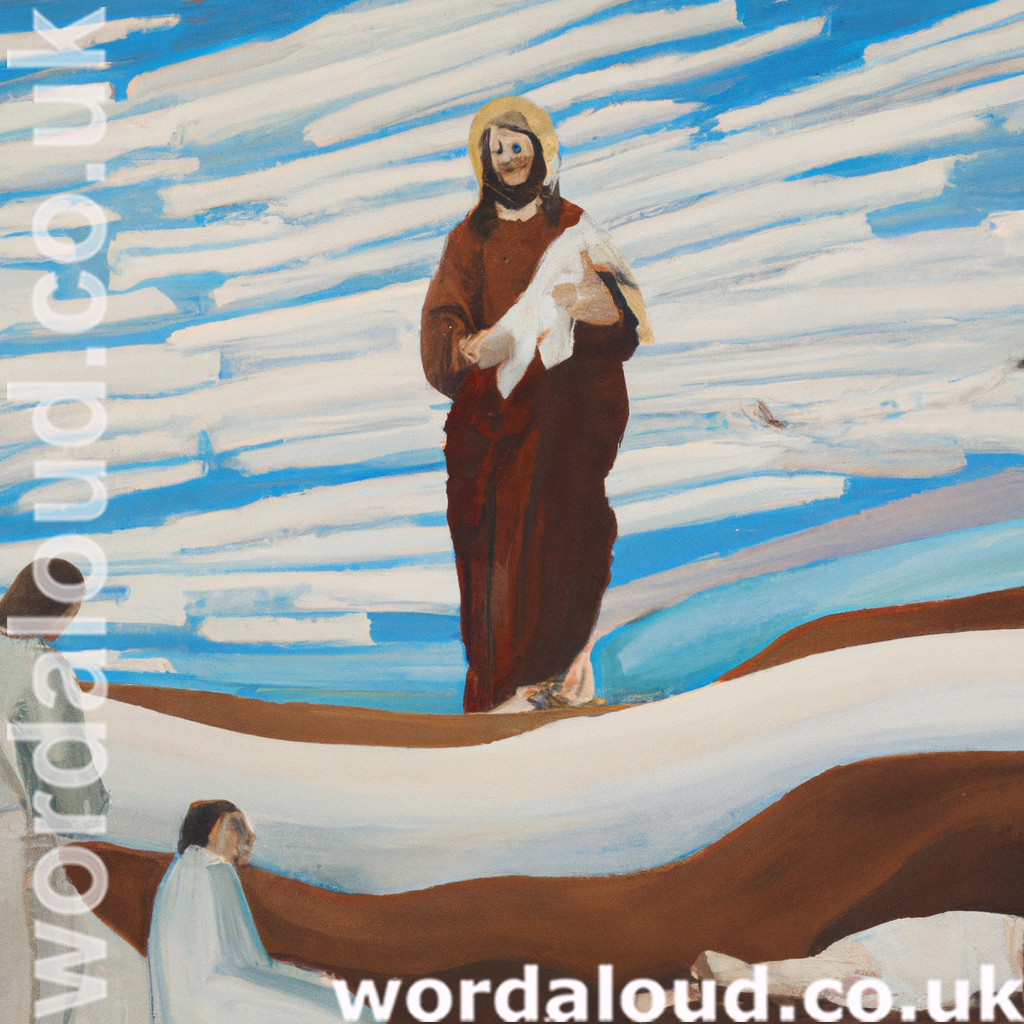
Christian Art | Jesus And The Jews Who Accuse Him
John 8: 51-59 – Lent Week 5, Thursday (Audio Bible, King James Version, Spoken Word)
51 Verily, verily, I say unto you, If a man keep my saying, he shall never see death.
52 Then said the Jews unto him, Now we know that thou hast a devil. Abraham is dead, and the prophets; and thou sayest, If a man keep my saying, he shall never taste of death.
53 Art thou greater than our father Abraham, which is dead? and the prophets are dead: whom makest thou thyself?
54 Jesus answered, If I honour myself, my honour is nothing: it is my Father that honoureth me; of whom ye say, that he is your God:
55 Yet ye have not known him; but I know him: and if I should say, I know him not, I shall be a liar like unto you: but I know him, and keep his saying.
56 Your father Abraham rejoiced to see my day: and he saw it, and was glad.
57 Then said the Jews unto him, Thou art not yet fifty years old, and hast thou seen Abraham?
58 Jesus said unto them, Verily, verily, I say unto you, Before Abraham was, I am.
59 Then took they up stones to cast at him: but Jesus hid himself, and went out of the temple, going through the midst of them, and so passed by.
The more we love God, the better we come to know him. Jesus continues to assert his knowledge of the Father, and too his eternal coexistence with the Father from before all time.
We are promised, if we believe in Jesus Christ, and if we keep his teachings, that we shall live with him forever. We shall share in the eternity he speaks of now.
Jesus tells the Jews that Abraham himself rejoiced in the promise of the Messiah to come. Now Jesus has come to fulfil this promise. Abraham took his son Isaac to be sacrificed at God’s command, and in so doing prefigured God’s offering of the Son. Jesus’ accusers now cannot see the ways in which the history of our salvation is becoming completed, that Abraham’s journey to the altar with his son was a shadow of the glorious reality of Christ’s incarnate presence and self-sacrifice.
Jesus, nevertheless, remains humble in the face of their accusations. He tells his people that he is not come to honour himself; it is his Father who honours him. Jesus is also clear that he has intimate and direct knowledge of God the Father, which others do not have, perhaps because, through internecine strife and external oppression, they have been drawn away from the true knowledge of the Law, of God, which was given to them, promised to them, and which is to be found in their hearts.
It is Jesus the rebel as well as the Son of God who has reclaimed this knowledge and is ready to teach it to all. Jesus has come to us with a new, saving message, which was inaccessible before his incarnation.
Still, Jesus’ people do not see how Jesus Christ, while incarnate, transcends all time. ‘Before Abraham was, I am.’ The Jews see blasphemy. They close their ears against what Jesus has to say. They seek to kill him now, to stone him to death. Jesus, however, is not yet ready to die. He passes through the midst of them. Their murderous desires are impotent. As the Jewish people were protected by God at the time of the Passover, so Jesus Christ now passes by.
For those who believe in Christ, who are reborn not from a perishable but from an imperishable seed through the Word of the living God, not from flesh but from water and the Holy Spirit, are finally established as “a chosen race, a royal priesthood, a holy nation, a purchased people, who in times past were not a people, but are now the people of God”.


Audio Bible KJV | King James Audio Bible | Endnotes
What Is The Nature Of Jesus’ I AM? | How Does Jesus Reveal Himself As God The Son?
John 8:51-59 is a pivotal moment in the Gospel of Saint John. Jesus boldly proclaims his divinity and challenges the religious authorities of his time. His words are not only a direct challenge to the religious leaders but also a challenge to Christians today to reexamine our understanding of God and the way we live our lives.
Jesus’ ‘I am’ equates himself with God using the same language that God used to reveal himself to Moses in Exodus 3:14. Jesus is making a radical claim about his own identity. He asserts that he is not just a prophet or a teacher but the very Son of God – God the Son.
Jesus’ use of the phrase ‘I am’ denotes that Jesus is the source of life and that his words have the power to give eternal life. This is radically contrary to the religious leaders of his time – and they were more concerned with following strict rules and regulations rather than cultivating a personal relationship with God – who is Jesus.
Jesus’ challenge to the religious authorities is a challenge to modernity. We can become so caught up in our own understanding of what is good that we fail to recognize that only God is truly good.
As Catholic theologian Hans Urs von Balthasar writes: ‘Only God is good and he alone can show us what is good. He alone can give us the power to do what is good, for only he is the source of life.’ (Credo) In other words, we must be willing to let go of our own preconceptions and allow God to guide us in our understanding of what is good and how we should live our lives – no matter that this may teach us in contrary fashion to all that we think we know.
This is particularly relevant during the season of Lent when we are called to examine our lives and turn away from sin. Jesus’ challenge in John 8:51-59 reminds us that true repentance and transformation can only come from a true and personal relationship with God – with Jesus. We cannot follow what we already know – our rules and regulations and expect to be transformed. We must be willing to let go of our own understanding and allow God to lead us in the way of righteousness.
Our Christian Life In Society
The challenge that Jesus presents in John 8:51-59 is not just about our understanding of God and our relationship with Him, but it is also about our relationship with others. Jesus is confronting the religious leaders who are more concerned with their own power and authority than with the well-being of the people they are supposed to serve. Jesus challenges the Temple authorities to see beyond their own interests and to truly care for the people.
As Catholic theologian Henri Nouwen writes: ‘The great mystery of the Gospel is that those who love God must also love their neighbors as themselves, that they must look at their neighbors with God’s eyes, and that they must love them with God’s love.’ (The Living Reminder) This is the radical revolution that Jesus is calling us to – a revolution of love and compassion that sees beyond ourselves and our own interests and sees the value and dignity of every person, no matter who they are.
This revolution of love requires us to let go of our own preconceptions and to allow God to transform us from the inside out. It requires us to be open to the Holy Spirit and to be willing to follow wherever God leads us. It requires us to be willing to be vulnerable and to embrace the suffering that comes with loving others.
As Protestant theologian Dietrich Bonhoeffer writes: ‘When Christ calls a man, he bids him come and die.’ (The Cost of Discipleship) This may sound harsh, but what Bonhoeffer is getting at is the idea that true discipleship requires us to let go of our own desires and to follow Christ no matter where he leads us, even if it means suffering and sacrifice.
Jesus And The Old Testament
In the Old Testament, we see numerous examples of God challenging the people to turn away from their own desires and to follow Him. One such example is in the book of Isaiah, where God declares: ‘For my thoughts are not your thoughts, neither are your ways my ways, saith the Lord.’ (Isaiah 55:8) This is a reminder that our human understanding is limited and flawed, and that we must be open to God’s wisdom and guidance.
In the book of Micah the prophet asks: ‘What does the Lord require of you but to do justice, and to love kindness, and to walk humbly with your God?’ (Micah 6:8) This is a call to action, a call to put aside our own desires and to work towards justice and kindness in the world, guided by God’s wisdom and love.
In Catholic theology, there is a concept known as ‘the imitation of Christ’, which involves striving to follow Christ’s example of selflessness and love. This requires us to let go of our own desires and to be willing to sacrifice for the sake of others, just as Christ did. As Saint Francis of Assisi once said: ‘It is in giving that we receive.’
In Protestant theology, there is a similar emphasis on following Christ’s example of selflessness and sacrifice. This is often referred to as ‘taking up the cross’, which involves embracing the suffering that comes with following Christ and putting aside our own desires for the sake of others.


- George Herbert | The Temple | The Church | The Church-Floore | Christian Poems | Metaphysical Poetry

The poem describes a metaphorical interior of a sacred space. This symbolizes a concept of the human heart as a temple built by God. Each element of the architecture serves as an allegory for spiritual virtues, struggles, and the divine influence in maintaining the integrity of the space. The poet weaves a contemplative vision that ties physical imagery to theological themes [ … ]

The first two chapters of the Gospel of Luke are more than history, as we now understand the term. The narrative captures core truths of the events which took place upon the birth of Jesus. They serve as a mirror in which we discover the meaning of the birth of Jesus and recognize that Jesus came to fulfil the promise of the Old Testament. They reflect the longing of the human heart as we find out about Jesus. To the Christians of Luke’s time, the infancy narrative of Luke’s Gospel offered a lesson in how to persevere in adversity as the Old Law gave way to the New. The attitude of Mary is a model to us all, as we welcome Jesus into our own lives. We marvel just as Joseph and Mary marvelled. Mary’s obedience teaches the way [ … ]
Christian Art | Parousia | Second Coming | Lamb Of God, You Take Away The Sins Of The World Luke 17: 26-37 (Audio Bible KJV, Spoken Word) Early Christian thought about the Parousia – the second coming – was largely influenced by the teachings of Jesus and the writings of Saint Paul. In the early Christian community, expectation of Christ’s return was strong, and many Christians believed that it would happen in their lifetime. This belief is evident in the New Testament, where the authors express a sense of urgency in their writings and encourage their readers to be prepared for Christ’s imminent return. As Christianity spread throughout the Roman Empire, the idea of the Parousia became more complex and nuanced. Theological debates arose around the nature of Christ’s return and the events that would precede it. Some theologians, such as Origen and Augustine, saw the Parousia as a spiritual event that was already happening in the Church. Others, such as the Montanists and the millenarians, believed in a literal, physical return of Christ and the establishment of a new, earthly Kingdom. In the Middle Ages, the Parousia was often associated with apocalypticism and the idea of a final, cataclysmic battle between good and evil – the last battle. The idea of the Antichrist, who would precede Christ’s return, became a popular theme in Christian literature, and the book of Revelation (Apocalypse – meaning to reveal, to uncover) was interpreted as a prophetic guide to the end of the world. Biblical Basis For The Parousia | The Second Coming The concept of the Parousia, or the Second Coming of Jesus Christ, is central to Christian eschatology and is supported by numerous biblical passages in both the Old and New Testaments. In the Old Testament, there are numerous passages that refer to the coming of a Messiah who will restore Israel and bring about the final judgment. For example, in Daniel 7:13-14, it is written: ‘I saw in the night visions, and, behold, one like the Son of man came with the clouds of heaven, and came to the Ancient of days, and they brought him near before him. And there was given him dominion, and glory, and a kingdom, that all people, nations, and languages, should serve him: his dominion is an everlasting dominion, which shall not pass away, and his kingdom that which shall not be destroyed.’ This passage describes a divine figure who comes in the clouds and is given dominion over all nations. In the New Testament, the Parousia is described in greater detail, particularly in the teachings of Jesus and the writings of Saint Paul. Jesus speaks of his return in many passages, including Matthew 24:30-31, where Jesus says: ‘And then shall appear the sign of the Son of man in heaven: and then shall all the tribes of the earth mourn, and they shall see the Son of man coming in the clouds of heaven with power and great glory. And he shall send his angels with a great sound of a trumpet, and they shall gather together his elect from the four winds, from one end of heaven to the other.’ Here, Jesus describes his return in power and glory, accompanied by angels who gather Jesus’ elect from all over the world. In Saint Paul’s letters, the Parousia is also described in detail. In 1 Thessalonians 4:16-17, Saint Paul writes: ‘For the Lord himself shall descend from heaven with a shout, with the voice of the archangel, and with the trump of God: and the dead in Christ shall rise first: Then we which are alive and remain shall be caught up together with them in the clouds, to meet the Lord in the air: and so shall we ever be with the Lord.’ This passage describes a resurrection of the dead and the gathering of believers to meet the Lord Jesus in the air. The language and imagery used to describe the Parousia are often dramatic and apocalyptic in nature. The Parousia is often described as a time of judgment, when the righteous will be separated from the wicked, and God’s justice will be fully revealed. The imagery of clouds, trumpets, and angels is used to depict the power and glory of Christ’s return. Theological Interpretations Of The Parousia | Jesus’ Second Coming The concept of the Parousia has been interpreted in a variety of ways throughout Christian history. Dispensationalism Dispensationalism is a theological framework that emerged in the 19th Century and has since become popular among some evangelical and fundamentalist Christians. Dispensationalists believe that history is divided into distinct periods or ‘dispensations’, each of which is marked by a particular mode of divine revelation and a specific plan of salvation. According to dispensationalist theology, the Parousia will be preceded by a period of tribulation, during which the Antichrist will establish a one-world government and the Jews will be restored to their homeland. The Parousia itself will involve a physical, visible return of Christ, who will establish a thousand-year reign on earth before the final judgment. Preterism Preterism is a theological interpretation of the Parousia that holds that many of the prophecies in the New Testament, particularly those in the book of Revelation, were fulfilled in the first century AD. According to this view, the Parousia occurred in a spiritual sense when Christ ascended to heaven and sent the Holy Spirit to empower the Church. Preterists argue that the tribulation and other end-time events predicted in the New Testament were fulfilled in the destruction of the Temple in Jerusalem in AD 70. Postmillennialism Postmillennialism is a theological view that holds that the Parousia will occur after a period of history in which the Church will gradually bring about the kingdom of God on earth. According to this view, the Church will spread the gospel throughout the world, and social, political, and economic conditions will gradually improve. Eventually, Christ will return to a world that has been largely transformed by the Gospel. Amillennialism […]