Loading...
Daily Bible Verses | The Gospel Of Saint MatthewDaily Bible Verses For Advent & Christmas

Daily Bible Verses For Advent | Christian Faith | Prayer | Jesus Teaching in the Temple | By What Authority? | King James Audio Bible KJV | Love Revealed By Jesus Christ

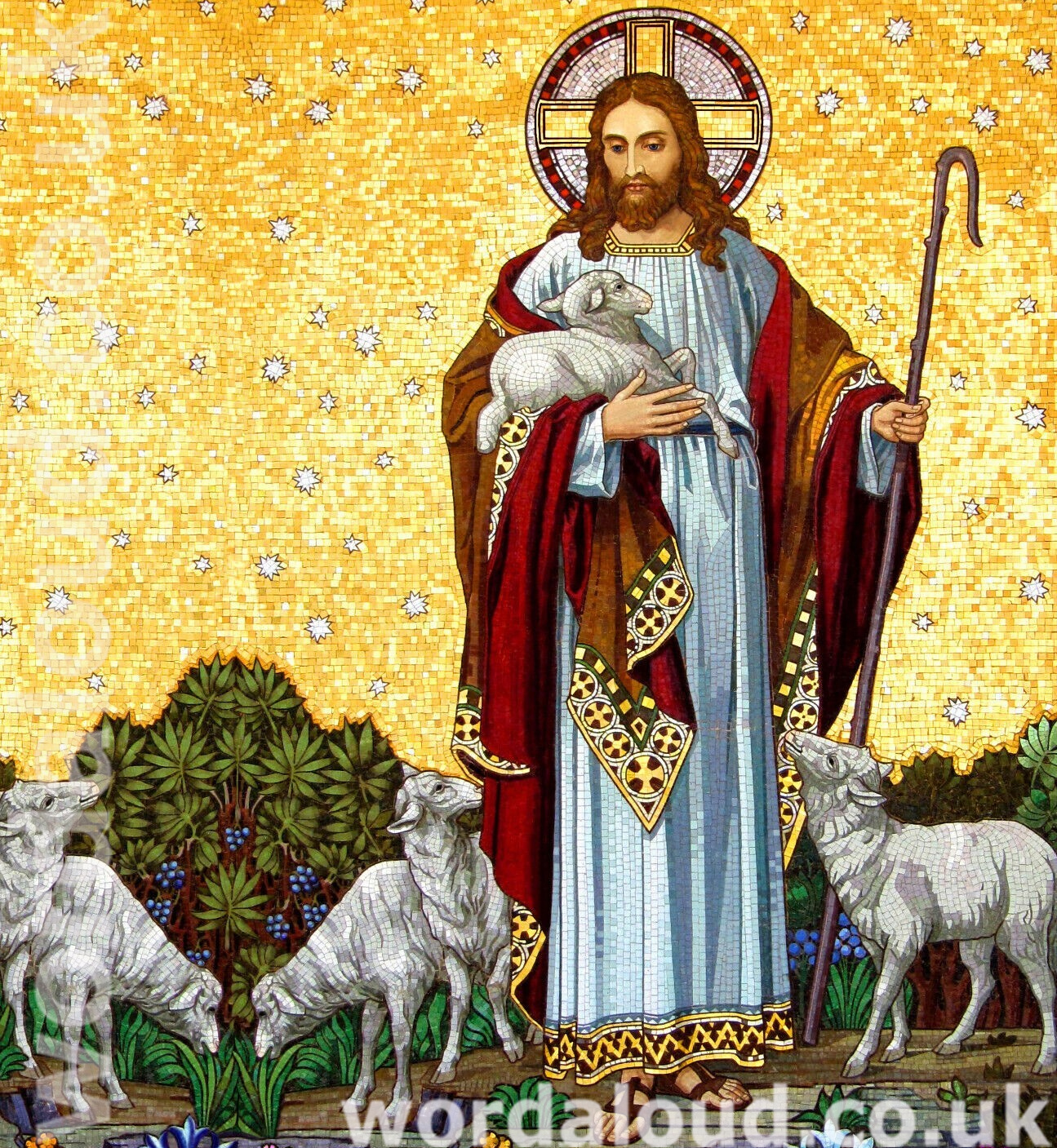
Audio Bible | Parable Of The Good Shepherd | Oliver Peers
Christian Art | King James Audio Bible KJV | Daily Bible Verses Advent
Matthew 21: 23-27 | King James Audio Bible KJV | Daily Bible Verses Advent | Love Revealed By Jesus Christ

23 ¶ And when he was come into the temple, the chief priests and the elders of the people came unto him as he was teaching, and said, By what authority doest thou these things? and who gave thee this authority?
24 And Jesus answered and said unto them, I also will ask you one thing, which if ye tell me, I in like wise will tell you by what authority I do these things.
25 The baptism of John, whence was it? from heaven, or of men? And they reasoned with themselves, saying, If we shall say, From heaven; he will say unto us, Why did ye not then believe him?
26 But if we shall say, Of men; we fear the people; for all hold John as a prophet.
27 And they answered Jesus, and said, We cannot tell. And he said unto them, Neither tell I you by what authority I do these things.

Today’s verses hold a message for those early Christians of the time when the Gospel was being written. Those Christians faced persecution at the hands of the Roman authority. It would have been reassuring for them to hear of how Jesus challenged authority, helping them to find the courage to keep their faith.

Christ has cleansed the Temple, driving out the money changers and the salesmen, and he has healed and taught in the Temple. The chief priests and the elders do not seek to try to understand what is happening. They do not ask what is the meaning of Jesus’ actions; rather their concern in for authority.

The chief priests and the elders are presented once again as false shepherds, who feed themselves and neglect their sheep, only being concerned for their own interests and not for the spiritual wellbeing of their flock. Their authority is threatened by Jesus, and this is their motivation as they ask: ‘By what authority doest thou these things?’

Jesus turns the question around to become a challenge to his accusers. He knows that John the Baptist’s authority came from God – Jesus himself went to be baptized by John. The Jewish authorities have previously shunned John, seeing him too as a threat.

They cannot answer Jesus’ question, again because of their concern for maintaining their position. They cannot say from God, because this will excuse their error in their attitude to John. They cannot say ‘of men’ because this would turn the people against them.

The chief priests and the elders are trapped in a false position they have set up for themselves, and which Jesus has now exposed. They cannot respond with honesty to Jesus. Their worldly concerns preclude a way to the truth.

See also: Mark 11: 27-33 – Week 8 Ordinary Time, Saturday.

Almighty God, give your people grace to enter on the way of salvation. As they hearken to the voice of John, the Lord’s herald, bring them safely to Jesus, whom John foretold.

Jesus Prayer | Lost Sheep Of Israel | Prayer For Those Who Stray | Christian Faith | Gospel

King James Audio Bible | Endnotes

We may be always inspired by the teachings of Jesus of Nazareth, as here in Jesus’ interactions in the Temple. This moment of the Gospel of Matthew depicts Jesus teaching in the temple and facing opposition from the religious leaders of his time.

Jesus was known for his powerful sermons and also the use of parables to convey important messages to his followers. Jesus taught the importance of faith and obedience to God, and emphasized the need for a life of love and service to others. We may recall in these verses of the Bible the Sermon on the Mount, where Jesus taught a new path of salvation – far and away removed from religious orthodoxy.

In this instance in the Temple, religious leaders of the Temple ask Jesus for proof of his authority to teach. Jesus responds in a sense with a parable – from the Greek parabole, an analogy or comparison, to throw beside – asking them about the baptism of John the Baptist. This parable was a powerful reminder that faith and obedience to God must be at the forefront of our lives, and that we must be willing to recognize and follow the guidance of those who have been called by God to lead us.

As Christians, we reflect on the teachings of Jesus and strive to embody Jesus’ message in our daily lives. We find comfort and guidance in the words Jesus spoke, and in the examples Jesus set through his life and ministry. Just as Jesus faced opposition in the Temple, we too may face challenges and obstacles as we seek to live out our faith. Just as Jesus persevered, even unto his final hours in the Garden of Gethsemane, so too we remain steadfast in our commitment to serving God and following in his footsteps.


Meditations On The Love Of Jesus Christ | Word Aloud | Prayer And Reflection
  • Audio KJV Bible | Jesus | Scribes, Pharisees | Jewish Temple | Oliver Peers | Hypocrites

    Today’s Gospel verses continue Jesus’ stinging critique of the hypocrisy of the Pharisees. Jesus condemns the Pharisees’ conduct, threatening them with punishment – ‘Woe unto you!’ – if they do not repent and mend their ways. Having over the centuries acquired a degree of power in Jerusalem, the Pharisees now abuse that power. Greedy for honour and recognition as they are, their show of great virtue is merely that, a show, while in essence they live in gross discordance with the truth of God [ … ]

  • A Bishop’s Lenten Homily | Jesus & Lazarus | Oliver Peers

    ‘Death,’ says His Grace, ‘throws it all apart. For we are not as we should be. Faith requires our adjustment to God’s truth. God’s triumph in a very real sense requires in us the loss of our everything. Which, as with Mary at the other end of Jesus’s life, is God’s truth.’ The Gospel reading is of John 11: 1-45, which is a long passage, and His Grace’s homiletic theme commences in textual wilderness. Our brokenness – in this place – a family home. Our faith, our doubt, our death… The irruption – death, doubt, fear – within our precious scenes and our most intimate places. Our domesticity. His Grace speaks from the chair, as is a bishop’s prerogative, and says: ‘So much is obscure in the Gospels. We’re always reaching through them. We’re never there. Really, we never are. Our knowledge, our understanding, of the Gospels is never complete, and with each reading comes a new revelation. There are always new riches there. Just as there are between all of us, between myself and you. The Gospels are living texts. This is a part of the conversation we have with our own Christianity. It is a part of who we are in our relationship with Jesus. We are in this sense always on the brink. ‘So yes, there is plenty that doesn’t seem to make sense. As one of the order of bishops, we would be lying if we said that weren’t the case. They are not easy texts to encounter, if by that word we may signify something more than a superficial glancing off against, but rather a profound search for the word of God. The Gospels are written by people who had their own ideas, and often didn’t know what had really happened. Luke is quite explicit on this point. His is an investigation, from the explicitly claimed point of view of an historian, rather than that of a first-hand witness, who attempts, so he says, to set out an orderly account, out of the chaos, the sheer muddle, that has been handed down to him. It is possible to imagine Luke researching and composing his account after many years, when there has arisen a desire to know what exactly happened, and this implies a certain call to faith and certain demands of historicity, to historical exactitude. So in these different ways, the people of the first years of Christian faith are in the dark. There is also a decisive need to define the life of Jesus. And people didn’t get Jesus. The whole meaning of Christianity is only now beginning to take root throughout the composition. So much needs to be evangelized. The light shines almost in tentative fashion like that first star, which drew the wise men from the east to our Lord’s cradle. ‘John’s is widely held to be a very late Gospel. There are others who say that John’s Gospel might have been the first to acquire its true shape, because it most fully expresses Jesus, as we know him to be, as members of the Catholic Church. We don’t really know when any of this is being written, but we get a feel in John of a Gospel refined over many years, through a community. So there’s a lot going on there that I’d like you to think about. ‘What I would like to suggest to you is that, while within the Gospels we are often confronted with clues, guesswork, stories that have been handed down through so many people, and so in this sense we might find ourselves to be in the wilderness, this is the very desolate space itself to which we must give ourselves in order to experience Christ’s full redemption in our lives. I suggest it is for God’s glory that we do so. ‘As we become aware of ourselves, in this seminary, we find ourselves in a very secure, comfortable setting, and there are signs of Easter everywhere. Within the very fabric of these buildings, our Lord is risen; our Lord lives. But now this is our Lenten journey, where death enters, where death breaks us. We are to ride into Jerusalem in triumph, and then we are to be utterly broken, all hope gone, our hope extinguished. And really, I suggest to you, it is only by inhabiting this thought, as if we don’t know Easter is there, that our new life can follow, just when we have given up all hope, when every promise that Jesus made to us seems to have been cancelled. ‘And here now we have the story of Lazarus. I should like to suggest to you that we have a very powerful call now. In our very comfortable space, our domesticity, with all this comfort, where so very little might seem to happen each day, so it might seem to you, there is a disturbance within all of this comfort, and that is a disturbance within ourselves, and that is our call to Jesus. I think it is correct to say that our most comfortable places break in the light of Jesus from the inside, in order that we may take the necessary steps to be with Jesus. ‘Faith is not comfortable. I think that we can all receive the message of the rolling away of the rock from the tomb of Lazarus to say something of vital importance to ourselves concerning our openness to God’s love. The rock we roll away can come in all sorts of guises, but we know when we are blocked, and I firmly believe if we are truthful then we know where those blocks might be. ‘Next Sunday, which will be Palm Sunday, we process as it were to Jerusalem, to begin our Holy Week. Now as I speak to you we are on the brink. Even now, I suggest it might be very good for all of us to lay aside what we think we know, to fall apart a little, and so […]

  • Audio Bible KJV Oliver Peers | Nativity | Date Christmas

    As Christians, we celebrate the birth of Jesus on Christmas Day, observed on December 25th each year. While the date of Jesus’ birth is not known, and is not in the Bible, the celebration of Christmas Day on December 25th has been a tradition since at least the 4th century. It is thought that the early Christian church may have chosen this date in order to co-opt the celebrations of the winter solstice and other pre-Christian holidays that were observed around this time of year [ … ]

Search Google Here | A Holy Land Jerusalem Pilgrimage? | A Safari? | An Escape..