
Luke 9: 22-25 – Thursday after Ash Wednesday (Audio Bible, Spoken Word)
21 And he straitly charged them, and commanded them to tell no man that thing;
22 Saying, The Son of man must suffer many things, and be rejected of the elders and chief priests and scribes, and be slain, and be raised the third day.
23 ¶ And he said to them all, If any man will come after me, let him deny himself, and take up his cross daily, and follow me.
24 For whosoever will save his life shall lose it: but whosoever will lose his life for my sake, the same shall save it.
25 For what is a man advantaged, if he gain the whole world, and lose himself, or be cast away?
Jesus orders his disciples to keep his true identity, as the Messiah, a secret. We might wonder why this should be. One answer to this is that many of the people of whom we read in the Bible were hoping for and expecting the coming of the Messiah, who would lead the Jewish people to freedom, and yet their expectation – of a new judge or great warrior king – was not in accord with Christ’s true purpose, namely to serve and to suffer and so to save.
Jesus foretells his suffering and his death and resurrection. By doing so he helps his disciples to believe in him. He also shows how he freely accepts the sufferings to come. Christ’s complete self-sacrifice is voluntary.
We recall the words of the prophet Isaiah (53:1-9):
1 Who hath believed our report? and to whom is the arm of the LORD revealed?
2 For he shall grow up before him as a tender plant, and as a root out of a dry ground: he hath no form nor comeliness; and when we shall see him, there is no beauty that we should desire him.
3 He is despised and rejected of men; a man of sorrows, and acquainted with grief: and we hid as it were our faces from him; he was despised, and we esteemed him not.
4 ¶ Surely he hath borne our griefs, and carried our sorrows: yet we did esteem him stricken, smitten of God, and afflicted.
5 But he was wounded for our transgressions, he was bruised for our iniquities: the chastisement of our peace was upon him; and with his stripes we are healed.
6 All we like sheep have gone astray; we have turned every one to his own way; and the LORD hath laid on him the iniquity of us all.
7 He was oppressed, and he was afflicted, yet he opened not his mouth: he is brought as a lamb to the slaughter, and as a sheep before her shearers is dumb, so he openeth not his mouth.
8 He was taken from prison and from judgment: and who shall declare his generation? for he was cut off out of the land of the living: for the transgression of my people was he stricken.
9 And he made his grave with the wicked, and with the rich in his death; because he had done no violence, neither was any deceit in his mouth.
Jesus teaches self-denial. Should we wish to be with Christ we must take up our cross daily to follow him. We are called to deny what we used to be and confess our rebirth in Christ. Our denial may be of wilfulness, conceit or fleshy pleasures, perhaps criticism of others or complaint about our own situation – really anything, any sin, that comes between us and the perfection we long for and which Christ represents.
We are taught to do everything with a view to our eternal life. This is the reward that renders earthly riches and earthly pleasures of no consequence. Our salvation is imminent. We are called to be worthy of Christ when he comes again in glory. We are to take up our cross each and every day and follow him.
‘Certainly it is true that the water of rebirth initially brings about our new life of grace, but for all of us it remains necessary to struggle every day against the rust of our earthly nature… All of us must strive hard and so on Easter day no one should remain bound by the vices of his former nature… These forty days, instituted by the apostles, should be given over to fasting which means, not simply a reduction in our food, but the elimination of our evil habits.’ Pope St Leo the Great
Audio Bible KJV | Endnotes
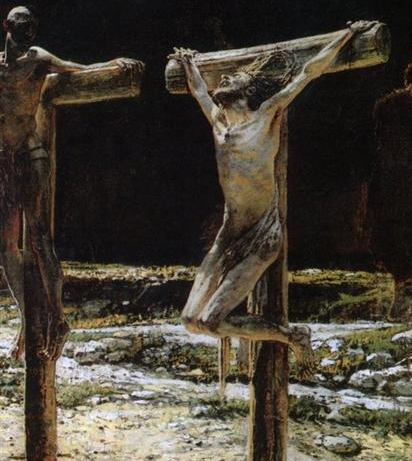
What does it mean: ‘Take up your Cross and follow me’?
The passage emphasizes the centrality of Jesus’ suffering and death in his mission. Jesus predicts that he will ‘suffer many things, and be rejected of the elders and chief priests and scribes, and be slain, and be raised the third day’ (Luke 9:22, KJV), highlighting the sacrificial nature of his mission and the importance of his death and resurrection.
The command to take up one’s Cross is a powerful metaphor for discipleship. In Jesus’ time, the Cross was a symbol of death and humiliation, used to execute criminals and political rebels. By asking his followers to take up their Cross and follow him, Jesus is asking them to accept the reality of their own suffering and potential persecution for their faith. This call to self-denial and sacrifice is a fundamental aspect of Christian discipleship, emphasizing the importance of living a life of service to others and prioritizing one’s relationship with God above all else.
The passage highlights the importance of faith over worldly pursuits. Jesus asks: ‘For what is a man advantaged, if he gain the whole world, and lose himself, or be cast away?’ (Luke 9:25, KJV) This emphasizes the fleeting nature of worldly wealth and power and the need to prioritize one’s faith over material possessions or social status. In this way, the passage encourages Christians to seek a deeper, more meaningful purpose in life, rooted in their relationship with God.




Saint Columban (c. 543–615) was an Irish monk and missionary whose work helped to shape early medieval monasticism in continental Europe. His writings, including sermons and monastic rules, reveal a spirituality that is both ascetic and deeply scriptural. The passage we have today develops a theme central to his teaching: the inexhaustible desire for Christ as the fountain of life and bread of life [ … ]

The poem emphasizes universality and inclusivity of divine worship, suggesting that the entire world resounds with praise for God. The refrain, ‘Let all the world in every corner sing, / My God and King,’ creates a communal call to worship through the poem [ … ]
Psalm 26 declares innocence and an earnest request for divine scrutiny and vindication. It represents a heartfelt commitment to living a life characterized by integrity and righteousness as perceived by the Lord [ … ]
