
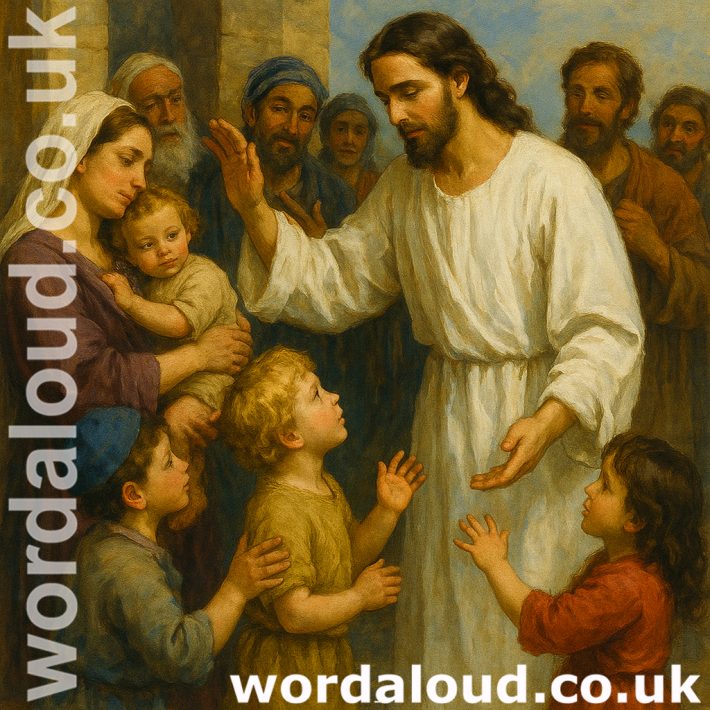
Christian Art | Jesus With The Little Children | Blessings In Jesus Christ
Office Of Readings | Week 12, Friday, Ordinary Time | A Reading From The Homilies Of Saint Gregory Of Nyssa On The Beatitudes | The Hope Of Seeing God
‘The hope of seeing God.’
Saint Gregory of Nyssa, of the great Cappadocian Fathers, offers a profound meditation on the beatific vision—the promise that the pure in heart shall see God. His homily explores not only the depth of this promise but the existential and theological tension between divine transcendence and human limitation. As a mystic and theologian, Gregory challenges us to move beyond despair at our weaknesses and embrace the hope made possible by grace.
Hope Of Seeing God | Historical And Theological Context
Saint Gregory lived during the fourth century, a time when Christianity was emerging as the dominant religion in the Roman Empire. Deeply influenced by Platonic philosophy and Origenist theology, he developed a spiritual theology focused on the soul’s ascent to God, characterised by perpetual growth in holiness (epektasis). Gregory’s interpretation of the Beatitudes is part of this larger theological framework, particularly his notion that union with God is a never-ending journey into infinite goodness.
In his homily on the Beatitudes, Gregory addresses the sixth beatitude: ‘Blessed are the pure in heart, for they shall see God.’ (Matthew 5:8) This becomes the lens through which he examines the Christian life’s ultimate goal.
Key Themes Of Saint Gregory’s Homily
- Seeing as Possession
Gregory equates seeing with possessing. To see God is to possess every good thing—immortality, joy, light, peace, and fullness of being. This is a deeply biblical view, drawing on Semitic notions where ‘seeing’ implies intimate participation (cf. Psalm 128:5). For Gregory, the beatific vision is not mere observation, but transformative communion.
- The Paradox of Divine Invisibility
Gregory confronts a paradox: if Scripture says that no one can see God (cf. John 1:18; 1 Timothy 6:16), how can Christ promise the vision of God to the pure in heart? He likens the challenge to standing on a mountain peak and looking into a dizzying abyss—our finite minds reel at the mystery. Yet this apparent impossibility becomes the occasion for faith and hope.
Gregory affirms that God is by nature invisible and unknowable in essence. However, God reveals Himself in ways accessible to the purified soul. Thus, the vision of God is not a static glimpse but a participation in divine life that continually deepens.
- Purity as the Condition for Vision
Gregory anchors the promise of the beatitude in moral and spiritual purity. The pure in heart are not those without sin, but those who are continually cleansed and conformed to God through repentance, humility, and love. This purity aligns the soul with Christ, the true image of the invisible God (Colossians 1:15).
This is not moral perfectionism but relational fidelity—a lifelong process of being purified by divine grace. The purification of heart involves detachment from passions, egotism, and worldly desires that obscure the vision of God.
- Hope, Not Despair
Although Gregory expresses his own sense of awe and smallness before the mystery, he does not fall into despair. He reminds the reader that Christ would not command the impossible. God’s commands always come with grace sufficient to fulfil them. If the vision of God were truly beyond human capacity, Christ would not invite us to seek it.
The examples of Moses, Paul, and John confirm this. Though they confess the unseeable nature of God, they also stand as witnesses to profound intimacy with Him. Their vision may not be full in this life, but it is real and transformative. Gregory therefore calls us not to hopelessness but to perseverance.
Contemporary Relevance | Jesus Christ Today
The vision of God is not an abstract promise but the very goal of our existence. It is the promise that love will be fulfilled, that desire will be satisfied, and that rest will be found in the eternal light of the Trinity. Gregory of Nyssa’s homily calls us to walk this path with courage, knowing that the One who invites us will also accompany and complete the work He began in us.
‘Blessed are the pure in heart, for they shall see God.’ This is not only a future hope but a present transformation.
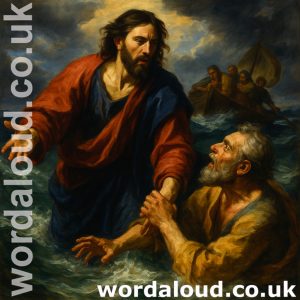
A Reading From The Homilies Of Saint Gregory Of Nyssa On The Beatitudes | The Hope Of Seeing God
The happiness God promises certainly knows no limits. When one has gained such a blessing, what is left to desire? In seeing God one possesses all things. In the language of Scripture, to see is to have. May you see the good things of Jerusalem is the same as May you possess the good things of Jerusalem. When the prophet says: May the wicked man be carried off and not see the glory of the Lord, he means: May he not share in the glory of the Lord.
One who has seen God has, in the act of seeing, gained all that is counted good: life without end, everlasting freedom from decay, undying happiness, a kingdom that has no end, lasting joy, true light, a voice to sing pleasingly in the spirit, unapproachable glory, perpetual rejoicing, in a word, the totality of blessing.
Such is the wonderful hope held out by the beatitudes. As we have seen, the condition for seeing God is purity of heart, and now once more my mind is in confusion, as from an attack of giddiness, wondering if purity of heart is something impossible, something beyond the capacity of human nature. If the vision of God is dependent on purity of heart, and if Moses and Paul did not attain this vision – they state that neither they nor anyone else can see God – then the promise of the beatitude spoken by the Word seems to be something impossible of realization.
What do we gain from knowing the means by which God may be seen if we have not the power to see him? It is like saying that one is blessed if one is in heaven because in heaven things are seen that are not seen on earth. If we were told beforehand how to get to heaven, it would be helpful to know that one is blessed if one is in heaven. But as long as the way to heaven is impossible what do we gain by knowing about the happiness of heaven? This only saddens and annoys us when we realize the good things we are deprived of, because it is impossible to get there.
Surely the Lord does not encourage us to do something impossible to human nature because the magnitude of what he commands is beyond the reach of our human strength? The truth is different. He does not command those creatures to whom he has not given wings to become birds, nor those to whom he has assigned a life on land to live in water. If then in the case of all other creatures the command is according to the capacity of those who receive it, and does not oblige them to anything beyond their nature, we shall come to the conclusion that we are not to give up hope of gaining what is promised by the beatitude. John and Paul and Moses, then, and any others like them, did not fail to achieve that sublime happiness that comes from the vision of God; not Paul, who said: There is stored up for me a crown of righteousness, which the judge who judges justly will give me, nor John, who leaned on the breast of Jesus, nor Moses, who heard God saying to him, I know you above all others.
If it is clear that those who taught that the contemplation of God was beyond their powers are themselves blessed, and if blessedness consists in the vision of God and is granted to the pure in heart, then purity of heart, leading to blessedness, is certainly not among the things that are impossible.
Hence it can be said that those who with Paul teach that the vision of God is beyond our powers are right in what they say, and that the voice of the Lord does not contradict them when he promises that the pure in heart will see God.
Prayer With Jesus
O God of Light and Life,
You have promised the vision of Your face to the pure in heart.
Cleanse our thoughts, purify our desires, and align our lives with the image of Your Son.
Let us never lose heart in the struggle toward holiness,
but strengthen us with the hope of beholding You.
May we hunger for the day when we shall see You as You are,
and dwell forever in Your glory.
Through Christ our Lord. Amen.
Glossary Of Christian Terms
- Beatific vision: The direct, intuitive vision of God enjoyed by the blessed in heaven.
- Purity of heart: Inner cleansing from sin and passions, enabling spiritual perception.
- Epektasis: Gregory of Nyssa’s term for the soul’s eternal progress into God’s infinite goodness.
- Transcendence: The attribute of God being above and beyond creation.
- Contemplation: The prayerful vision of God, especially through love and silence.
- Image of God: A theological concept that human beings are created in God’s likeness, capable of communion with Him.
- Mystical theology: A branch of theology dealing with the soul’s union with God through contemplation.
- Theosis: The process of becoming partakers of the divine nature (2 Peter 1:4); deification.
- Passion: In patristic theology, disordered desires or emotions that hinder the soul’s union with God.
- Cappadocian Fathers: Gregory of Nyssa, his brother Basil the Great, and Gregory Nazianzen—early theologians who shaped Trinitarian doctrine.




The poem presents an image of a fallen soldier in the snow, as his comrades try to move him into the sun in hopes of reviving him. This act becomes a metaphor for futile efforts of better-humanity to counteract ridiculous war and death. The poem juxtaposes the soldier’s past experiences of the sun’s warmth and life-giving qualities with the current reality of his lifeless state, highlighting stark contrast [ … ]
This reading is drawn from one of the Festal Letters of Saint Athanasius of Alexandria (c. 296–373). Each year, the bishop of Alexandria would issue a letter announcing the date of Easter and offering reflections on its theological and spiritual meaning. These letters were deeply pastoral in tone and also rich in doctrinal teaching, reinforcing central truths of Christian faith [ … ]
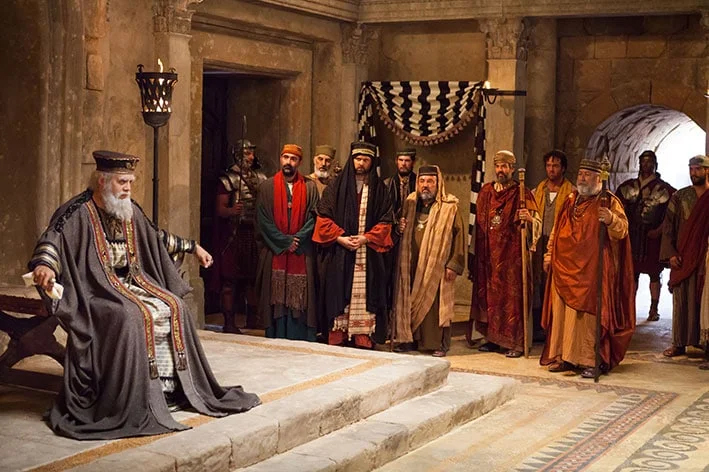
King James Audio Bible | KJV | King James Version King Herod There were several individuals named Herod who played significant roles in ancient history, particularly in the history of the Roman Empire and the region of Palestine. Here is a brief overview of the most notable Herods: Herod the Great: Also known as Herod I, he was a Roman client king of Judea, ruling from 37 BC to 4 BC. He is perhaps most famous for his role in the biblical story of the birth of Jesus, in which it is said that he ordered the slaughter of all male children in Bethlehem under the age of two in an attempt to kill the newborn Jesus. Herod Antipas: Also known as Herod II, he was the son of Herod the Great and ruled over Galilee and Perea, two regions in Palestine, from 4 BC to 39 AD. He is mentioned in the New Testament as the ruler who imprisoned John the Baptist and later had him beheaded. Herod Agrippa I: Also known as Herod III, he was the grandson of Herod the Great and ruled over Judea from 41 to 44 AD. He is mentioned in the New Testament as the ruler who imprisoned the apostle Paul. Herod Agrippa II: Also known as Herod IV, he was the great-grandson of Herod the Great and ruled over parts of Palestine and Syria from 50 to 100 AD. He is mentioned in the New Testament as the ruler who heard Paul’s defence before the Roman governor Festus. These rulers, who were known as the Herodian dynasty, were not Jewish but rather descended from a Greek family that had converted to Judaism. Despite this, they were appointed as rulers by the Roman Empire and were generally unpopular among the Jewish population due to their collaboration with the Roman occupation and their often brutal methods of rule. Herod The Great Herod the Great, also known as Herod I, was a Roman client king of Judea who ruled from 37 BC to 4 BC. He was born in 73 BC in Idumea, a region in southern Palestine, and was the son of Antipater the Idumean, an Edomite who had been appointed as a governor of Judea by the Roman general Pompey. Herod rose to power after the Roman general Julius Caesar appointed him as king of Judea in 40 BC. He consolidated his power over the next few years by defeating his rivals and establishing himself as the undisputed ruler of the region. As king, Herod embarked on a massive building program that included the expansion and renovation of the Temple in Jerusalem, the construction of the port city of Caesarea Maritima, and the fortification of several cities in Judea. He also commissioned the construction of a number of palaces and other buildings, including the famous Herodium, a palace-fortress located south of Jerusalem. Despite his many accomplishments, Herod was a controversial figure who was known for his harsh rule and his willingness to use violence to maintain his power. He was married several times and had a large number of children, several of whom he had executed when they posed a threat to his rule. One of the most famous stories associated with Herod is the biblical account of the birth of Jesus, in which it is said that he ordered the slaughter of all male children in Bethlehem under the age of two in an attempt to kill the newborn Jesus. According to the New Testament, Jesus was saved by his parents, who fled to Egypt, and later returned to Palestine after Herod’s death. Herod died in 4 BC at the age of 70, leaving a legacy as one of the most significant rulers in the history of ancient Palestine. Herod Antipas Herod Antipas, also known as Herod II, was the son of Herod the Great and ruled over Galilee and Perea, two regions in Palestine, from 4 BC to 39 AD. He was born in 20 BC and was named after his father’s patron, the Roman emperor Augustus. Like his father, Herod Antipas was known for his ambitious building projects, including the construction of the city of Tiberias on the Sea of Galilee and the expansion of the Temple in Jerusalem. He was also known for his political cunning and his ability to navigate the complex political landscape of the Roman Empire. Herod Antipas is mentioned in the New Testament as the ruler who imprisoned John the Baptist, a prominent religious figure who criticized Herod’s marriage to his sister-in-law, Herodias. According to the New Testament, John was eventually beheaded at the request of Herodias’ daughter, Salome, who danced for Herod and his guests at a banquet. Herod Antipas is also mentioned in the New Testament as the ruler who oversaw the trial and execution of Jesus. Although he initially wanted to release Jesus, he ultimately handed him over to the Roman authorities at the urging of the Jewish religious leaders. Herod Antipas’ rule came to an end in 39 AD when the Roman emperor Caligula exiled him to Gaul, modern-day France. He died in exile a few years later. Herod Agrippa I Herod Agrippa I, also known as Herod III, was the grandson of Herod the Great and ruled over Judea from 41 to 44 AD. He was born in 10 BC and was the son of Aristobulus and Bernice, two of Herod the Great’s children. Herod Agrippa I was well-educated and fluent in both Greek and Hebrew, and he was highly regarded by the Roman authorities for his loyalty and his ability to maintain order in Judea. He was appointed as king of Judea in 41 AD by the Roman emperor Claudius, who was impressed by his abilities and saw him as a reliable ally in the region. As king, Herod Agrippa I continued the building projects of his grandfather and expanded the Temple in Jerusalem. He also implemented a number of reforms aimed at improving the lives of the […]
