
Christian Art | George Herbert | The Temple | The Church | The Temper (2)
George Herbert | The Temple | The Church | The Temper (2)
It cannot be. Where is that mightie joy,
Which just now took up all my heart?
Lord, if thou must needs use thy dart,
Save that, and me; or sin for both destroy.
The grosser world stands to thy word and art;
But thy diviner world of grace
Thou suddenly dost raise and race,
And ev’ry day a new Creatour art.
O fix thy chair of grace, that all my powers
May also fix their reverence:
For when thou dost depart from hence,
They grow unruly, and sit in thy bowers.
Scatter, or binde them all to bend to thee:
Though elements change, and heaven move,
Let not thy higher Court remove,
But keep a standing Majestie in me

George Herbert | The Temple | The Church | The Temper (2)
The poem explores themes of divine presence, spiritual longing, and human instability. The poem opens with a stark reflection on the transient nature of spiritual joy and the sudden void that follows when such joy is absent. Herbert questions the disappearance of an overwhelming sense of divine joy that had recently consumed his heart, seeking an explanation or resolution from God. This inquiry sets the stage for a meditation on the balance between divine grace and human imperfection.
Herbert acknowledges the constancy of the material world, which aligns with God’s creative word and art. In contrast, the ‘diviner world of grace’ is described as subject to sudden change, as God continually renews and reconstructs it, portraying God as an active, daily Creator. This duality highlights tension between the enduring, visible world and a more fluid, spiritual realm, suggesting that while physical existence remains steady, spiritual experiences fluctuate.
The poem shifts to a plea for stability, Herbert asking God to ‘fix [His] chair of grace’, a metaphor for establishing a constant divine presence. The poet desires his faculties—emotions, thoughts, and actions—to be anchored in reverence for God. An absence of divine stability leads to disorder, where these faculties become unruly, indulging in their own pursuits without divine guidance. The metaphor of these powers ‘sitting in [God’s] bowers’ suggests complacency or distraction, emphasizing need for divine authority to keep Herbert’s inner world ordered and devoted.
The final stanza calls for a divine intervention to unify Herbert’s scattered energies and align them with God’s will. The use of the words ‘scatter’ and ‘bind’ reflects the push and pull between chaos and discipline. The poet notes that while natural elements and even the heavens may change or move, they implore God’s ‘higher Court’—a symbol of divine judgment and grace—not to shift or withdraw. The desire is for God’s majesty to remain constant within, ensuring a stable source of spiritual grounding.
The poem’s structure underscores a progression of themes from a question of lost spiritual joy to a petition for divine steadiness. Juxtaposition of divine permanence and human variability is reinforced throughout, suggesting that only God’s enduring presence can mitigate the unpredictability of human experience. Imagery of God as Creator and sustainer reflects the theological idea of continual divine involvement in both the physical and spiritual realms.
The poem is a meditation on the speaker’s dependence on divine grace for spiritual stability and fulfilment. It underscores the human experience of fluctuating spiritual states and longing for constant divine presence that binds and unifies the self. Herbert’s appeal for God to maintain an unchanging presence within him points to an understanding of faith as needing continual divine reinforcement to counteract human frailty and inconsistency.



While the Pharisees deny him, two blind men, who because of their blindness would be excluded from normal Jewish worship, are able to see Jesus for who and what he is. The way in which the blind men hail Jesus is significant: ‘Thou Son of David.’ This implies recognition of Jesus as the Messiah. It is as if, despite physical blindness, there is an inner light – and this is a thought we may all take to ourselves as we seek Jesus [ … ]

The Epistle of Barnabas is an early Christian text that reflects on the meaning of Christ’s suffering, the interpretation of scripture, and the idea of spiritual renewal. This reading describes how the death of Christ leads to the forgiveness of sins and the formation of a new people shaped by that forgiveness [ … ]
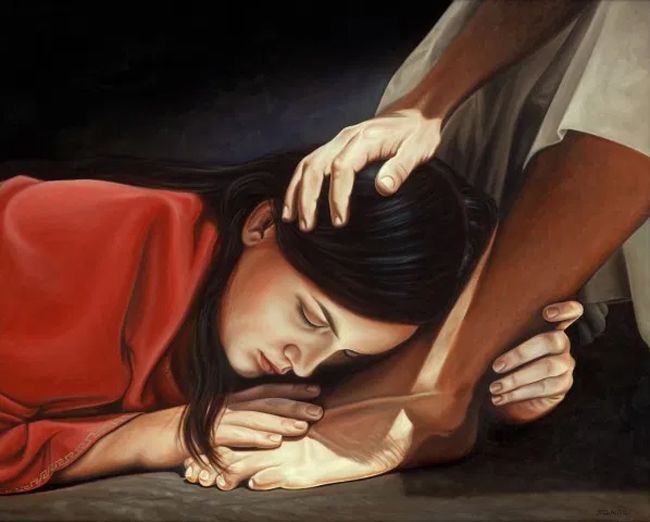
As we have heard in our Palm Sunday reading, Mary anoints Jesus. In John’s account, she anoints Jesus’ feet and wipes them with her hair. This is a sign of great love and humility, which Jesus will offer to his followers in John’s account of the Last Supper. The ointment she uses is very precious, costing a year’s wages for a labouring man, and the whole house is filled with the beautiful scent [ … ]