
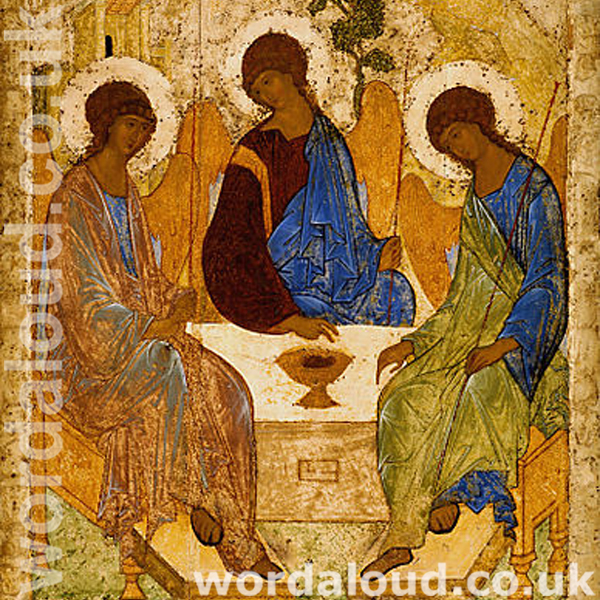
Christian Art | Trinity | God’s Love Revealed By Jesus Christ
Office Of Readings | Advent Thursday Week 2 | A Reading From A Sermon By Saint Peter Chrysologus | Love Desires To See God
‘Love desires to see God.’
Saint Peter Chrysologus reflects on the long history of God’s dealings with humanity and sees one thread running through it all: God counters human fear with love. When the world fell into sin, God did not abandon it or treat it only with justice. Instead, he drew near with tenderness, guiding, calling, comforting, and reshaping hearts so that love—not fear—would be the foundation of worship.
In each figure he recalls, Chrysologus traces God’s consistent method. With Noah, God does not simply issue commands about the ark; he shares in the labour, closes the door himself, and protects what is being preserved. Divine authority expresses itself as companionship. With Abraham, God accompanies his journeys, honours him with promises, rescues him from danger, and blesses him with gifts he could never have imagined. All of this is meant to teach Abraham that true obedience springs from love freely given, not fear of punishment.
Jacob receives the same teaching through different means. God meets him in his distress with a dream and meets him again in a mysterious wrestling match. God’s closeness is startling and personal. In both the comfort and the struggle, Jacob discovers a God who embraces in order to draw the heart near.
Moses too is called with fatherly affection. God does not summon him harshly but speaks to him as a father speaks to a son, inviting him into the work of liberation.
In all these examples, Chrysologus sees a single movement: the love of God ignites love in the human soul. Divine love overwhelms fear, and the heart begins to long for God, to desire not only his gifts but his very presence. Love awakens a deep yearning to see God face to face. This longing is not measured by reason; it exceeds calculation. Love does not ask whether its desire is possible—it simply desires.
This leads Chrysologus to a profound insight: the longing to see God may be impossible in purely human terms, but the desire itself is good. It is a sign of a heart touched by God. Moses asks to see God’s face. The psalmist prays the same prayer. Even pagan idol-making, though mistaken, reveals a misguided form of the same impulse: the desire to behold what one worships.
For Chrysologus, this longing is both wound and gift. Love wounds the heart with desire, and the wound becomes a blessing because it draws the soul toward God. The saints counted all other blessings as small if they could not lead to the vision of the Lord. In this way, love becomes the true engine of faith: it moves, directs, and shapes the whole life toward the God who first loved us.

A Reading From A Sermon By Saint Peter Chrysologus | Love Desires To See God
When God saw the world falling to ruin because of fear, he immediately acted to call it back to himself with love. He invited it by his grace, preserved it by his love, and embraced it with compassion.
Thus, when the earth had grown old in evil, God sent the flood both to punish and to release it. He called Noah to be the father of a new era, urged him with gentle words, and showed his trust in him. He instructed him about the present and reassured him about the future. God did not just issue orders but shared in the work of shutting into the ark all that was to be born into the world in the future. Thus by sharing in love he took away servile fear, and he protected with shared love whatever their shared labour had saved.
Thus God called Abraham out of the heathen world, lengthened his name from ‘Abram’, and made him our father in faith. He accompanied him on his journeys, protected him in foreign lands, enriched him with possessions, and honoured him with victories. He made promises to him, saved him from harm, accepted his hospitality, and astonished him by giving him the offspring he had despaired of. Abraham was favoured with so many good things and drawn by God’s sweet love so that he would learn to love, not fear: love, not fear was to inspire him to worship.
Thus when Jacob was fleeing, God comforted him with a dream and roused him to combat upon his return. He hugged him in a wrestler’s grip so that he would love the one who had given battle and not fear him.
Thus God called Moses as a father would. It was with fatherly affection that he invited him to become the liberator of his people.
But in all the events we have recalled, the flame of God’s love set human hearts on fire and intoxicated human senses. Wounded by love, men longed to see God with their bodily eyes.
How could our narrow human vision perceive one whom the whole world cannot contain? What will be, what ought to be, what can be – the law of love does not care about these things. Love does not have judgement, reason, strategy. Love refuses to be consoled when its goal proves impossible, refuses to be cured if its goal is difficult to achieve.
Love destroys the lover if he cannot obtain what he loves. It goes where it is led, not where it ought to go. Love gives birth to desire, it bursts into flame and that fire draws it to seek forbidden things. What more is there to say?
Love cannot accept not seeing the thing that it loves. That is why the saints counted whatever they deserved as being nothing if it did not mean that they could see the Lord.
Thus although a love that desires to see God may not be desiring something reasonable, but still its desire is a truly good thing.
Thus it was that Moses dared to say: If I have found favour in your eyes, show me your face.
Thus it was that the psalmist said: Show me your face. Even the pagans were obeying the same impulse when they made their idols: even though they were mistaken, they knew that they had to see with their eyes what they worshipped with their hearts.
Christian Prayer With Jesus
Lord of mercy,
you draw us from fear into love.
Inflame our hearts with the desire to seek your face
and strengthen us to follow wherever your love leads,
until the longing you awaken in us
is fulfilled in the vision of your glory.
Amen.
Glossary Of Christian Terms
Peter Chrysologus – Fifth-century bishop of Ravenna known for short, vivid sermons on Scripture and salvation.
Noah, Abraham, Jacob, Moses – Figures in the Old Testament through whom God guided, blessed, and formed his people.
Fear / love – For Chrysologus, fear represents distant obedience; love represents the intimate response God desires.
Desire to see God – A spiritual longing for the direct vision of God, fulfilled only in heaven.
‘Show me your face’ – A biblical prayer expressing the longing for God’s presence (e.g., Exodus 33:18; Psalm 27:8).




In this poem, George Herbert reflects on the Bible, addressing it as a source of spiritual richness, healing, and profound wisdom. The poem opens with a direct address, calling the Bible an ‘infinite sweetness’ that nourishes the heart, suggesting that its contents offer a spiritual sustenance likened to honey, a substance both soothing and medicinal. Herbert compares the Bible’s words to a form of healing that reaches into any grief or pain one may experience, with the power to bring comfort and relief to the soul [ … ]

Second Temple Judaism refers to the religious and cultural practices of the Jewish people during the Second Temple period, which lasted from the construction of the Second Temple in Jerusalem in 516 BCE until its destruction by the Romans in 70 CE. During this time, Judaism was marked by the development of various religious movements and the emergence of important religious figures such as the Pharisees, Sadducees, and Essenes [ … ]

Psalm 24 expresses awe and reverence for God the Creator of the universe. The psalm resonates with themes of divine ownership, holiness, and quest for spiritual purity and access to the presence of the Lord [ … ]
