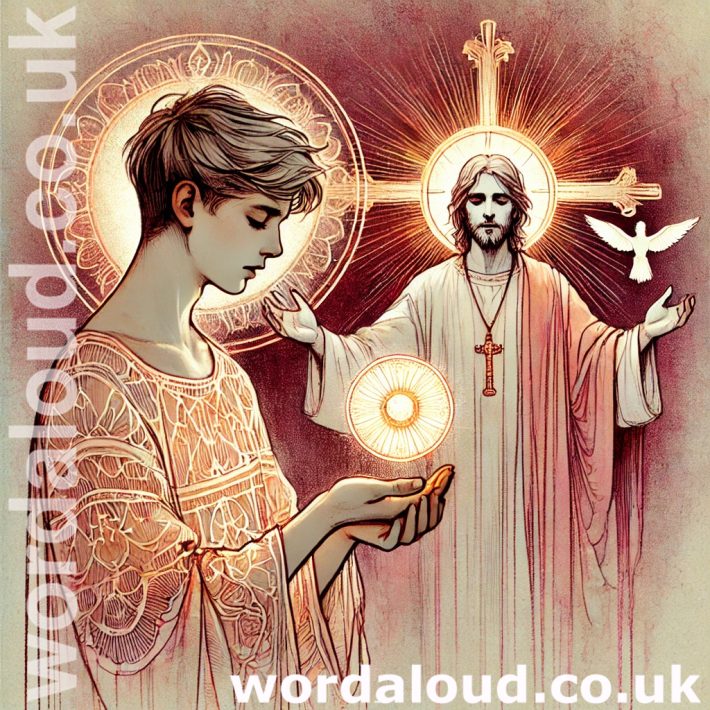
Christian Art | Love Revealed By Jesus Christ | A Boy At Prayer With Jesus
Office Of Readings | Eastertide Week 5, Sunday | A Reading From The Commentary Of Saint Cyril Of Alexandria On The Second Letter To The Corinthians | God Has Reconciled Us Through Jesus
‘God has reconciled us through Jesus Christ and conferred on us the ministry of reconciliation.’
Rooted in the theological tradition of the Alexandrian school, Saint Cyril brings to bear a rich spiritual and doctrinal understanding of what it means to be reconciled to God through Jesus Christ. This reading forms a cornerstone of Eastertide’s ongoing theme of renewal and resurrection.
Transformation Of The Believer | New Creation In Christ
Saint Cyril begins with the assertion that Christians, having been filled with the Spirit and promised resurrection, can live as though the future glory has already broken into the present. His exposition of 2 Corinthians 5:17 (‘If anyone is in Christ, he is a new creation’) emphasizes a radical transformation of the human person. This is not mere moral improvement but a mystical renewal in which believers are no longer defined by the limitations of the flesh or the corruptibility of sin.
This echoes the broader tradition of theosis (deification), a key concept in Eastern Christian theology, in which the faithful become partakers in the divine nature (cf. 2 Peter 1:4). In being ‘transformed into the Word’, Christians become living reflections of Christ Himself, not by nature as the Son is, but by participation.
Christ’s Death And Resurrection | A New Mode Of Being
Cyril carefully distinguishes between the former life under sin and the new life in Christ. He notes that though Christ was once known ‘in the flesh’, that is, subject to suffering and death, He now lives forever in glory. Christ’s bodily resurrection is not merely a return to mortal life but an entrance into a new, imperishable existence—an existence that He now shares with believers through the Spirit.
Referencing Romans 6:10, ‘The death he died, he died to sin once for all; but the life he lives, he lives to God,’ Cyril affirms that Christ’s victory over death is definitive and transformative. Believers, therefore, must view themselves as having ‘passed beyond’ the flesh—not in the sense of abandoning the body, but in no longer being enslaved to its corruptible nature.
Reconciliation As Divine Initiative
Central to Cyril’s reflection is the idea that reconciliation is the work of God. ‘This is all God’s doing,’ he insists, echoing 2 Corinthians 5:18. Cyril aligns closely with Paul’s theology of grace: it is God who takes the initiative, reconciling the world to Himself through Christ. The Incarnation is not a mere divine gesture but a full entry into human suffering and alienation in order to redeem it from within.
Here we see the fruit of Cyril’s involvement in the Council of Ephesus (431 AD), where he defended the unity of Christ’s person—fully God and fully man. It is precisely this union that allows Christ to serve as the perfect mediator between God and humanity, able to reconcile us because He truly shares both natures.
Ministry Of Reconciliation | A Vocation For The Church
Cyril’s use of the phrase ‘ministry of reconciliation’ is rich with ecclesiological and pastoral implications. As Christ is the reconciler, so too the Church—His mystical body—is entrusted with continuing this mission in the world. This extends beyond sacramental confession (though it includes it) to the entire life of the Church as a witness to mercy, restoration, and peace.
The Catechism of the Catholic Church (CCC 1461–1466) upholds this idea, stating that bishops and priests, by virtue of the sacrament of Holy Orders, act in the name of Christ and in union with the Church to forgive sins and reconcile the faithful to God.
Worship In Spirit And In Truth
Finally, Cyril reminds us that reconciliation leads to true worship. In a clear allusion to John 4:24, he writes that we now ‘worship [God] in spirit and in truth’ through the Son. This indicates that reconciliation is not only a juridical restoration of favor but a relational union that enables genuine worship—communion with the living God.
In this way, the post-Easter season moves us from the penitential realism of Lent into the jubilant celebration of the Church’s new life in Christ. As Saint Augustine once said, ‘The Christian should be an alleluia from head to foot.’

God Has Reconciled Us To Himself Through Christ And Given Us The Ministry Of Reconciliation
Those who have a sure hope, guaranteed by the Spirit, that they will rise again lay hold of what lies in the future as though it were already present. They say: ‘Outward appearances will no longer be our standard in judging other men. Our lives are all controlled by the Spirit now, and are not confined to this physical world that is subject to corruption. The light of the Only-begotten has shone on us, and we have been transformed into the Word, the source of all life. While sin was still our master, the bonds of death had a firm hold on us, but now that the righteousness of Christ has found a place in our hearts we have freed ourselves from our former condition of corruptibility.’
This means that none of us lives in the flesh any more, at least not in so far as living in the flesh means being subject to the weaknesses of the flesh, which include corruptibility. Once we thought of Christ as being in the flesh, but we do not do so any longer, says Saint Paul. By this he meant that the Word became flesh and dwelt among us; he suffered death in the flesh in order to give all men life. It was in this flesh that we knew him before, but we do so no longer. Even though he remains in the flesh, since he came to life again on the third day and is now with his Father in heaven, we know that he has passed beyond the life of the flesh; for having died once, he will never die again, death has no power over him any more. His death was a death to sin, which he died once for all; his life is life with God.
Since Christ has in this way become the source of life for us, we who follow in his footsteps must not think of ourselves as living in the flesh any longer, but as having passed beyond it. Saint Paul’s saying is absolutely true that when anyone is in Christ he becomes a completely different person: his old life is over and a new life has begun. We have been justified by our faith in Christ and the power of the curse has been broken. Christ’s coming to life again for our sake has put an end to the sovereignty of death. We have come to know the true God and to worship him in spirit and in truth, through the Son, our mediator, who sends down upon the world the Father’s blessings.
And so Saint Paul shows deep insight when he says: This is all God’s doing: it is he who has reconciled us to himself through Christ. For the mystery of the incarnation and the renewal it accomplished could not have taken place without the Father’s will. Through Christ we have gained access to the Father, for as Christ himself says, no one comes to the Father except through him. This is all God’s doing, then. It is he who has reconciled us to himself through Christ, and who has given us the ministry of reconciliation.

Glossary Of Terms
Reconciliation
The restoration of a right relationship between humanity and God, broken by sin. In this context, reconciliation is accomplished through Christ’s incarnation, death, and resurrection, bringing peace between God and humankind.
Incarnation
The Christian doctrine that the Son of God took on human nature in the person of Jesus Christ. This is a foundational mystery of the faith, celebrated particularly at Christmas and central to understanding salvation.
Justification
A theological term referring to the act by which God declares a sinner to be righteous on account of faith in Jesus Christ. It involves the forgiveness of sins and a transformation into a new state of grace.
The Flesh
Biblically, ‘the flesh’ can refer either to human physicality or to a state of existence governed by sin and weakness. Saint Cyril uses it primarily in the latter sense — life without the Spirit and marked by corruption.
Corruptibility
The state of being liable to decay, sin, or death. Opposed to the eternal, incorruptible life in God offered through Christ.
The Word
A title for Christ, especially in the Gospel of John (‘In the beginning was the Word…’). It emphasizes his divine nature as the Logos — God’s eternal wisdom and creative expression.
Mediator
One who reconciles two parties. Christ is the unique mediator between God and humanity, because he is both fully divine and fully human.
Sovereignty Of Death
A phrase referring to the dominion death had over humanity due to sin before Christ’s resurrection, which conquered death and offered eternal life.
Ministry Of Reconciliation
The mission entrusted to Christians — particularly to the apostles and their successors — to announce God’s forgiveness through Christ and to invite others into restored relationship with God.
‘In Christ’
A Pauline expression denoting the believer’s spiritual union with Jesus. To be ‘in Christ’ is to share in his life, death, and resurrection and to be part of the new creation.
New Creation
A theological idea, especially from 2 Corinthians 5:17, indicating the total renewal of a person through the Holy Spirit — a transformed life that begins now and is fulfilled in the resurrection.
Curse
Biblical shorthand for the consequences of sin, often symbolized by the law’s condemnation and the power of death. Christ redeems humanity from the curse by taking it upon himself on the cross (cf. Galatians 3:13).
The Only-Begotten
A title of Christ, affirming that he is the unique, eternal Son of God, begotten by the Father before all ages.
Worship In Spirit And Truth
A phrase from John 4:23 that denotes genuine, spiritual worship rooted not in external ritual but in a living relationship with God through Christ and empowered by the Holy Spirit.
Blessings Of The Father
Spiritual gifts and graces — such as mercy, forgiveness, sanctification, and eternal life — poured out on the world through Christ.



Psalm 126, of the Psalms of Ascent, begins with a reflection on past deliverance. The psalmist recalls a time when the Lord reversed the fortunes of Zion, likening this experience to a dream. This imagery conveys the profound impact and almost unbelievable nature of the transformation experienced by the people [ … ]
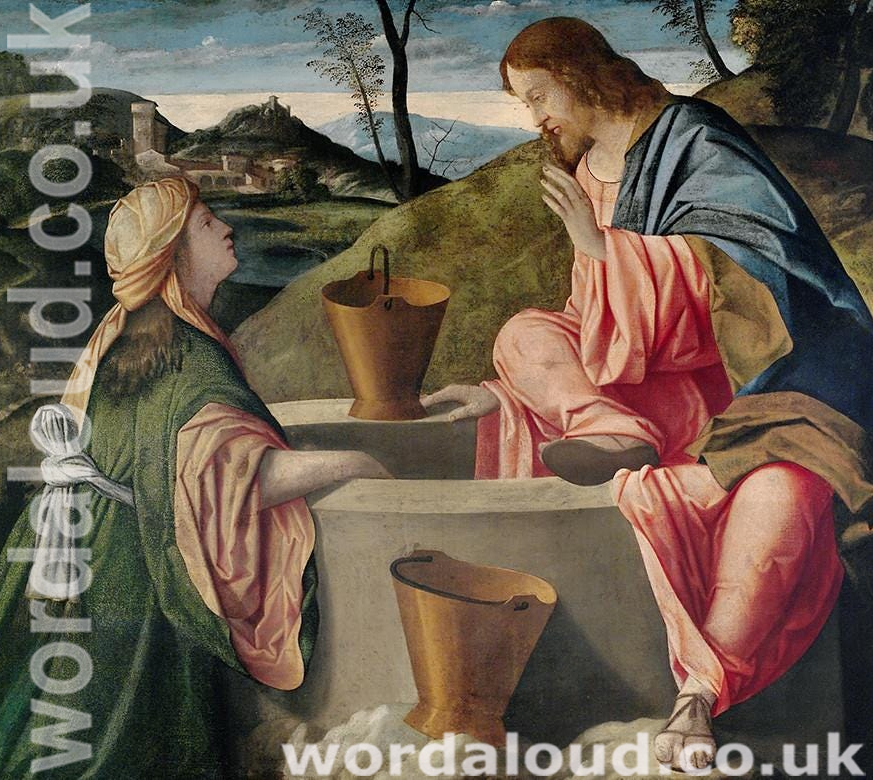
Saint John of the Cross reflects on the difference between the time before Jesus Christ and the time after Jesus’ coming. He begins by recalling that in the ancient law, prophets and priests needed revelations, visions, and signs. This was not a weakness but a necessity: the foundation of faith had not yet been laid, and the gospel had not yet been spoken in its fullness. God therefore met them in many ways—through images, symbols, and partial glimpses. Everything God revealed then pointed toward something greater that had not yet arrived [ … ]

As I meditate on the love of Jesus Christ, I am reminded of the institution of the Lord’s Supper and the profound love Jesus revealed in doing so. In the midst of his last meal with his disciples, Jesus took bread and wine, gave thanks, and gave them to his disciples, saying, ‘This is my body, which is given for you. Do this in remembrance of me.’ (Luke 22:19, KJV)