
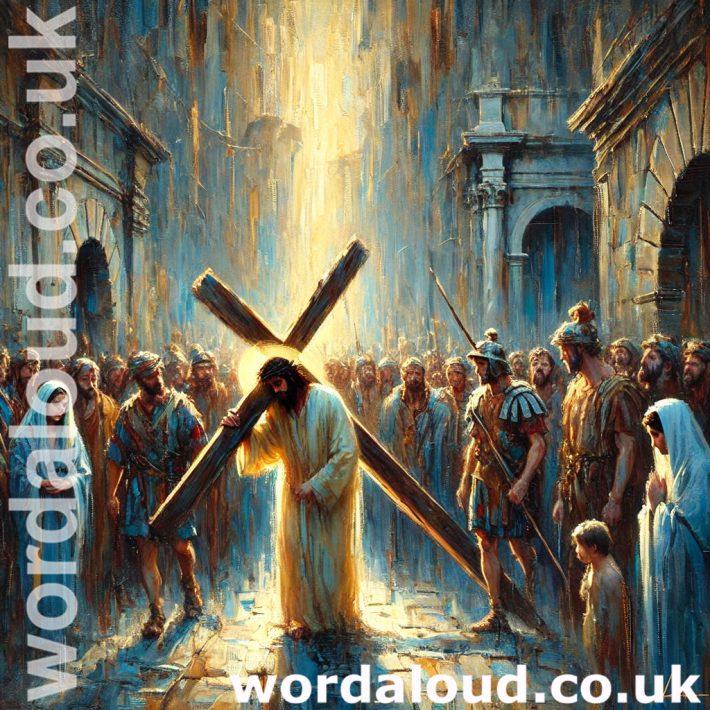
Christian Art | Jesus Crucified | Christian Martyrdom | Love Revealed By Jesus
Office Of Readings | Ordinary Time Week 10, Monday | A Reading From The Letter Of Saint Ignatius Of Antioch To The Romans | Christian Witness | Martyrdom
‘Let me be a Christian in reality and not only in repute.’
Let Me Not Only Be Called A Christian, But Prove To Be One
This deeply moving letter from Saint Ignatius of Antioch, composed on his journey to martyrdom in Rome around AD 107, is one of the earliest and most passionate testimonies to Christian witness through suffering. Ignatius, the bishop of Antioch and a disciple of the Apostle John, wrote this letter to the Christian community in Rome to plead that they not intervene in preventing his execution. Far from fearing death, he embraces it as the culmination of his discipleship in Christ. The letter is both a theological reflection and a spiritual testament on martyrdom, discipleship, and union with Christ.
Historical Context
Ignatius lived during a time of intense persecution of Christians under the Roman Empire. Arrested in Antioch, he was escorted under heavy guard to Rome, where he was to be executed in the Colosseum. Along the way, he wrote a series of letters to various Christian communities, encouraging unity, orthodoxy, and fidelity to their bishops. His Letter to the Romans stands out in tone and content. Unlike his other letters, he does not instruct or correct but instead begs the Roman Christians not to save him. His desire is not merely to die but to become ‘the food of beasts’, that he might ‘become Christ’s pure bread’.
Ignatius’ insistence on martyrdom may strike modern readers as extreme, but in his cultural and theological setting, martyrdom was seen as the ultimate witness (martyria) to the truth of the Gospel. In an age where apostasy could preserve one’s life, martyrdom was the supreme proof of fidelity to Christ.
Martyrdom As Eucharistic Witness
Ignatius’ statement, ‘I am His wheat … that I may become Christ’s pure bread,’ is rich in Eucharistic imagery. He sees his own death as a participation in the sacrifice of Christ. This theology is deeply rooted in Saint Paul’s letters, particularly Philippians 3:10—‘to know Christ … and the fellowship of His sufferings, becoming like Him in His death’. Ignatius identifies with Christ both in suffering and in offering himself for the sake of the Gospel.
In comparing his body to wheat ground by the beasts, he connects martyrdom to the Eucharist: just as bread is made by crushing grain, so his own body will become an offering to God. It is a radical embodiment of Romans 12:1— ‘Offer your bodies as a living sacrifice.’
Discipleship And Imitation Of Jesus Christ
Throughout the letter, Ignatius returns to the theme of discipleship. He says, ‘Now I am beginning to be a disciple,’ showing that true discipleship is not merely learning or association, but full identification with the suffering Christ. This echoes Jesus’ own words in Luke 9:23: ‘Whoever wants to be My disciple must deny themselves and take up their cross daily and follow Me.’
Ignatius sees in his suffering not defeat but victory—echoing 1 Corinthians 1:18, where Paul speaks of the cross as ‘foolishness to those who are perishing, but the power of God to us who are being saved’. His refusal to escape martyrdom demonstrates a profound trust in God’s providence and a confidence in the resurrection.
True Freedom In Christ
Although he calls himself a ‘condemned criminal’ and a ‘slave’, Ignatius sees martyrdom as the path to freedom: ‘If I suffer, I shall become the freedman of Jesus Christ.’ This paradox—freedom through suffering—is at the heart of Christian theology. It contrasts starkly with Roman ideals of honour, power, and control. Ignatius’ dignity does not come from social status or autonomy, but from his conformity to Christ, the crucified Lord.
This is particularly significant in the Roman context, where execution was a tool of imperial control. By embracing death voluntarily, Ignatius reclaims agency and redefines honour in Christian terms.
Contemporary Relevance | Jesus Christ Today
In a secular age that often prioritises comfort and success, Ignatius’ letter is a countercultural call to radical faithfulness. While few are called to martyrdom today, all Christians are called to die to self, to bear witness, and to put Christ above worldly values. Ignatius challenges us to consider whether we merely bear the name ‘Christian’ or whether we truly live in a way that proves our identity in Christ.
His rejection of ‘persuasive propaganda’ reminds us that the power of Christianity lies not in rhetoric or social appeal, but in the lived reality of holiness, courage, and love. Christianity, he says, ‘shows its greatness when it is hated by the world’—a message of strength in the face of marginalisation.
The letter also speaks to themes of justice, dignity, and suffering in our own time. In a world where many still face persecution, discrimination, or imprisonment for their beliefs, Ignatius stands in solidarity with them. His joyful embrace of suffering is not masochistic but rooted in a transcendent hope.
Reflection | Love Revealed By Jesus Christ
Ignatius does not seek death for its own sake, but longs for union with Christ. His whole letter breathes with a longing to ‘gain Jesus Christ’. He reminds us that Christian life is not a moral philosophy or a cultural identity, but a living relationship with the crucified and risen Lord. His words urge us to examine our own hearts: Do we desire Christ above all? Are we prepared to be faithful when it costs us?
He closes with an astonishing list of tortures—fire, the cross, wild beasts, mangling, and more—declaring his readiness for them all, if only he may reach Christ. In this, he echoes the martyrs of every age and offers us a luminous example of hope beyond suffering.

A Reading From The Letter Of Saint Ignatius Of Antioch To The Romans | Christian Witness | Martyrdom
You have never begrudged the martyrs their triumph but rather trained them for it. And so I am asking you to be consistent with the lessons you teach them. Just beg for me the courage and endurance not only to speak but also to will what is right, so that I may not only be called a Christian, but prove to be one. For if I prove myself to be a Christian by martyrdom, then people will call me one, and my loyalty to Christ will be apparent when the world sees me no more. Nothing you can see is truly good. For our Lord Jesus Christ, now that he has returned to his Father, has revealed himself more clearly. Our task is not one of producing persuasive propaganda; Christianity shows its greatness when it is hated by the world.
I am writing to all the churches to declare to them all that I am glad to die for God, provided you do not hinder me. I beg you not to show me a misplaced kindness. Let me be the food of beasts that I may come to God. I am his wheat, and I shall be ground by the teeth of beasts, that I may become Christ’s pure bread.
I would rather that you coaxed the beasts to become my tomb and to leave no scrap of me behind; then when I have died I will be a burden to no one. I shall be a true disciple of Christ when the world no longer sees my body. Pray to Christ for me that by these means I may become a sacrifice to God. I do not give you orders like Peter and Paul. They were apostles, I am a condemned criminal; they were free, I am still a slave. But if I suffer, I shall become the freedman of Jesus Christ and I shall rise again to freedom in him.
Now as a prisoner I am learning to give up my own wishes. All the way from Syria to Rome I am fighting wild beasts, by land and by sea, by day and by night, chained as I am to ten leopards, I mean the detachment of soldiers who guard me; the better you treat them, the worse they become. I am more and more trained in discipleship by their ill usage of me, but I am not therefore justified. How happy I will be with the beasts which are prepared for me! I hope that they will make short work of me. I shall even coax them to devour me quickly and not to be afraid of touching me, as sometimes happens; in fact, if they hold back, I shall force them to it. Bear with me, for I know what is good for me. Now I am beginning to be a disciple. May nothing visible or invisible rob me of my prize, which is Jesus Christ! The fire, the cross, packs of wild beasts, lacerations, rendings, wrenching of bones, mangling of limbs, crushing of the whole body, the horrible tortures of the devil – let all these things come upon me, if only I may gain Jesus Christ!
Prayer With Jesus
Lord Jesus Christ, through the witness of your martyr Ignatius, you have shown us that true discipleship means total surrender. Grant us the courage to bear your name not only in word, but in deed. Strengthen all who suffer for the faith, and let the grain of our lives, ground by love, become an offering pleasing to you. May nothing—visible or invisible—separate us from you, but may we run our race with perseverance, until we too may say: ‘Now I am beginning to be a disciple.’
Amen.
Glossary Of Christian Terms
- Martyrdom: The act of dying for one’s faith; considered the highest witness to Christ.
- Eucharistic imagery: Symbolism relating to the Eucharist (Holy Communion), especially the idea of sacrifice and union with Christ.
- Freedman of Christ: A term used by Ignatius to express that, through suffering and death, he will attain spiritual freedom in Christ.
- Discipleship: Following Christ not only in belief but in action, especially through suffering and sacrifice.
- Witness (Martyria): The original Greek term for ‘martyr’, meaning ‘witness’—to the truth of the Gospel.
- Roman persecution: Refers to the historical period during which Christians were targeted by Roman authorities, especially under emperors like Trajan and Nero.
- Propaganda: In Ignatius’ context, refers to persuasive rhetoric that lacks the power of authentic Christian witness.
- Imitatio Christi: The imitation of Christ, particularly in His suffering and humility.



The Penitential Psalms offer a path to spiritual growth and redemption, and this is reflected in the redemption offered by Christ on the Cross. Through his death and resurrection, Christ offers the forgiveness of sins and the hope of eternal life to all who believe in him. The Penitential Psalms, through their focus on repentance and the mercy of God, can be seen as a powerful tool in the process of conversion and reparation that leads to redemption [ … ]

In Jesus’ time, the swearing of oaths was common, and the casuistry surrounding such oaths was intricate. There were what we would now term loopholes – ‘perfectly’ legal ways of doing wrong. The letter of the Law, rather than the spirit, had proliferated – the whole of the Sermon on the Mount concerns this subject – and thereby our knowledge of the will of God had been deliberately obscured [ … ]
Jesus has performed many healing miracles in his homeland, the area in the region of the Sea of Galilee – also known as the Lake of Tiberius and the Lake of Gennesaret. These miracles, or signs, have communicated something of the truth of Jesus to the people, who have responded to Jesus’ miracles and to his teaching. It is through the Sermon on the Mount and other teachings as much as through the healing miracles that people have responded to Jesus, recognizing in Jesus the answer to questions they have long asked, and prayers they have prayed for generations [ … ]
